Skip navigation

Category Archives: musical instruments

All that remains at this stage is to cut the inner and outer circles to make the annulus of the rosette. I start by drilling a hole in the centre of the work piece…

… and then use a Dremmel mounted in a shop-made jig to cut the circles. (More details of the jig are available in the ‘Tools and Jigs’ section of this site.)

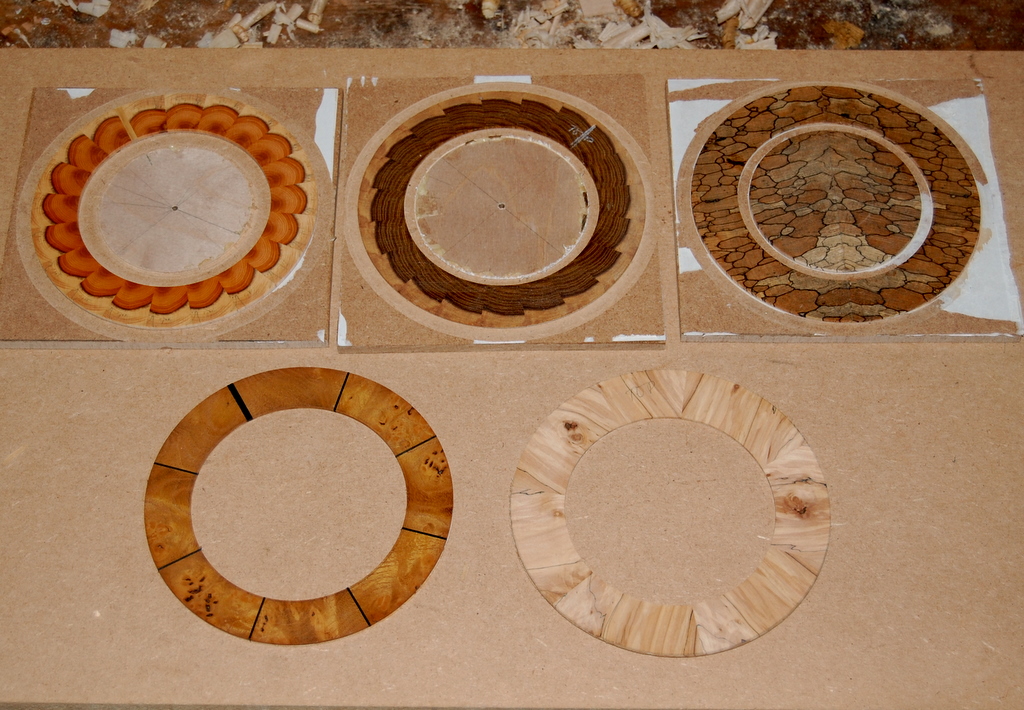
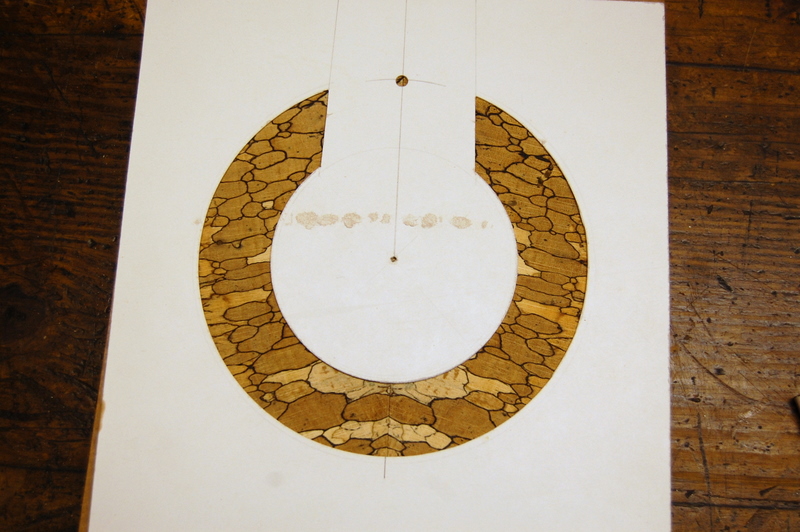
Here are the two rosettes that I’ve talked about in early posts in this series cut out.

And here are a few more. Going clockwise from top left, they’re made of English yew, laburnum, spalted beech, spalted crab apple and mulberry burr.

It’s probably best to leave them attached to their base until you’re ready to install them on the soundboard but, as you can see from the two rosettes at the bottom, I don’t always heed my own advice.

The rosette below is made from laburnum, arranged to show the striking contrast between the light coloured sapwood and the dark heartwood. It’s rather more complicated to make than the spalted beech rosette shown in the previous post and a fair degree of accuracy is needed throughout.

The starting point is a small piece of laburnum. This one has been air drying for a couple of years and I reckon that it should be pretty stable by now. I’ve scraped off the wax that covered the endgrain while it was drying.

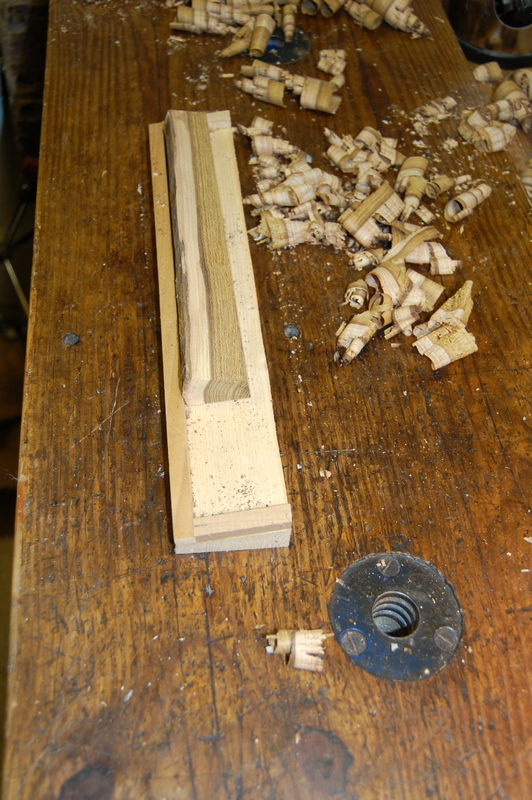
The first step is to decide how many individual sector shaped pieces to use to complete the circle. I’m planning to use 20 for this rosette, which means that the sides of the billet must be planed to converge at an angle of 18°. That’s hard to manage on the bench top and it’s worth making a cradle to hold the wood while you plane it to size and shape. Go slowly and carefully because it’s important not only that the angle is right but that there’s no taper along the length of the piece. In addition, the width must be right so that the line between the sap wood and the heart wood ends up where you want it to be in the finished rosette.

Having planed the wood to a near perfect prism, it’s sliced on the bandsaw.

The pieces are numbered as they come off, so that they can be put together again in consecutive order.

Here the rosette is being assembled ‘dry’.

It may be necessary to make some fine adjustments with a shooting board and a block plane.

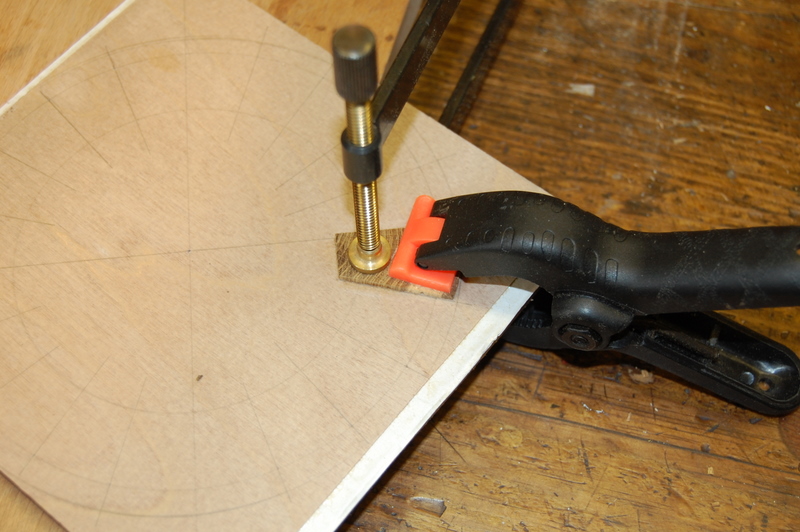
Here, the first piece is being glued and clamped into position on its plywood base. The base has been marked out in pencil to aid positioning of the individual pieces.

As the pieces are glued into place, the rosette nears completion.

Cleaned up and levelled with a finely set block plane.

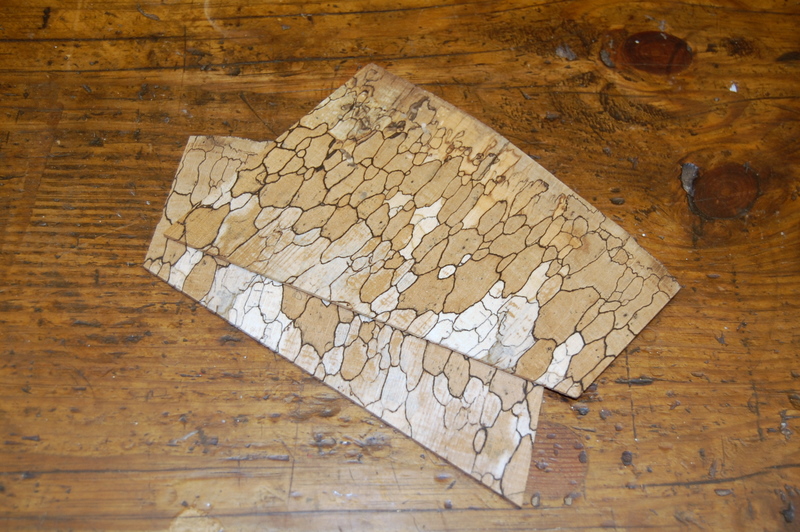
One of the rosettes is going to be a replica of the one used for the zebrano guitar that I made last year from this remarkable lump of spalted beech.

I used a bandsaw to cut 2 thin (3mm) slices …

… and trimmed and book matched them to create a symmetrical pattern.

A card with a rosette shaped cut out helps give an idea of what the finished rosette will look like.

I use veneer tape to keep the two pieces in registration while they are glued to the base that I described in the previous post.

Clamping up.

Out of the press and ready to be planed flat and cut into shape. The veneer tape comes off easily if a little hot water is brushed on.

The next post will be about the construction of a different sort of rosette.

Last July I wrote a couple of posts about making a guitar rosette from spalted beech. But I missed the opportunity to photograph some of the details of its construction and, since I’ve been making some similar rosettes recently, I thought it might be useful if I had a second attempt at explaining the method.

For reasons that I’ve discussed before, I like the visual effect of rosettes made by inlaying wood with contrasting colours or a striking figure and often use this technique when making guitars.

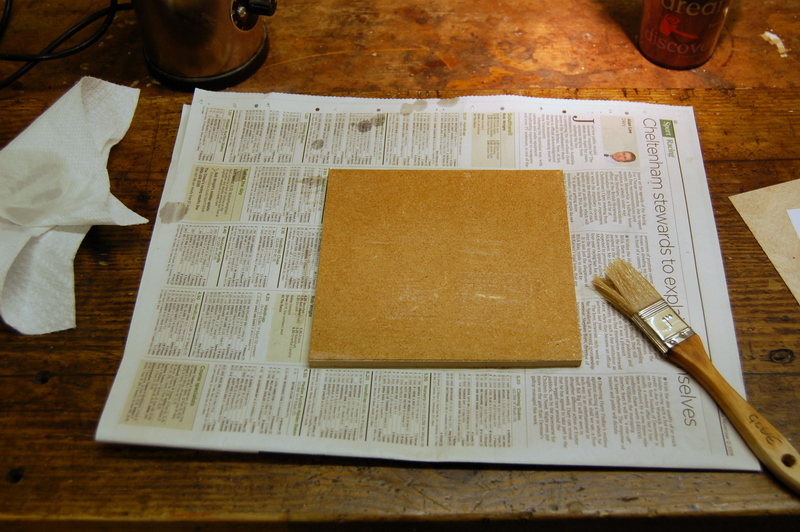
These rosettes are made from at least 2, and usually many more, individual pieces and I’ve found that it’s much easier to assemble them accurately on a base of thin birch plywood (0.4mm or 0.6mm thick*) than it is to inlay them directly on the soundboard. Because the plywood is so thin, it too needs a stable base during the assembly process. But, of course, it must be possible to remove this base when assembly is complete. I start with a square of 6mm MDF, a similarly sized sheet of clean paper and the square of  plywood that will be the permanent base of the rosette.

One surface of the square of MDF is given a thin coat of hot hide glue.

The sheet of paper is then smoothed down…

…before adding a second coat of glue…

Glueing up 3

and the layer of plywood.

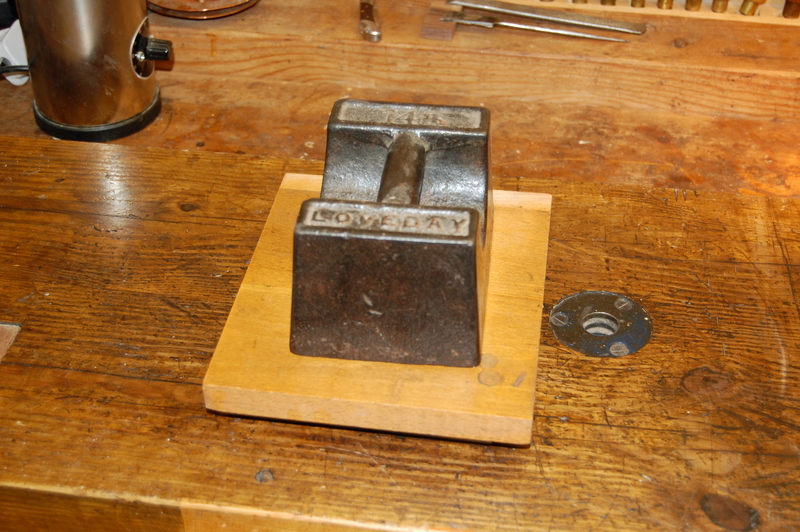
The whole thing is then clamped up in a nipping press and left to dry overnight.

If you don’t have a press, a flat board and a weight work just as well.

The point of the paper and the hot hide glue is that, after it has been assembled, the rosette is easy to detach from the MDF base. In another post, I’ll show the next stages of the process.

*This sort of plywood is used by model makers and, at least in the UK, is easily available from the sort of shops that supply materials for people who build model aeroplanes.

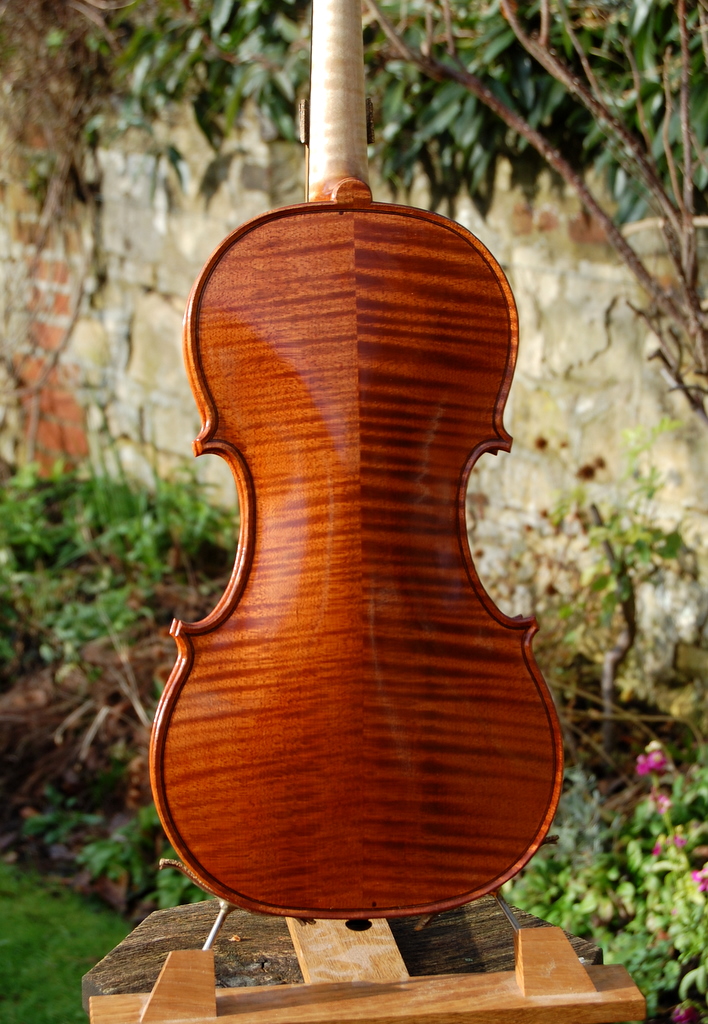
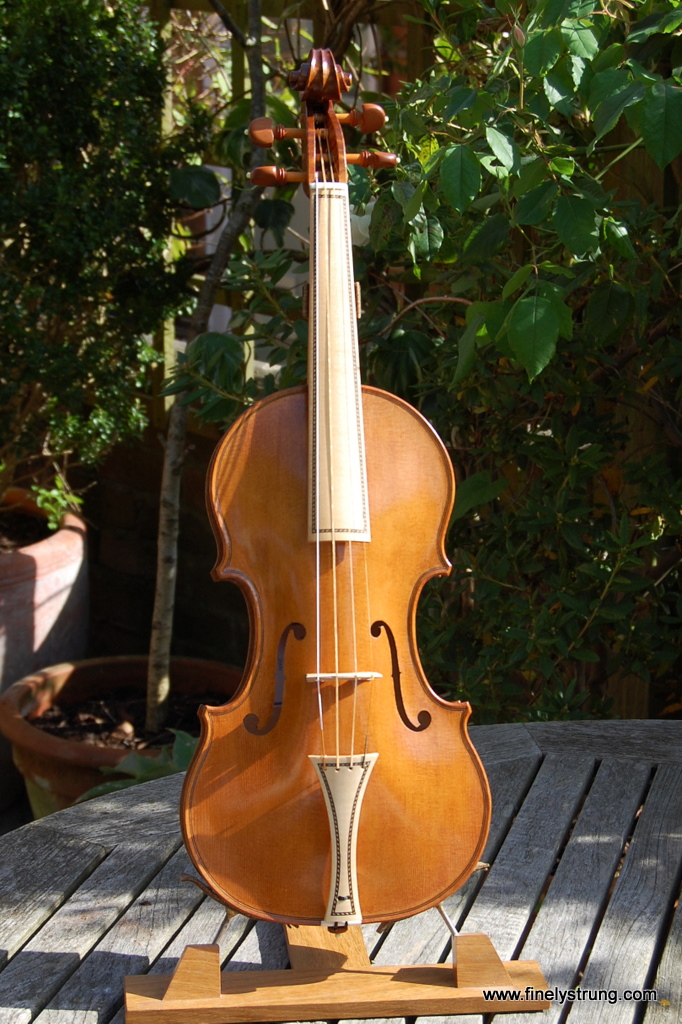
Below are a couple of photographs of my last instrument of the noughties, a copy of a violin made by Guarneri del Gesù in 1742. It’s very slightly smaller than the original with a body stop of 190mm, and a string length of 320mm. I think it’s going to be a powerful instrument but it will be a few weeks before it gets a proper trial because the violinist for whom I made it recently broke her right arm – unpleasant enough for anyone, but doubly unfortunate for a string player.

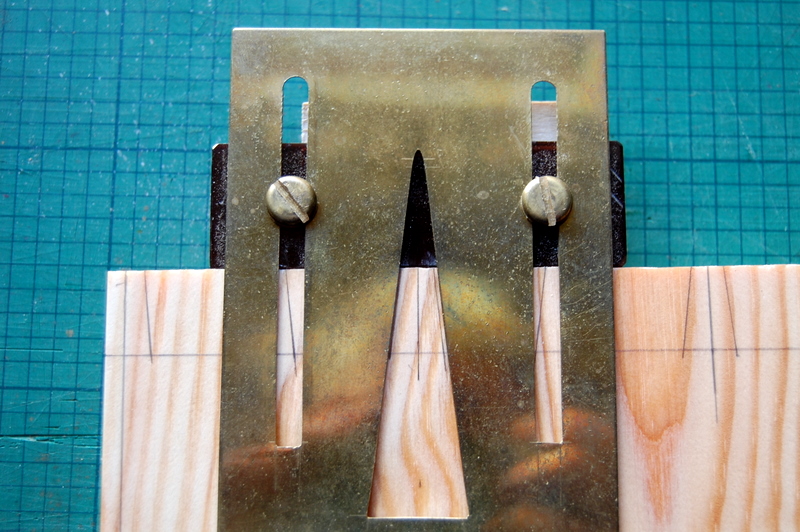
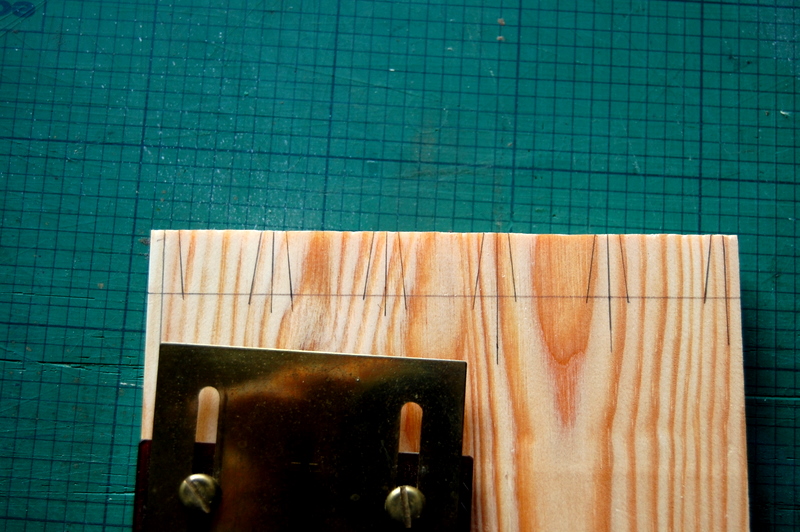
Another useful aid to cutting dovetails is a dovetail marker. Several different designs are available to buy but I like this shop-made one best. Once again, it comes from Robert Wearing’s book, The Resourceful Woodworker (ISBN 0 7134 8006 8), and is fairly easily made from a sheet of brass 1 to 2 mm thick. Its advantage over the type that Lie-Nielsen and Veritas make is that you only have to set out the centre position of the pins on the edge of the board. The triangular ‘window’ of the marker then lets you see exactly where you’re marking out the joint. It works equally well whether you prefer to cut the pins or the tails first – an argument that I don’t intend to get into.

I suppose purists who like to use a steeper slope for dovetails in softwood would need two markers, one at a 1 in 6 slope and one at 1 in 8. I confess that I never bother about this, cutting all dovetails at 1 in 8, regardless of what sort of wood I’m working with.


A few weeks ago, I dropped in on the Tartini ensemble during a rehearsal in St Mary’s  church, Penzance. They were preparing for a concert of music by Dietrich Buxtehude and Jan Adam Reincken. And a very interesting and exciting concert it turned out to be:  music by two composers whose work is heard less often than it deserves to be, with brilliant performances on period instruments by the ensemble.

Here’s a photograph taken during the rehearsal.

It was also the first outing for the baroque violin that I wrote about a couple of posts ago.  After the rehearsal, Pamela Rosenfeld played this adagio by Tartini on it, accompanied by Nigel Wicken on a chamber organ.

Tartini adagio

Patrick Gale, who commissioned the baroque cello that I completed earlier this year, spoke  about why music was important to him in a recent broadcast on  BBC Radio 3.  If you missed his  brief and amusing  talk,  you can listen to it  here for the next few days.

Back in May, I wrote about making a baroque violin, a loose copy of the Charles IX violin of 1564 by Andrea Amati, now in the Ashmolean Museum, Oxford. After it was completed, and while still in the white, it went off for a short trial by the violinist who had commissioned it and, having been approved, came back to be varnished. Varnishing is now finished and the fiddle has been set up again just in time for its new owner, Pamela Rosenfeld, to play it in the Buxtehude festival in Cornwall later this month.

Below are a few photographs of the completed instrument.

DSC_0019-1

DSC_0021

DSC_0027

The zebrano guitar has now been collected by its new owner, Dave Crispin. He played it for a while before taking it away, and allowed me to capture a few minutes on a pocket recorder. The recording isn’t very good, I’m afraid, because the microphone is positioned much too far away from the instrument, but Dave has promised to come back for another session after he has had a chance to get used to  his new guitar and when I have worked out a better recording system. In the meantime, here’s a taste of the sound it makes.

Either click on the blue labels to download them to your own media player, or simply start the audio player in the bar.

Dave trying out his guitar for the first time

Dave improvising on the new guitar – with a bit of help from Jamie in the background

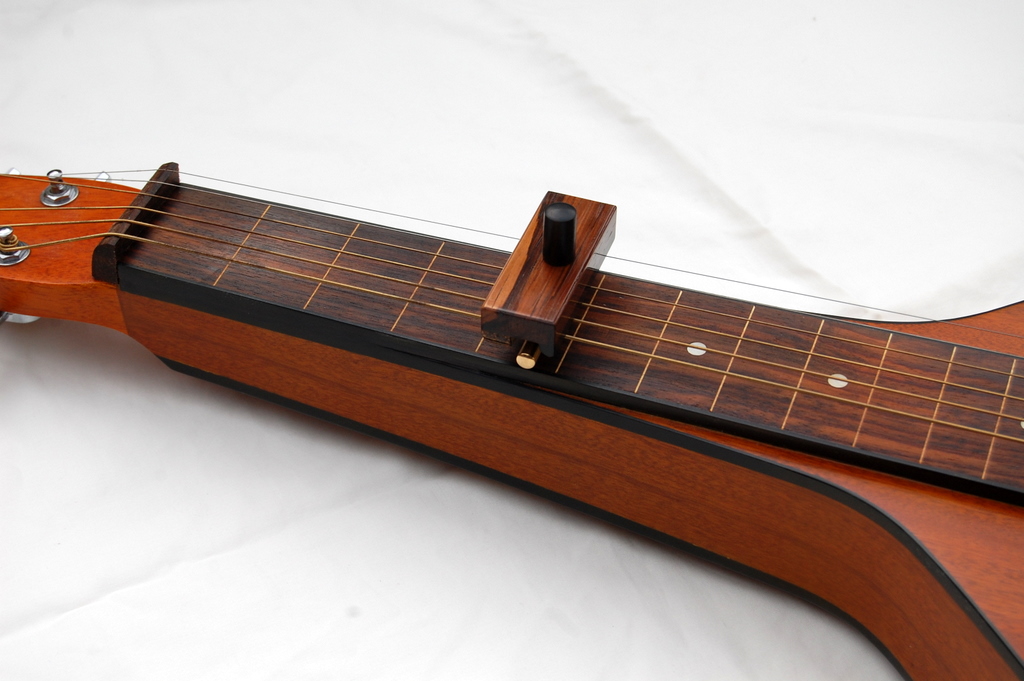
A while ago, a friend bought himself a lap steel guitar – the sort with a hollow neck, square in section – but became frustrated because he couldn’t find a capo that would fit it. He couldn’t use the usual type of capo, of course, because the hollow neck of the guitar was too thick and too fragile to allow the clamp to work and because the strings were too high over the fingerboard. So I made him this device, which is easy to fit and adjust and works well.

DSC_0007

In case anyone else has a similar problem, I thought it might be worth explaining how it’s made. You’ll need a scrap of hardwood roughly 2.5 x 1 x 3/8 inches in size; a piece of bone or ebony to make the inverted nut; some cork or leather to damp the strings on the headstock side of the capo; a 2.5 inch length of round bar in brass or steel of 1/4 inch diameter; a short length of threaded rod of 1/8 inch diameter; and a small piece of wood or metal or plastic to make a knob with which to turn the threaded rod. You’ll also require a matching tap to cut a thread in the hole of the brass bar.

The photographs below should make the construction clear, so I’m not going to give details. If you have any queries, please email me at info@finelystrung.com. The only thing to watch out for is that the threaded rod that pulls the bar against the underside of the strings shouldn’t be too long or it may damage the fingerboard.

To fit the capo, loosen the screw holding the metal bar – but not so far that the bar becomes detached. Hold the capo with its long axis parallel to the strings and insert the bar between the two middle strings. Then rotate both the capo and the bar through 90 degrees, making sure that the nut side of the capo is orientated to face the bridge. Slide the capo to the desired position and screw it up just tightly enough to produce a clear sound from all the strings.

DSC_0001-1

DSC_0004-1

DSC_0003-1

DSC_0005

DSC_0013

The guitar that I have been writing about in my last few posts is now, more or less, completed. It’s finished with French polish, which will benefit from a final burnishing in a couple of weeks time when it has got fully hard. But I couldn’t wait any longer to string it up and hear how it sounds. The back and ribs are zebrano and the soundboard is European spruce. The binding is Rio rosewood and maple, and the soundhole rosette and headstock veneer are spalted beech. I’m pleased with how it has worked out, though perhaps I got carried away when it came to the rosette, which might have been more elegant if the diameter had been a little less. Below are a few photographs of the completed instrument.

-0002

-0009

-0011

-0014

-0007

Last week I made a bridge for the guitar that I’m building at the moment. Here’s a photograph taken while it was being French polished. It’s in Rio rosewood and the tie block is inlaid with a strip of spalted beech to echo the rosette that I wrote about a little while ago.

DSC_0006

To cut the channel for the saddle and for the recess behind the tie block, I used this very simple router table. The idea came from an article in Fine Woodworking (No 182, February 2006) where Doug Stowe described how he made something rather similar for a full size router. There’s a brief description of his table here where there’s also a link to a full explanation and downloadable free plans.

DSC_0013

In my table, the Dremmel is mounted overhead on a cantilever. The table itself is a board of mdf. The adjustable fence is simply a straight strip of wood that pivots at one end and that is clamped at the other – an arrangement that allows a remarkable degree of precision. Depth of cut is controlled by the position of the router bit in the collet. The Dremmel isn’t powerful enough to cut slots to their full depth in one pass so, to avoid the fiddly business of repeatedly having to change the position of the router bit in its collet, I place a shim of 1.5mm thick plywood under the workpiece for each subsequent pass.

DSC_0012

The only bit about making the table that’s not straightforward is how to mount the Dremmel firmly and vertically in the cantilever in a way that allows removal. I solved the problem by buying a 3/4 inch diameter 12tpi tap, which matches the thread on the nose of the Dremel when the collar above the collet is removed. Then it was only a matter of drilling an undersized hole and tapping it out.

DSC_0007

The table is quick and easy to set up and it doesn’t take up much room in the cupboard when it’s not being used. It isn’t big enough to deal with anything very large, of course, but for making guitar bridges it works fine.

In Roy Courtnall’s book, Making Master Guitars, there’s an interview with José Romanillos in which he talked about some of techniques he uses. To attach the ribs to the foot of the neck, he prefers a wedged joint over the usual 2mm wide slot cut at the 12th fret line. Apparently, he got the idea from seeing such a joint in a 17th or 18th century French guitar. He gives some rudimentary instructions about how to make it:

‘You cut a wide tapering slot, then fit the rib tight up against the front end. Then you drive a wedge down, which matches the taper exactly. It is very strong.’

Well, I haven’t had any problems with strength of the joint when the ribs are housed in conventional narrow slots. But I’ve never found it easy to cut these slots to exactly the right width with a hand saw. If you want to do it with a single cut, you need to adjust the set of a back saw so that it cuts a kerf 2mm wide. Quite apart from the fact that it’s hard to do this without breaking the teeth, it makes the saw almost useless for any other purpose. The alternative is to do it by making two cuts. After the first cut, you can place a piece of plastic or plywood in the kerf to guide the saw for the second cut. But it’s not a very satisfactory solution because it’s too easy to cut into the plastic or wood and end up with a slot that’s too narrow near the bottom. You can get around that problem by substituting a sheet of metal, such as a cabinet scraper, but it doesn’t do the saw much good. Things get even more difficult if you want the slot to be 2.5 or 3.0mm wide to accommodate laminated ribs.

So I was interested to learn about Romanillos’ wedge technique and decided to try it out in the guitar that I’m making at the moment, which does have laminated ribs – zebrano lined with maple with a finished thickness of about 3mm.

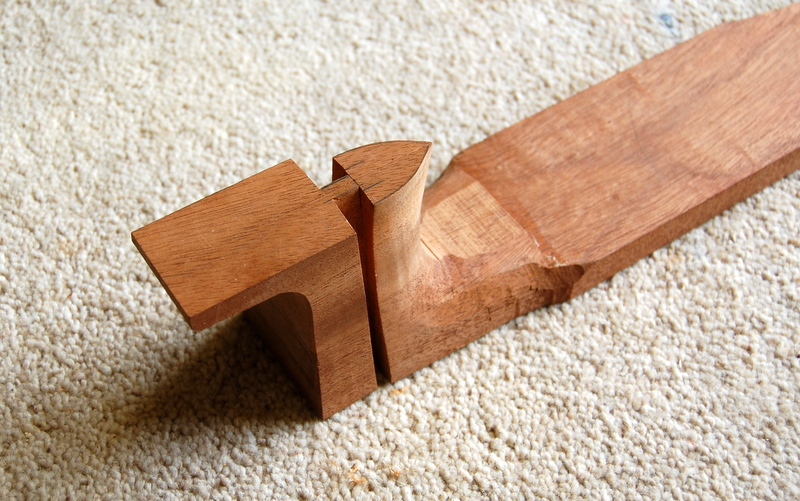
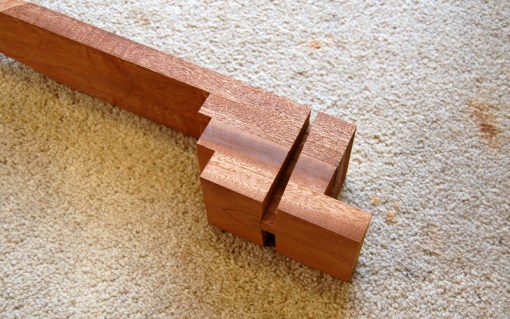
The 2 photographs below show the wide tapering slots cut and chiselled out in the foot of the neck before the heel has been shaped.
DSC_0004

DSC_0003

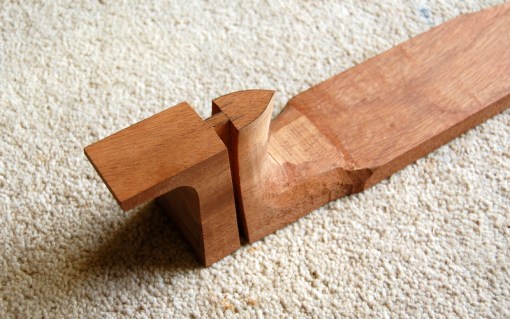
Here, I’ve roughly shaped the heel and lower part of the neck.
DSC_0005

Then I cut the wedges and adjusted them to fit. Obviously, it’s particularly important that they draw everything up tight before the narrow end of the wedge reaches the soundboard end of the slot. I deliberately made them too long initially to give plenty of room for error.

DSC_0009

This is a dry run before gluing to make sure that everything fits perfectly. I discovered that another advantage of making the wedges too long at the beginning was that it provided something to grip when wriggling them out.
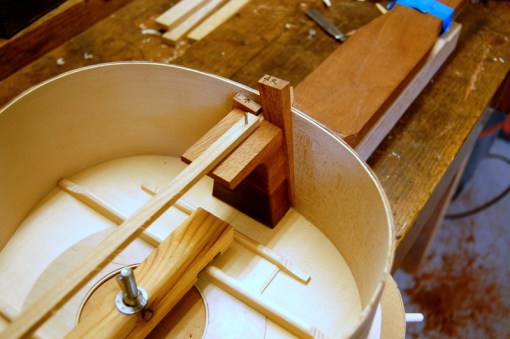
DSC_0014

And this is the finished joint, glued and cleaned up. As you can see, I’ve already started attaching the ribs to the soundboard with tentellones.

DSC_0018

Altogether, this turned out to be a useful experiment. The wide slot presented no problems to saw or chisel out. Indeed, it was significantly easier than cutting the conventional narrow slot. There’s a bit of extra time and trouble preparing the wedges but, as long as you have the right jig (see here) it’s not difficult. Gluing up was easy: plenty of room to coat all the surfaces before putting them together and sliding in the wedge. A couple of taps with a light hammer and it’s done. I’m fairly sure that I shall be using this technique again.

A while ago, I wrote about using a Millers Falls scraper plane to cope with some highly figured cocobolo that I was using for the back of a guitar. It’s an excellent tool for finalising the thickness and it leaves a clean finish even on the most awkward wood. The disadvantage however, is that it takes only the thinnest of shavings so if you’re starting with wood that’s way too thick, you’re in for a lot of time and effort to get to the right final dimensions.

Of course, the usual way to get around the problem is to run the wood through a drum sander. But I haven’t got one, partly because there isn’t room for it in my small workshop and partly because I’m allergic to sandpaper. I don’t mean it literally – I don’t come out in a rash if I touch the stuff – but I do think that there are nicer and quieter ways of shaping wood than grinding it into dust.

Another solution is to use a plane with a toothed blade. This won’t eliminate tear out completely but, should it happen, it’s limited and shallow and can easily be dealt with by a scraper later. Toothed blades work because the individual teeth are too small to grab enough fibres running in the wrong direction to rip out a large lump.

I use a No 4 Record bench plane fitted with a standard blade that I modified to look like this. Put the blade in the vice, cutting edge upward. Take a cold chisel and, against all your instincts, hammer a small gap into the cutting edge every 3 or 4 mm. Then sharpen the blade in the usual way.

DSC_0022

Another way of cutting the teeth is to use a thin grinding wheel in a Dremmel.

DSC_0007-1

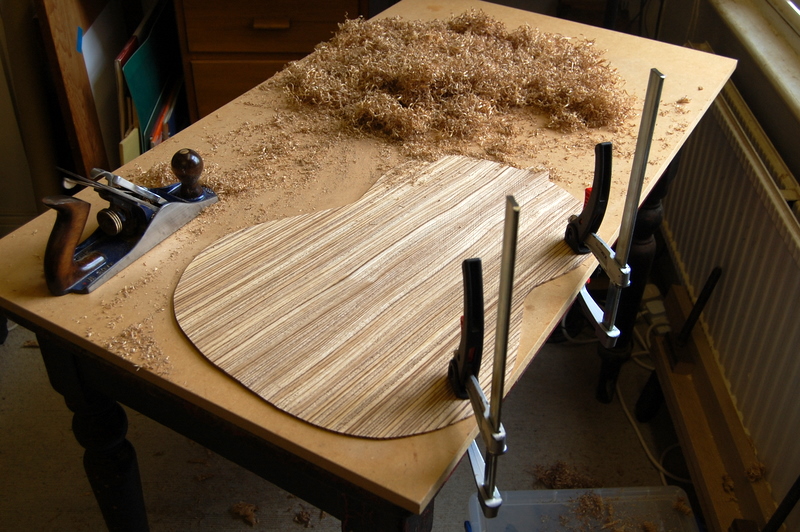
Here are a couple of pictures of a guitar back in zebrano being thicknessed with the toothed blade. If you’ve ever used this wood, you’ll know that the interlocked grain structure makes it very hard to work. With a toothed blade and a wipe of wax on the bottom of the plane, the task becomes a pleasure.

DSC_0019

The marks left by the toothed blade are just visible running diagonally from bottom right to top left. And you can see the linguine-like shavings that are produced.

DSC_0017

Switching over to the scraper plane for final adjustment of the thickness and to remove the corrugations left by the toothed blade.

DSC_0029