Skip navigation

Rather to my surprise, since it’s a pretty arcane subject, my last post on the elastic properties of spruce and how these vary according to the orientation of the growth rings attracted a lot of attention. Thanks to everyone who took the trouble to email me with their thoughts or to post comments. Stimulated by your interest, I thought that I might expand on a few things.

Because of the primitive way I carried out these experiments, there must be some questions about the validity of the measurements. One reason why I couldn’t show a difference between the stiffness of the wood in the different growth ring orientations might have been that my measurements weren’t sensitive enough. Another might have been that my preparation of the test bars of wood lacked accuracy or consistency. These possibilities seemed worth checking.

First, I re-planed the 9 test bars so that they were as square and straight and, this time, as uniform in their dimensions as I could reasonably manage.

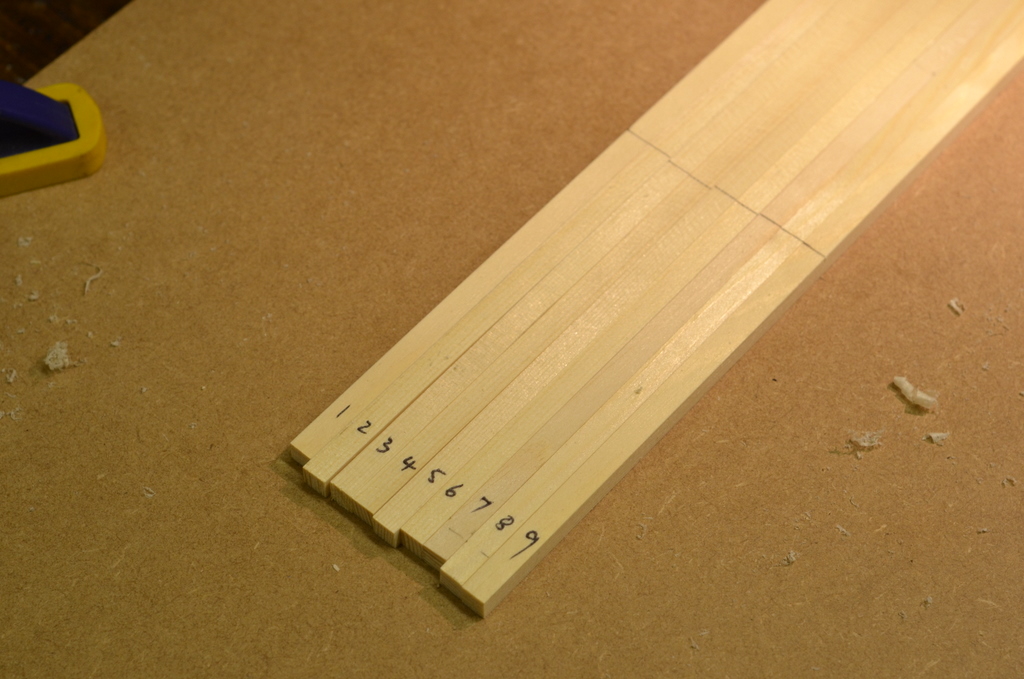
Then I made an estimate of their stiffness, in the same way as before, by clamping them in a vice one at a time and measuring the downward deflection produced by a load of 2lbs applied 20 cms from the vice jaws. Again, every piece was measured 4 times, rotating it through 90° between measurements. For each individual bar, I calculated the mean deflection (in inches) for the 2 measurements in the different growth ring orientations. 3 days later, I measured them again without reference to the earlier readings. The results are set out in the table below, rounded to the nearest hundredth of an inch.

These results seemed encouragingly consistent. The bars that were stiffer in the first set of measurements came out stiffer in the second set too. So it doesn’t look as if the readings are being swamped by random errors introduced by deficiencies in the experimental set-up or that any differences are due to lack of precision. And the actual values in the 2 sets of measurements were quite close too, so the findings are fairly reproducible.

As you can see, there was some variation in stiffness between bars. The deflections recorded for bars 1 and 4, for example, are somewhere between 10% and 20% less than those recorded for bars 5 and 9. It occurred to me that this might have been because my planing had been inaccurate, but when I checked the dimensions with vernier calipers I didn’t find that the stiffer bars were any larger. It may be that this variation is simply a reflection of how the properties of small pieces of wood differ slightly even when cut from the same board.

Although hardly necessary, since it’s obvious from the table that there’s no consistent difference in stiffness between quarter-sawn and flat-sawn orientations for individual bars, I carried out a straightforward analysis using a paired t test, which confirmed that there was no statistically significant difference. [Difference (quarter sawn minus flat sawn) = -0.004 (95% confidence interval : -0.015 to 0.007) p=0.38 df=8]

Guitar makers often flex wood in their hands to get a feel for its stiffness and I wondered if I would be able to identify the stiffest and the least stiff of the test bars by doing just that. Not a chance! I was quite unable to distinguish differences in stiffness between these bars by feeling how much they bent in my hands. It might be worth doing some more experiments to find out what sort of differences in stiffness can be reliably identified in this way. Perhaps we’re not as good at judging stiffness as we’d like to think?

One final thing, which someone kindly emailed me to point out, is that any shrinkage or expansion across the grain because of a change in moisture content of wood tends to be less at right angles to the growth rings than in parallel with them. So, where the growth rings are orientated vertically in the strut, any change in the width of the strut at the glue line with the soundboard will be smaller than if the growth rings had been orientated horizontally. Now in a guitar it’s hard to see that this will matter much because the struts are small, not usually subject to large changes in humidity and are glued in all sorts of different relations to the direction of grain of the soundboard itself, which is also going to move in response to changes in moisture content. But where the strut lies in the same north-south axis as the grain and growth rings of the soundboard – as, for example, in the bass bars of violins or cellos – I can see that there might be an advantage in keeping the growth rings of the strut in the same orientation as the soundboard. This is the best reason I’ve yet heard for keeping growth rings in bass bars vertical, although as I mentioned in my last post, it wasn’t a rule always followed by the great luthiers of the past.

Experienced guitar makers (and books about guitar making) always advise quarter-sawn spruce and vertical orientation of the growth rings for braces and harmonic bars. You hear the same if you ask a violin maker about selecting wood for the bass bar. They’ll explain that wood is stiffest in that orientation, which means that your soundboard will get maximum support for minimum weight.

That might seem the end of the matter but, if you’re one of those disagreeable people who can’t resist probing further and ask if they have ever measured the stiffness of wood in different grain orientations or, if they haven’t, how they can be so sure, you may hear the sound of feet shuffling and detect a swift change of subject.

In fact, as Liutiaio Mottala points out on his interesting website, considering the number of wooden structures that have been built over the years, the information available about how grain orientation influences the physical properties of strength and stiffness is remarkable sparse. In Chapter 4 of The Mechanical Properties of Wood, in USDA Forest Service, Wood Handbook – Wood as an Engineering Material, (available here) there’s a short section on the subject starting on page 4-31, saying that properties of wood do vary slightly according to orientation of annual rings in some species. Disappointingly, it gives no information either about the size of the variation or about which species exhibit the variation. Mottola’s website mentions work done by David Hurd, who found no difference in stiffness between quartersawn and flatsawn wood for the samples he examined but, as far as I can discover, no details are available on line.

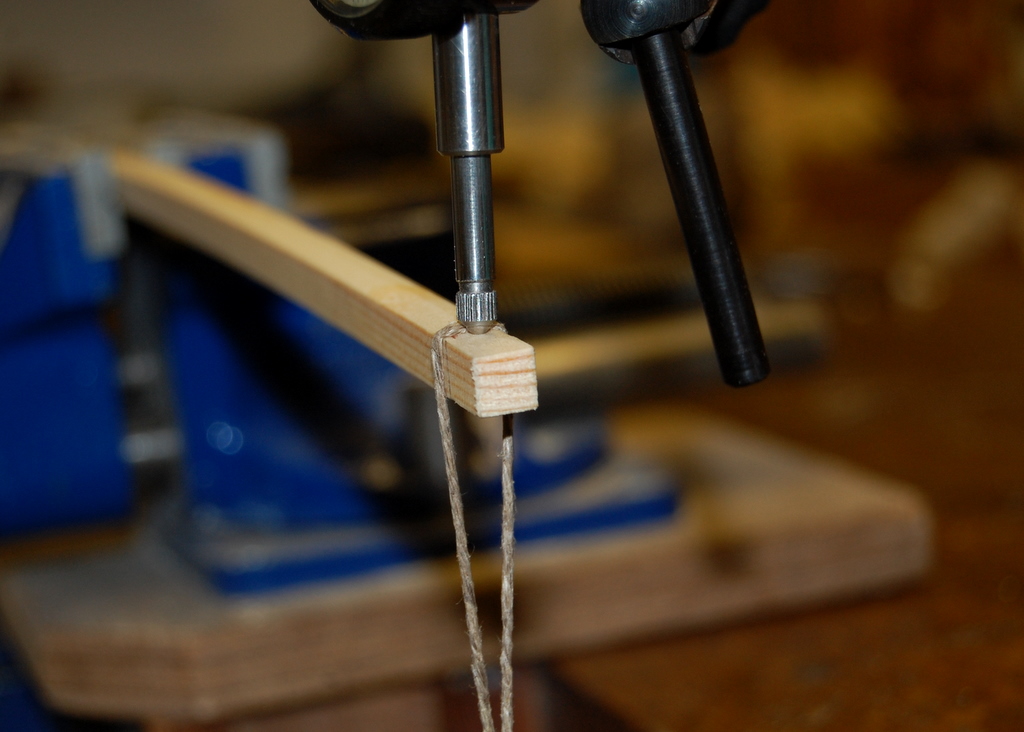
Using the rather primitive set-up shown below, I attempted some measurements myself. The wood is straight grained European spruce with around 14 growth rings to the inch. I sawed and planed 9 pieces, each around 35cms in length and between 7 and 8.5mm in width and depth. I used a shooting board to to make sure that each piece was as straight and as square in section as possible and that the growth rings were oriented more or less parallel to one face (and therefore more or less at right angles to the adjacent face).

Each bar was then clamped in a vice with about 22cms protruding horizontally. I then hung a weight of 2lbs, exactly 20cms away from the vice jaws and measured the resulting downward deflection 4 times for each piece, rotating it through 90° between each measurement.

I’ve summarised the measurements that I made in the table below. The deflections I’ve given are the mean of the 2 measurements for each bar in each orientation. As you can see, the way the growth rings were orientated made remarkably little difference to the magnitude of the measured deflection and there was no consistent tendency for the wood to be stiffer in either of the two orientations.

Now, I’m well aware of the many deficiencies in my experimental design. One of the most serious is that all my specimen bars were cut from the same board and it’s possible that other wood from other trees behaves differently. And of course both the way I prepared my specimen bars and the simple test rig meant that all sorts of errors could have influenced individual measurements. However, the consistency of the findings encouraged me to think that these errors can’t have been very large. If they had been, the size of the difference between quarter sawn and flat sawn deflections would have shown much more variation between different bars.

As a check that the sorts of results I was getting were plausible, I used simple beam theory (max deflection = Wl³ ⁄ 3EI )to calculate the size of deflection that might have been expected, using a value of 10 000 MPa for E, the elastic modulus of spruce. This worked out at 0.34 inches, which was close enough to the deflections that I was observing to reassure me that my simple set-up wasn’t completely inadequate for its purpose.

So what do I conclude? Well, probably nothing that would stand up in a court of law. But I’ve satisfied myself that that spruce cut on the quarter isn’t very different in stiffness from spruce that has been flat-sawn and that where wood of the size and sort used for bracing soundboards is concerned, it doesn’t matter much whether the growth rings are orientated vertically or horizontally. In future, when selecting wood for struts and braces I shall feel free to use either orientation, to make the best use of what I’ve got available.

As a postscript, I was interested to learn from Stewart Pollens’ book Stradivari (ISBN-13: 978-0521873048) that the Hill collection of 50 bass bars taken from violins and cellos of the first rank, including those attributed to Antonio Stradivari himself, contains 11 that are flat sawn (that is to say, the annual rings are orientated horizontally). Maybe instrument makers in 17th century Cremona made less of a fetish about the orientation of growth rings than we do today.

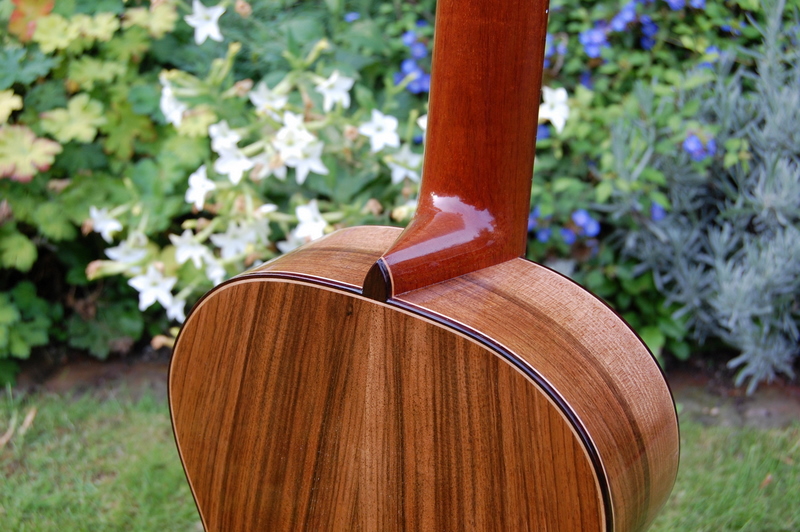
When working on the top of a guitar, I put the instrument on a carpet covered bench and prop up the neck on a block of wood that has a shallow, foam-lined curve cut into the top – as you can see in the photograph above. But I’ve recently learnt a better method. The device below, made out of 2 semi-circles of 18mm plywood, radius about 3 inches, adjusts itself automatically to the taper of the neck and supports it in a far more stable way.

The danger when using the simple block is that it tips over if the instrument is moved along its longitudinal axis. Of course, one can always clamp the block, but with the new neck cradle there’s no need. I’m grateful to Richard Nice (who invented the plane that I wrote about in my last post) for this bright idea.

Richard Nice, who among many other things makes guitars, recently showed me this attractive plane that he had designed for shaping soundboard braces and harmonic bars. He made it from an off-cut of beech and a discarded cutter from a plough plane and, so that there could be no doubt about its provenance, he signed it too.

The screw adjustment is simple but ingenious, depending only on a carefully sited screw tapped into the back of the plane and a slot cut into to the upper end of the iron.

The plane is comfortable to hold and works well. Its narrow cheeks enable it to take shavings from the lowest part of the brace and produce either a triangular or gothic arch section according to your preference.

A few days ago, my friend Michael Lavelle, surgeon, cellist and luthier, dropped in to return a plane that I had lent him and to try out the cello that I have been writing about recently. He brought with him a beautiful pochette, a copy of the famous Clapisson pochette made by Antonio Stradivari in 1717, that he had completed last year. Mike’s instrument has an owl’s face instead of a scroll.

He tells me that these instruments were used by dancing masters in the 18th and 19th centuries, presumably because they were so much easier to carry around than a full-sized fiddle. They’re held, not under the chin, but between the left chest and elbow and they’re played mainly in the first position.The name ‘pochette’ obviously comes from the French word for pocket. In England and Scotland they were known as kits or kit violins – which is probably a diminutive of pocket violin.

There are a few pochettes in musical instrument collections. The Burrell Collection in Glasgow has one, which can be seen here, but it’s not nearly as attractive as the Clapisson. And I believe that the V and A in London and the Edinburgh University Collection of Historical Musical Instruments have examples too.

Not many modern makers however, seem very interested in pochettes, although Owen Morse-Brown is an exception.

Mike hinted that his pochette might be for sale so, if you are interested, email me at info@finelystrung.com and I’ll put you in touch with him.

The varnish on the cello has hardened up enough to allow it to be re-strung and I’ve posted a few photographs of the completed instrument below.

I’ve been adjusting the bridge and the soundpost to get the best sound out of the instrument and to try to minimise a wolf note that takes over between F and F# on the G and D strings. The wolf is less fierce now the instrument has been varnished than it was when it was in the white. But I really don’t know whether that’s a direct result of the varnish or whether it’s other changes that I’ve made, which include re-fitting the bridge and the soundpost and lengthening the tailgut. Although it’s between notes, the wolf is still fairly obvious and I think likely to cause a problem to a player, particularly in the first position on the D string.

Perhaps physicists understand wolf notes, but I’m doubtful that there’s much science in taming them. James Beament gives a partial, although not entirely satisfying, explantaion in his book The Violin Explained. Arthur Benade also discusses them in Fundamentals of Musical Acoustics but I found his account almost incomprehensible. I asked around for advice and got as many opinions as people I consulted. An experienced cello maker told me that I had probably thinned the top too far and that rather than trying to suppress the wolf, which would probably adversely affect the instrument’s performance, I should move the soundpost closer to the bridge and tell the cellist that they need to find a way of playing around it. By contrast, other cellists and makers told me the opposite: that many good cellos have a wolf note, that it’s not an indication of a badly made instrument or an overthinned top and that it’s usually possible to suppress the wolf without compromising the sound of the instrument.

Robin Aitchison and Sarah Mnatzaganian have written a helpful article, which is available on their website: Wolf Notes and How to Tame Them. And there’s a useful discussion in Strings magazine. However, I gradually realised that, for all the talk of tuning the tailpiece and absorbing the resonance at particular frequencies, there’s no coherent theory of wolf note suppression. It’s largely, if not entirely, a matter of trial and error. The fact there are so many types of wolf suppression devices available only reinforces this view. If any one of them worked consistently well, without any adverse effects on how the instrument sounded on other notes, it would surely dominate the market.

In the absence of a plausible theory, it seemed sensible to start with the simplest and most easily reversible of these devices – a small weight on the G or C string between the bridge and the tailpiece. David Bice at New Harmony makes a series of them, in different weights. The design is rather clever in that they stay on the string without the need for a rubber liner, thumbscrew and locknut of the conventional type of wolf note suppressor. It’s claimed that this method of mounting has less effect on the general sound of the cello. They’re reasonably priced at $16 each but they have to be obtained from the USA, which is a pain if you live in England, and, unless you ordered the full range of 6 and tried them all, how could you be sure that you’ve chosen the one with the optimum weight?

I decided to improvise something similar out of small rare earth magnets. They’re cheap, widely available, and I had some in the workshop because I sometimes use them as catches or holders for small tools. The ones that I had were 10mm in diameter, 3mm in thickness and each weighed about 2 grammes. Here’s a stack of them.(Actually, they’re so powerful that it’s hard to show them except as a stack.)

Using a Dremmel cut-off wheel and a slipstone, I ground a slot in 2 of them roughly the diameter of the C and G strings in width but leaving the depth just a touch on the shallow side.

In combination with a second magnet, the grooved magnet will clamp onto the string firmly enough to stay in place while the instrument is played – see below.

One obvious advantage of using magnets is that they’re easy to remove and re-position. Another is that by adding more magnets it’s possible to change the mass on the string and find the minimum required to suppress the wolf. After a surprisingly small amount of fiddling about, I discovered that positioning the magnets on the tail of the C string was significantly more effective than putting them on the G string. Two magnets there substantially suppressed the wolf and 4 abolished it altogether – without any discernible dampening effects on other notes.

The conclusion was that the cello  needed about 8 grammes additional mass at this position on the C string. The magnets worked so well that I was tempted to leave it at that.  But then I worried about their strength and the possibility that, if anything ferrous came into proximity,  there might be a disaster. Perhaps better to replace them with something non-magnetic such as the brass ones made by New Harmony now that I knew the weight required.  

In the end, however, I bought a Lup-X wolf note eliminator rather than one from New Harmony, just because I could get one from the UK immediately rather than bother with import duty and endure several days delay. They weigh 8 grammes (just what I needed) and are nicely made and straightforward to fit, screwing directly onto the string. This is what they look like:

After all this, you may be wondering how the instrument sounds. Here’s a cellist friend trying it out. The recording was made using nothing more sophisticated than a portable Roland Edirol R-09 recorder and, as you can hear from the background noises, coughs, and conversation, I’ve left it completely unedited.

Cello trial.mp3

It may be that I was lucky and my wolf was easy to tame. It’s entirely possible that the Lup-X is less effective on some instruments and, since I’ve only this one experience, I hesitate to recommend them. However, by using the magnet trick, it’s easy to find out whether it’s likely to work on your cello before buying one.

Continuing my experiments with smaller guitars led me back to the 19th century and the instruments made by Louis Panormo. One of his guitars, made circa 1840, is in the Edinburgh University Collection of Historic Musical Instruments and, rather helpfully, a workshop drawing is available. I had other assistance too. My friend, Peter Barton, who makes fine acoustic guitars in Addingham, West Yorkshire has a Panormo guitar in his collection, which he generously allowed me to handle and photograph. And Gary Demos has a series of photographs documenting his construction of a Panormo guitar copy on his website.

Here are some photographs of the instrument as it was being built. It isn’t, and wasn’t intended to be, a slavish copy. I felt no need, for example, to reproduce the inexplicable scarf joint at the heel end of the neck that was indicated in the drawing of the Edinburgh instrument and that you may just be able to see below in the Panormo guitar owned by Peter Barton. In the photograph, it runs more or less horizontally from where the neck joins the ribs to the back of the neck, ending around the 7th fret position. (Do tell me, if you understand why Panormo did this.)

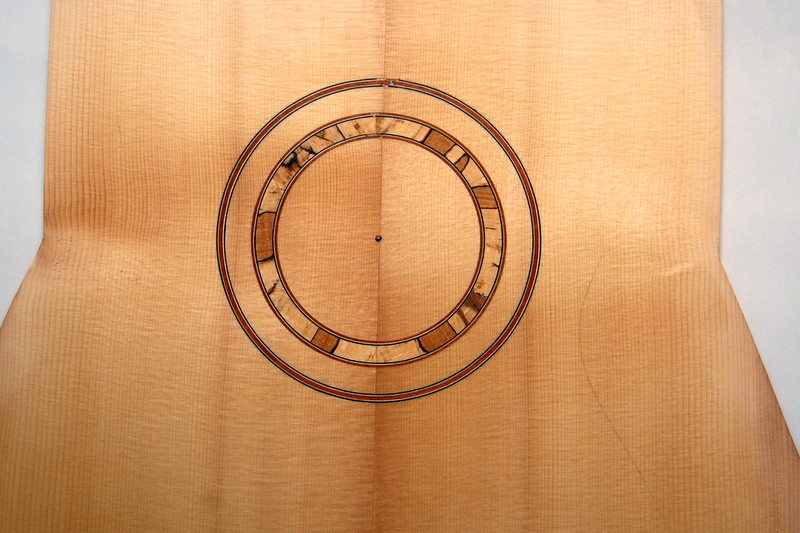
I also felt free to to inlay spalted beech for the rosette instead of the mother of pearl set in mastic of the original.

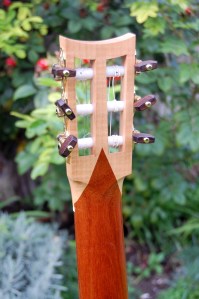
I did however, reproduce the V-joint between the neck and headstock, although the width of the headstock itself was increased slightly to accommodate modern tuning machines. Followers of this blog might recall an earlier post about making the V-joint.


.
.
.
.
.
.
.
.
.
.
.
.
.
.
.

The bridge design is more or less the same as Panormo’s, except that a slot was routed for a carbon fibre saddle to provide a little leeway for adjusting the action later on. His bridge has no saddle. Ebony bridge pins were turned to replicate the original way of fixing the strings.

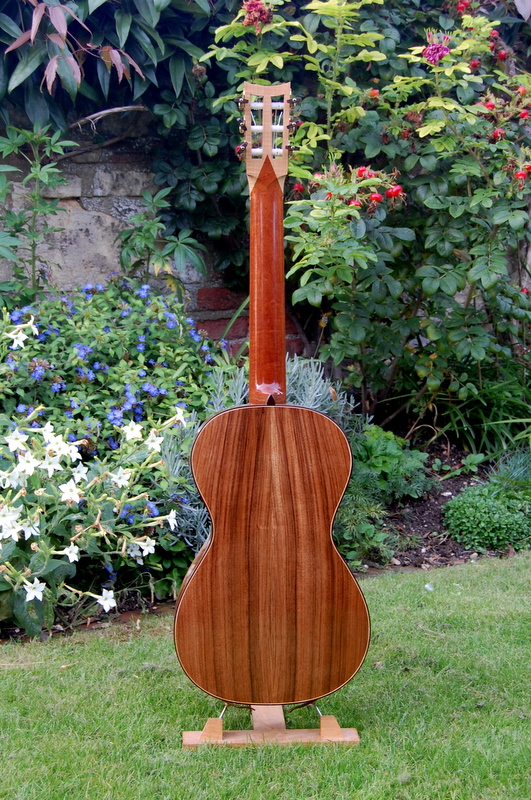
Here are 3 photographs of the completed guitar. The body length is 450mm, width across lower bout 290mm and scale length 630mm.


You can hear Gill Robinson, who now owns the guitar, playing three short pieces if you click on the titles below.

Allegro

The rain it raineth

Caleno costure me

Over a year ago, I wrote a post on this blog speculating that one reason why more men played the guitar than women was simply the dimensions of the instrument. It’s not that women aren’t attracted to the guitar; lots start to play it. But the trouble is that as they get better and the music gets more interesting, the stretches that they must make with their left hand become uncomfortably long, if not physically impossible, unless they have a unusually wide finger span.

No one seemed very interested in this theory (I don’t think I received a single comment) but, even so, I thought it would be worth making a smaller guitar with a shorter scale length, a narrower fingerboard and closer string spacing as an experiment. You can see photographs of the instrument here. It has been played by lots of guitarists both professional and amateur, both men and women. Most of them said they liked it and nobody complained that it made too small a sound, although a few of the men found that their fingers were too cramped at the nut end of the fingerboard.

And it did persuade someone to commission a similar instrument, shown below. It too, is a loose copy of a Hauser guitar. The soundboard is spruce and the back and ribs are of Madagascan rosewood (Dalbergia baronii). The bindings and bridge are of Rio rosewood and the rosette and headstock veneer are of English yew. The scale length is 630 mm; the width at the nut is 48mm; and the string spacing at the bridge is 56mm. I’m pleased both with how it looks and how it sounds and I hope its new owner will be too.


The cello that I’ve been writing about over the past few months isn’t far off completion. I always string instruments up before varnishing to be sure that they sound as they should. If adjustments are necessary and the top needs to come off, it seems better to do it before any colour or varnish is applied. This one was played by several decent cellists and I’m glad to say they had no complaints about the sound – a good response across the strings, although there’s a rather fierce wolf between F and F# on the G string and, to a lesser extent, on the D string too. It may prove necessary to fit a wolf note suppressor but I’ll defer judgement on that until it has been strung up again after varnishing. One of the cellists however, was helpfully critical about the shape of the neck – he thought that I had left it a touch too wide. So I reshaped it before starting to varnish.

Here’s the instrument strung up in the white:

And here are a couple of photographs after a few coats of varnish.

A while ago, I wrote about repairing the damaged soundboard of a cedar topped guitar. And I’ve recently had to deal with a similar problem, this time caused by the lid of the case falling on the guitar as it was being lifted out. The damage wasn’t structural but it did leave some conspicuous dents.

The soundboard had been finished by French polishing and I reckoned that simply re-polishing the damaged area would be almost enough. However, first, using a hot (but not too hot) iron and some wet kitchen paper, I steamed out the dents. When dry, I lightly sanded the area before brushing several coats of clear shellac into the places where the polish had been chipped off. After a couple of days to allow it harden, I sanded again with 1500 grit paper to level the area and then re-polished the whole of the lower part of the soundboard in the traditional way using a pad to apply the shellac. Another few days for the shellac to harden, a quick buff up with some burnishing cream and damaged area was almost invisible.

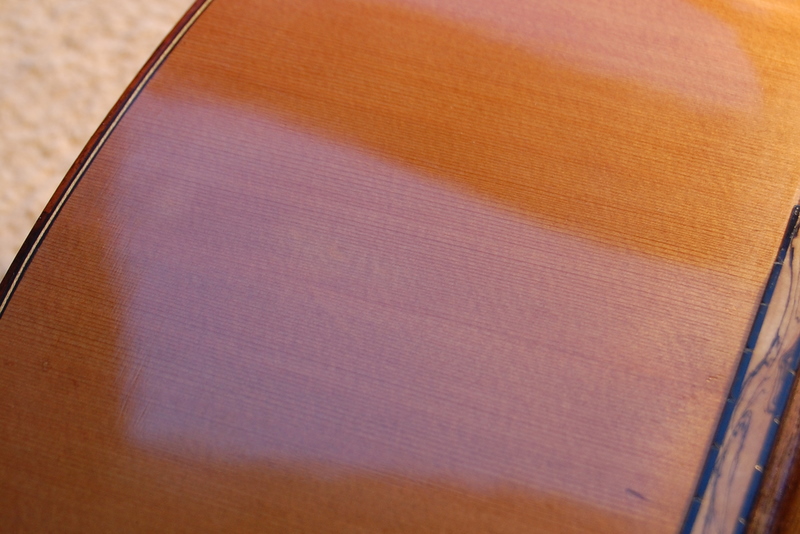
But not completely invisible because, viewed in certain lights, the repaired areas were just identifiable as slightly paler patches. You can see them in the photograph below. I had exactly the same problem with the last repair and I don’t know how to eliminate it. This time I tried exposing the bare wood to UV light for a few hours before applying any shellac but I’m very doubful that it made any difference. Maybe I should have left it under the UV light for longer. If anyone has a better idea, I’d love to hear from them.

My cello is making progress, even if rather slowly. I’ve just closed up the box, which is a step that requires a lot of clamps to hold everything in position while the glue sets.


And here’s the problem: where to find enough clamps. One solution is to buy or, cheaper, make spool clamps for the job. But these clamps are less than perfect because the force they exert operates at the edge of the plates rather than directly over the ribs. For clamps that put pressure in the right place, you have to buy a set of the dedicated cello clamps made by Herdim®, which, I’m told, are easy to use and work well. Unfortunately each of the Herdim® clamps costs about 15 Euros, so getting equipped with the 40 or so that are needed for a cello is quite expensive.

Partly out of meanness and partly because I enjoy making my own tools and jigs, I devised this alternative. The photographs make it fairly clear how the clamps are constructed and instructions are probably unnecessary. But perhaps a few details will be helpful. The clamping force is supplied by a wing-nut on 6mm studding. I made at least half of the clamping length out of aluminium tubing so that the clamps were as light as possible. It’s important that the aluminium tubing has an internal diameter only very slightly greater than the diameter of the studding so that the upper part of the clamp slides smoothly, but without play, over the lower part. The clamping pads are mahogany but, of course, any hardwood could be substituted. When making these pads, it’s a better idea to work a rebate into a length of cross grain mahogany and then saw it up than to craft each one individually. The pads are lined with cork that has been glued on in a profile that puts the pressure directly over the ribs. I used polyurethane glue to set the tubing into the clamping pads and to cement the studding into the aluminium tubing but I should think epoxy would work equally well.

The same principle also works for shorter clamps. The one below is designed for crack repairs. Shallow cleats are temporarily glued either side of the crack, which the jaws of this clamp can grip to close the gap.

At the Easter Instrument Making Course at West Dean this year, I had the pleasure of meeting Wouter Hilhorst, who was making a viola. Apart from admiring the precision and delicacy of his work, I was also interested to see that he had made his own planes, 2 of which were in the Japanese style. He let me take a quick photograph – see below.

We’ve recently had an email correspondence and he’s sent me some better photographs, and some details of how he made them. He gets the blades from the German company, Dick, and recommends their Japanese blades writing:

They are laminated and can be honed to a very sharp edge. As you probably know, blades for larger Japanese planes taper in thickness and wedge themselves in the more or less resilient oak plane bodies, which works surprisingly well. The small blades from Dick aren’t tapered in thickness, but only slightly in width. When I made them I thought I would wedge them widthwise, but the little recesses which grip the blade on both sides are enough, just by friction (although I had to glue two little strips of paper in the recesses of the smaller plane). The blade needs some space widthwise to be adjusted laterally.

He makes the planes from European oak or boxwood and chisels them out of a solid block. This is a technique that I intend to re-visit. All the planes that I’ve made recently followed the Krenov method in which you start by sawing two slices off the block to make the sides of the plane, shape the bed and throat from the middle section, and then glue it back together. There are some photographs of this method of construction here and here.


At the beginning of March I posted a few photographs of dovetail joints that, at first sight, look impossible to put together, let alone take apart. As I said then, there’s no real trick to them; it’s just that the assumptions one makes about the parts of the joint hidden to the eye turn out to be wrong.

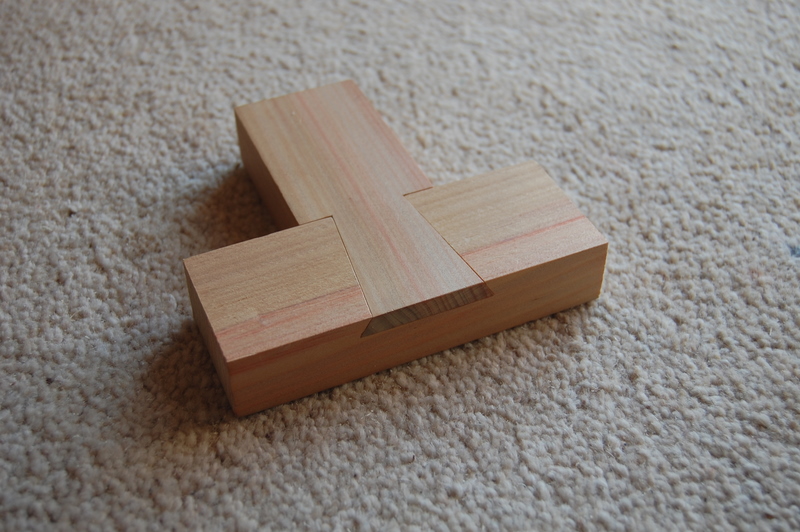
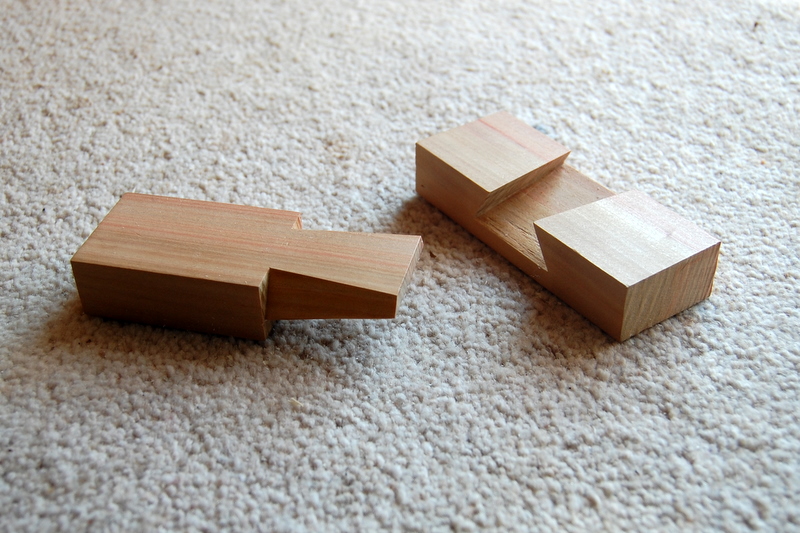
Here’s the double dovetail disassembled:


And here is the triple dovetail:


Ingenious and amusing, but rather short on practical applications.

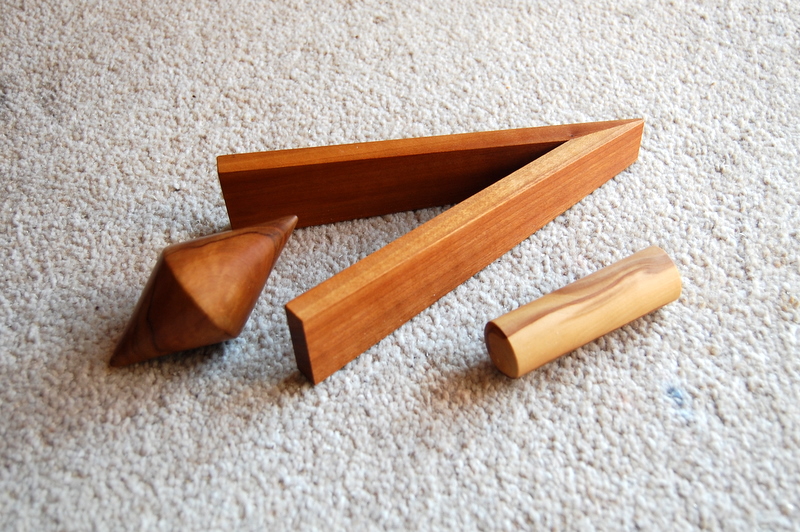
While on the subject of the apparently impossible, here’s another teasing puzzle that woodworkers can make to annoy their friends. It consists of 3 pieces: a cylinder, a symmetrical double cone and an inclined plane.

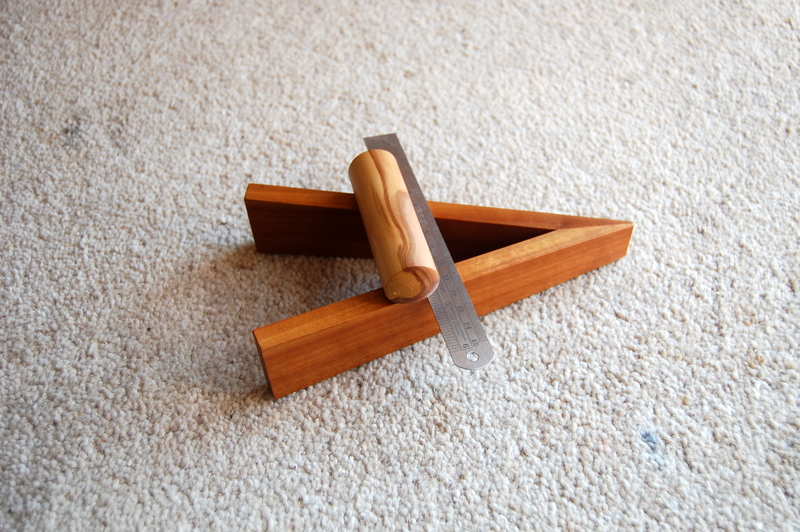
Surprisingly, placed together like this, there is no movement in either cylinder or cone. Wouldn’t you expect them to roll down the inclined plane?

The cylinder does, of course, roll down the plane but to take the photograph, I’ve used a ruler as a chock to prevent this happening.

The cone, on the other hand, has an inexplicable tendency to roll up hill. Once again, I’ve used a ruler as a chock to prevent it doing so.

These still photographs don’t really convey the anti-gravity properties of the double cone. For a more convincing demonstration, have a look at this video on YouTube.

Or, in case the link doesn’t work, paste this url into your browser: http://www.youtube.com/finelystrung#p/a/u/0/g7dCCskRMUg

As you can see, I’m working on a cello at the moment. But I’ve written about cello making before and, rather than repeat myself, I thought that I’d show a few wooden constructions that have amused me recently.

First, an old favourite – but one that people who don’t know the secret find seriously puzzling – the captive screw. There a trick to its manufacture, of course, and, if you can’t work out how it’s done, this YouTube video explains.

Rather more sophisticated is this apparently impossible double dovetail. There’s no trick here and the joint comes apart with ease. It’s just that the geometry of the joinery isn’t what one assumes it to be at first sight. The joint is occasionally useful. Roy Underhill describes an application in his book, The Woodwright’s Guide (ISBN978-0-8078-5914-8), where it’s employed to join the front legs to the top of a work bench.

The triple dovetail below is an ingenious puzzle that I found in Edwin Wyatt’s book, Wonders in Wood (ISBN 0-941936-40-6). Wyatt says that it was invented by someone called A B Cutler and published in a magazine, Industrial Arts and Vocational Education in 1930. It has no practical application as far as I know. The geometry of the joint is a variation on that of the double dovetail but it’s rather harder to make. Again, despite all appearances, the two pieces come apart easily – as you can see if you compare the positions of the ebony dots in the two photographs.

In a future post, I’ll show some photographs of the joints pulled apart.