Skip navigation

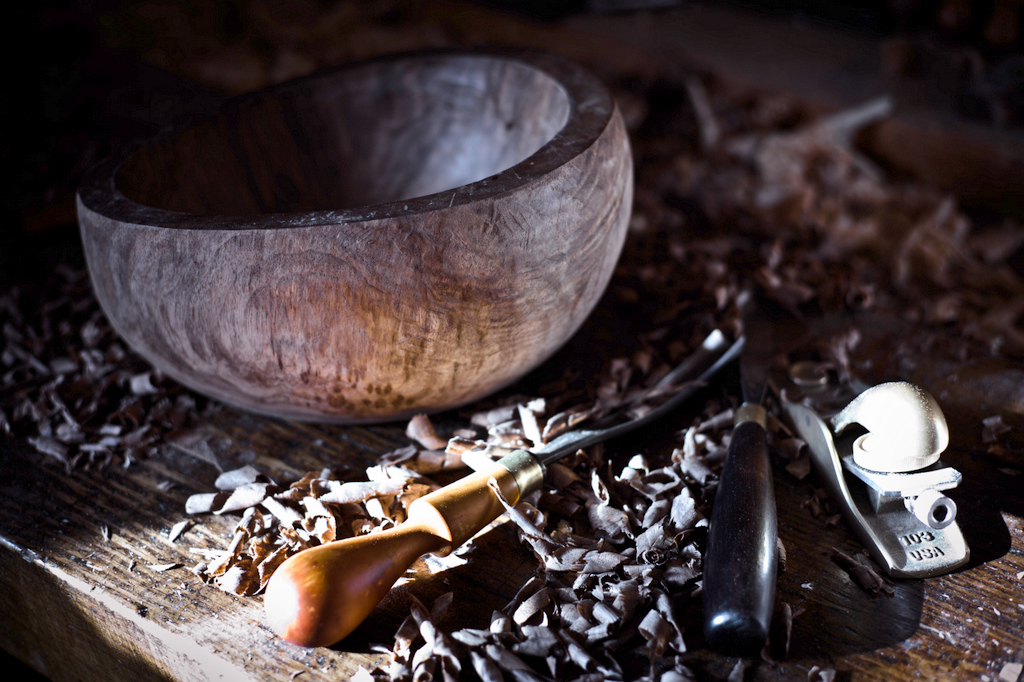
The low Autumn sunshine streaming into my workshop last week showed this oval walnut bowl in such a flattering light that I couldn’t resist taking a photograph. The bowl was being carved on the bench because my lathe isn’t big enough to turn a piece of this size.

Mind you, carving lets you do things that wouldn’t be possible on a lathe, as the photograph below shows. It’s taken from David Pye’s book The Nature and Art of Workmanship (ISBN 1-871569-76-1) and the author carved the dish out of the wood of the wild service tree, Sorbus torminalis. Service wood is not a timber that I’ve ever seen, although I understand that it was once sought after for harpsichord jacks.

I wasn’t attempting anything nearly as ambitious as Pye’s dish. What I had in mind was the egg-like form that Barbara Hepworth frequently used in her sculptures – but on a much smaller scale and as a utilitarian object rather than a work of art.

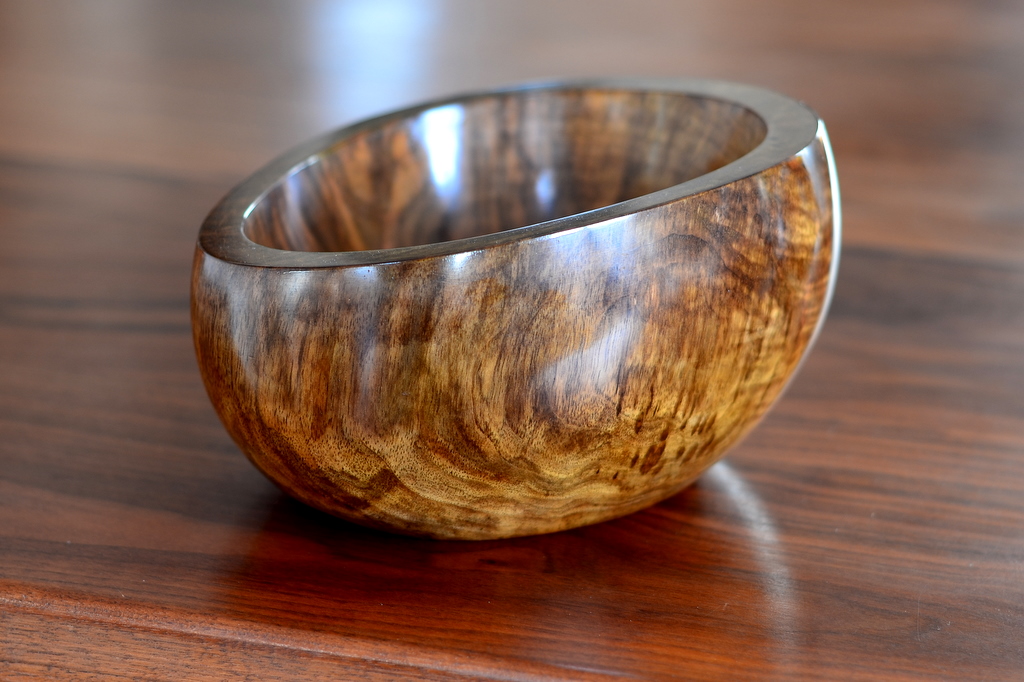
Here’s a photograph of the completed bowl, which has been finished with clear French polish.

To see a larger version of these photographs as a slideshow, click on any of the thumbnails below.

Footnote

1. Thanks to due to the anonymous photographer who posted the picture of Barbara Hepworth’s garden in St Ives, Cornwall on Flickr (http://flic.kr/p/7J4gud).

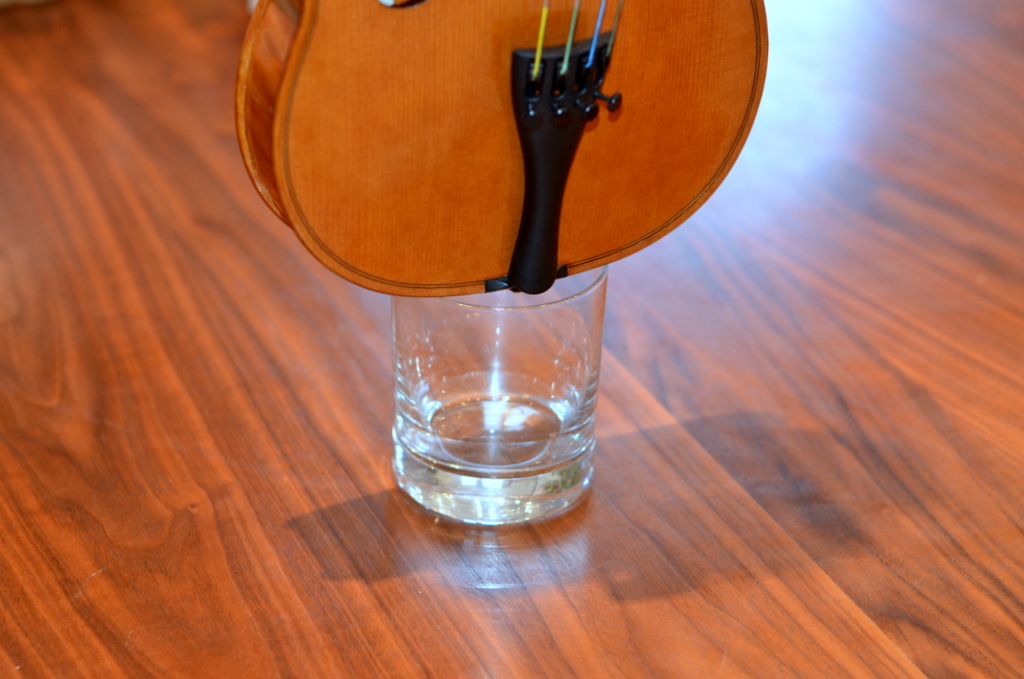
Violins are difficult to photograph but, thanks to Michael Darnton’s book on violin making, I’ve recently got better at it. As far as I know, the book isn’t published (or even finished) yet, but some chapters are available on-line. There’s one on violin photography which, amongst other good advice, mentions the ingenious technique of using a glass jar or tumbler to stand the instrument on while it’s being photographed. This is less precarious than it seems and has the great advantage of holding the violin vertically upright in a way that’s nearly invisible.


Previously, I’d used this stand, which is fine for displaying instruments but much less good than the glass method when it comes to photographing them.


Here are a couple of shots of a recent violin. They’re still not very good – the lighting is uneven, shadows are visible on the backdrop and the camera is positioned a little too high – but they’re a substantial improvement on anything I managed before.


The violin is based on an instrument made by Carlo Bergonzi in 1736 but I’ve made it three-quarter size for a violinist who, following an injury to her shoulder, can no longer play a full size fiddle comfortably.


Although I was sure that I’d read somewhere that there was a way of using a mirror to help judge when a drill bit was truly vertically, I struggled to find an account of how it was actually done. Eventually, after a lot of googling, I came across this letter and illustration published in Popular Mechanics nearly 80 years ago.

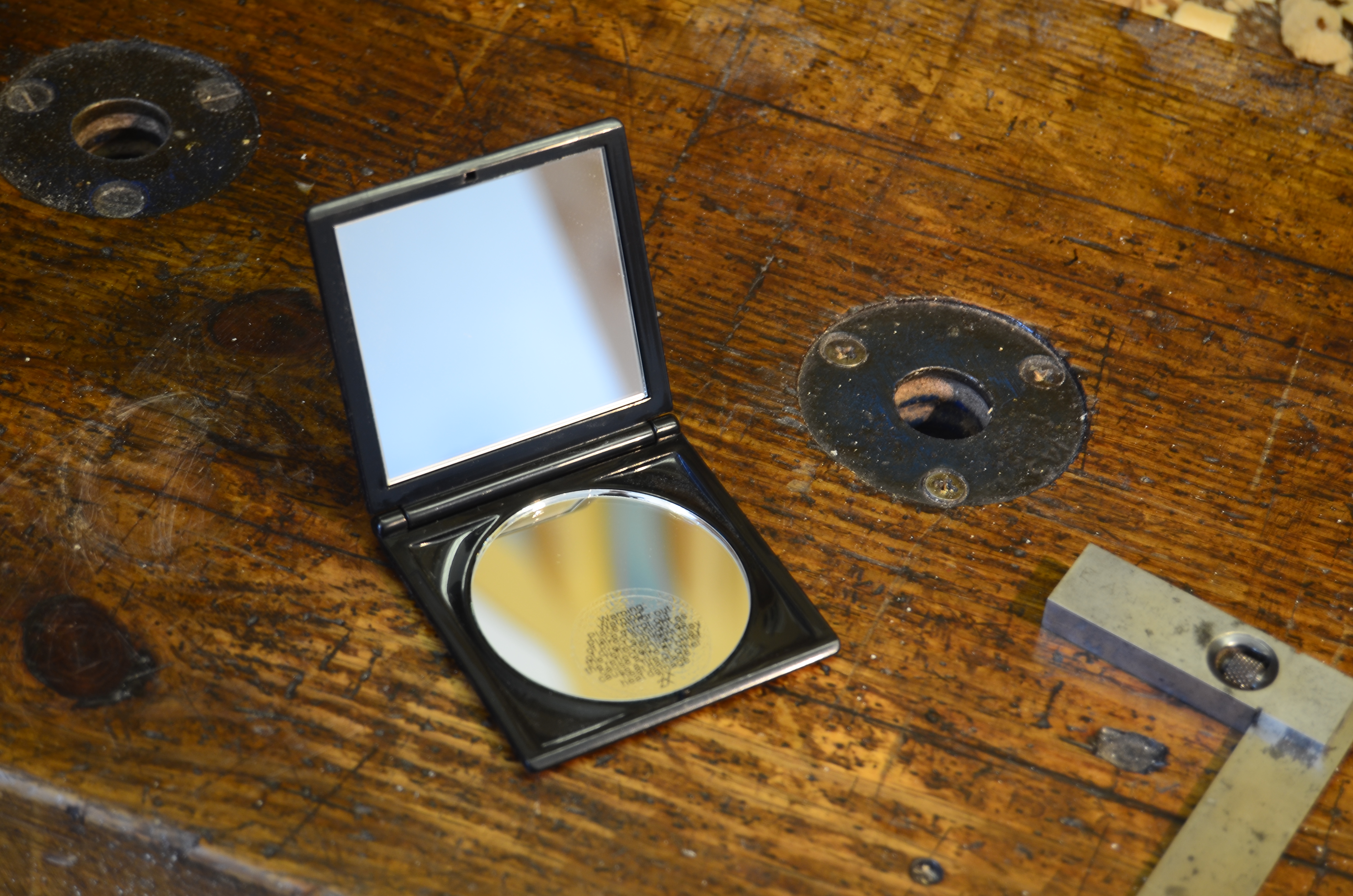
To find out if it worked, I bought a cheap handbag mirror.

First I cut off the hinge and trimmed back the plastic mount along one edge.

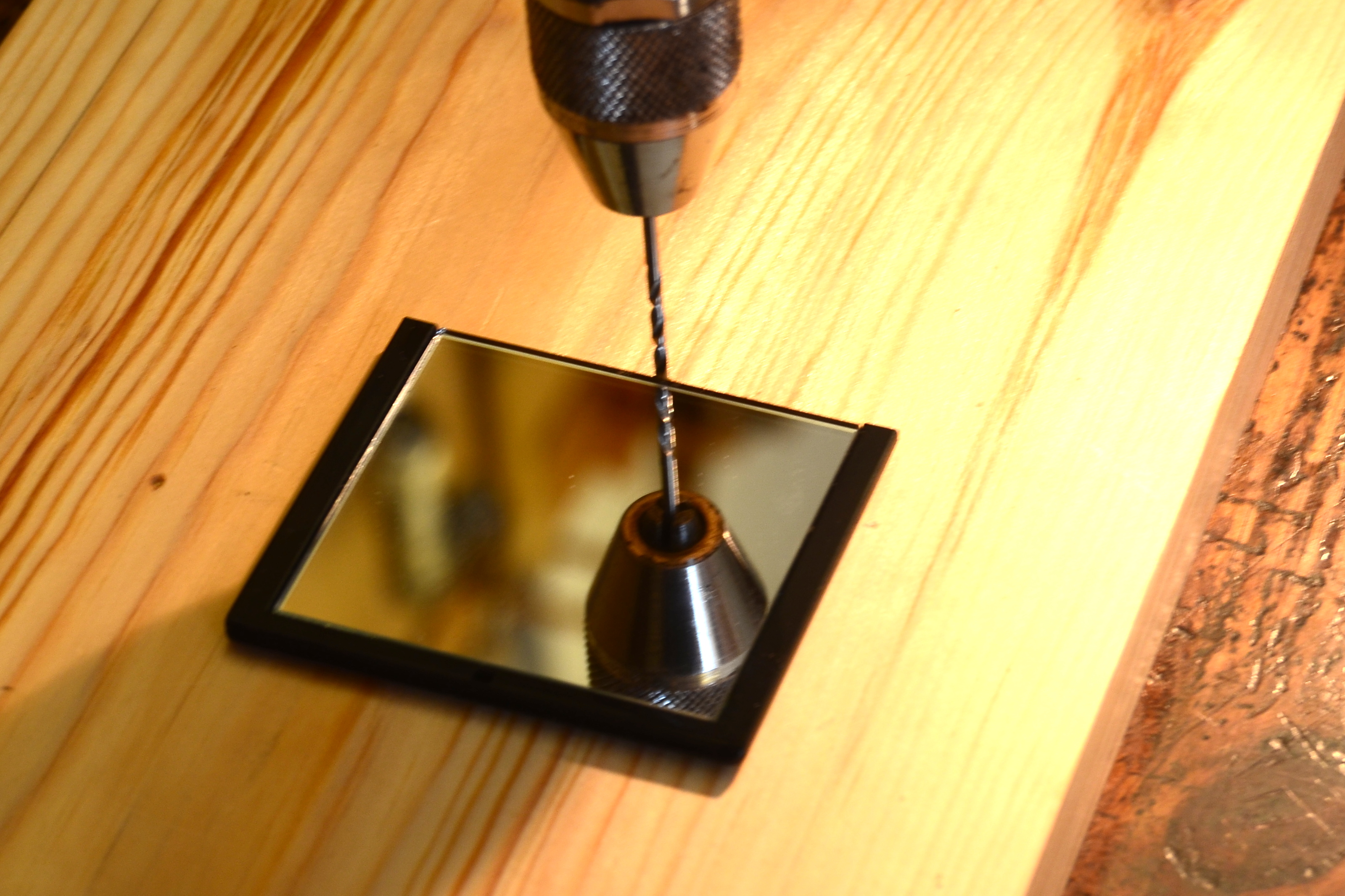
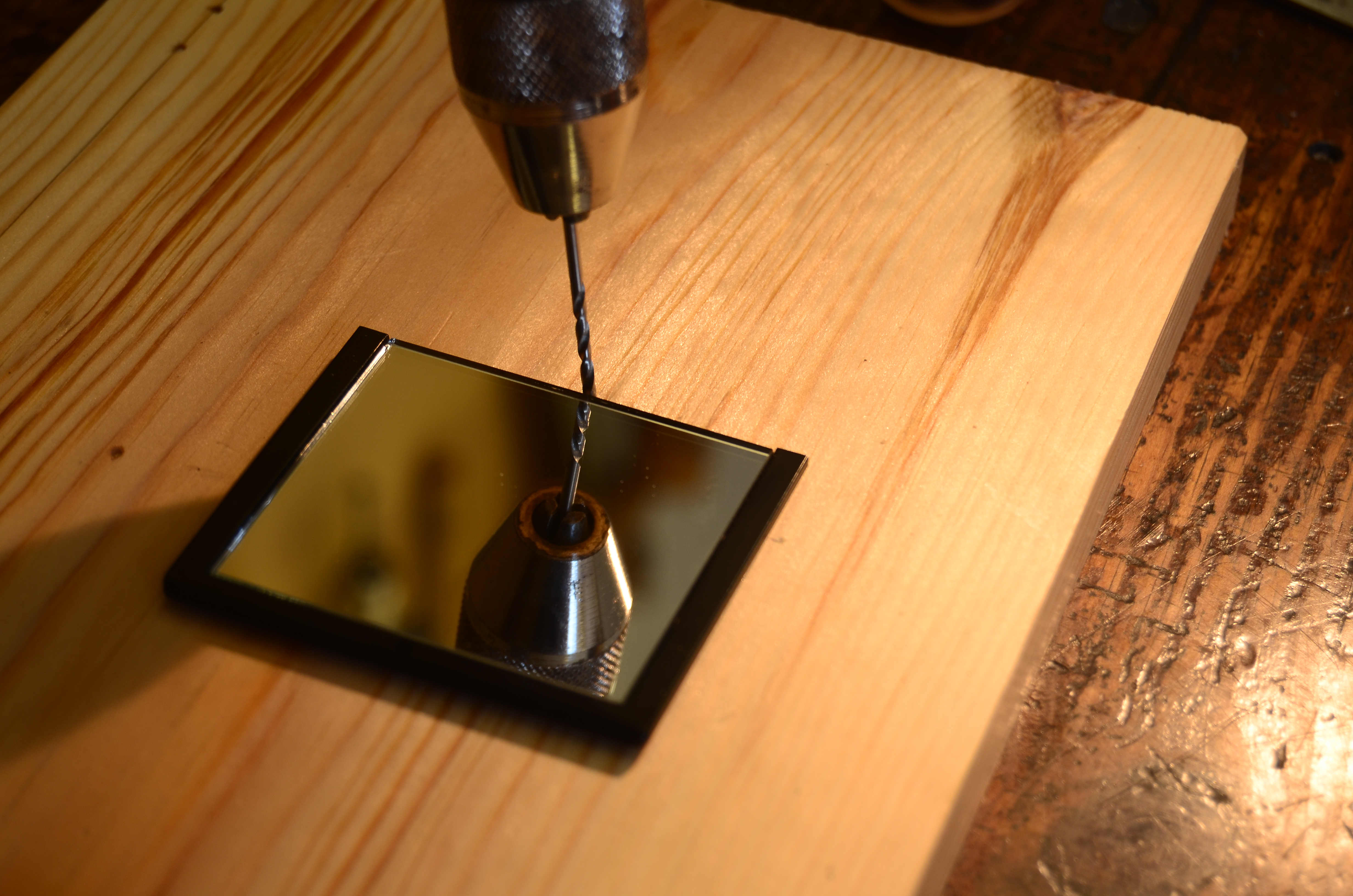
Placed next to the drill bit, the mirror showed when the drill was vertical…

… and when it wasn’t.

It’s a simple idea but I was impressed by how well it worked. A problem though, is that the mirror only tells you whether the drill is vertical in one axis. You have to move the mirror around the drill to check whether it’s vertical in the other axis and while you’re doing this, it’s easy to lose the vertical on the first axis.

One solution might be to have an L-shaped mirror or, perhaps better still, a mirror with a hole in its centre. Then, all you’d have to do to check that the drill was truly vertical in both axes would be to move your head.

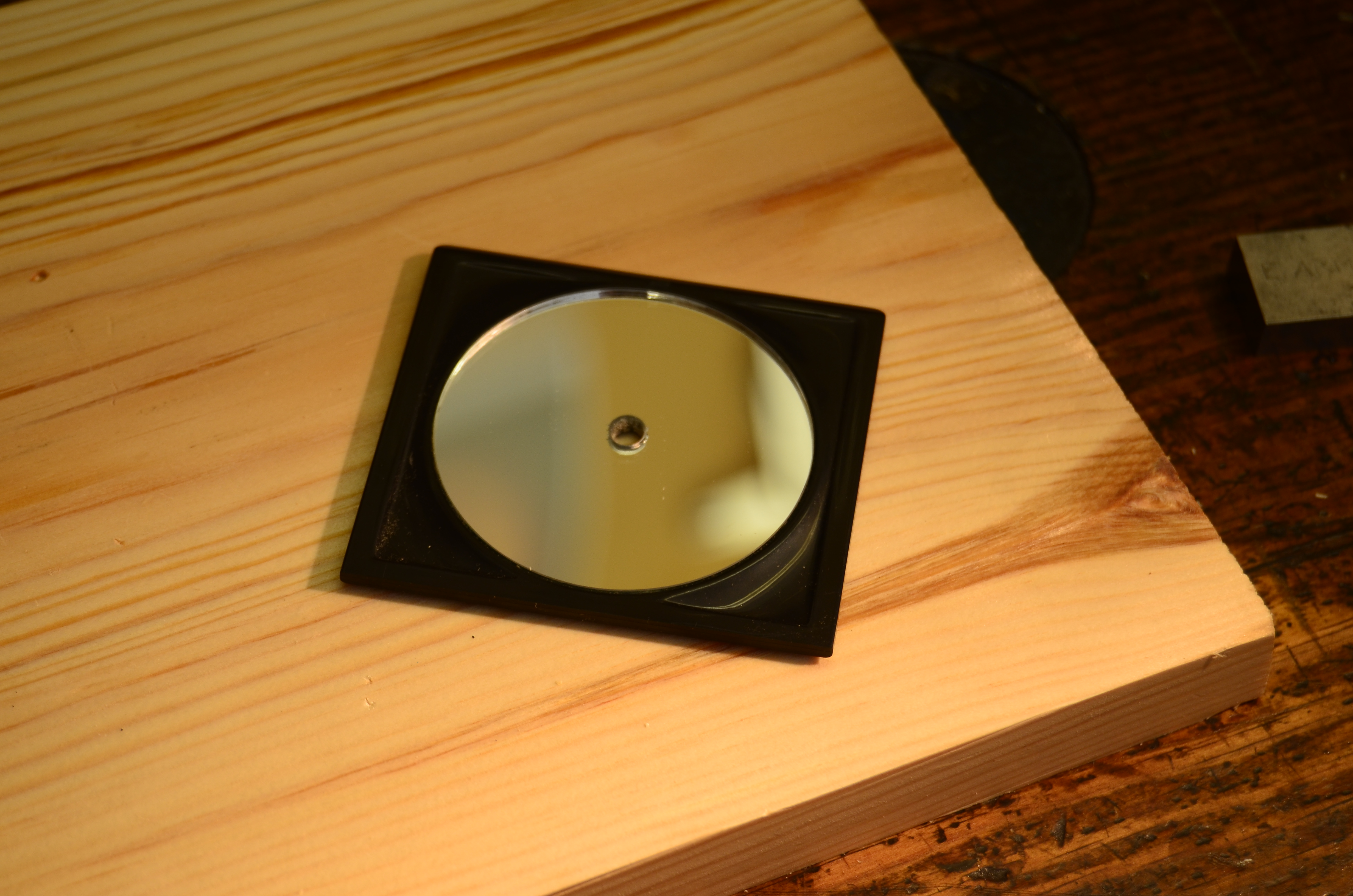
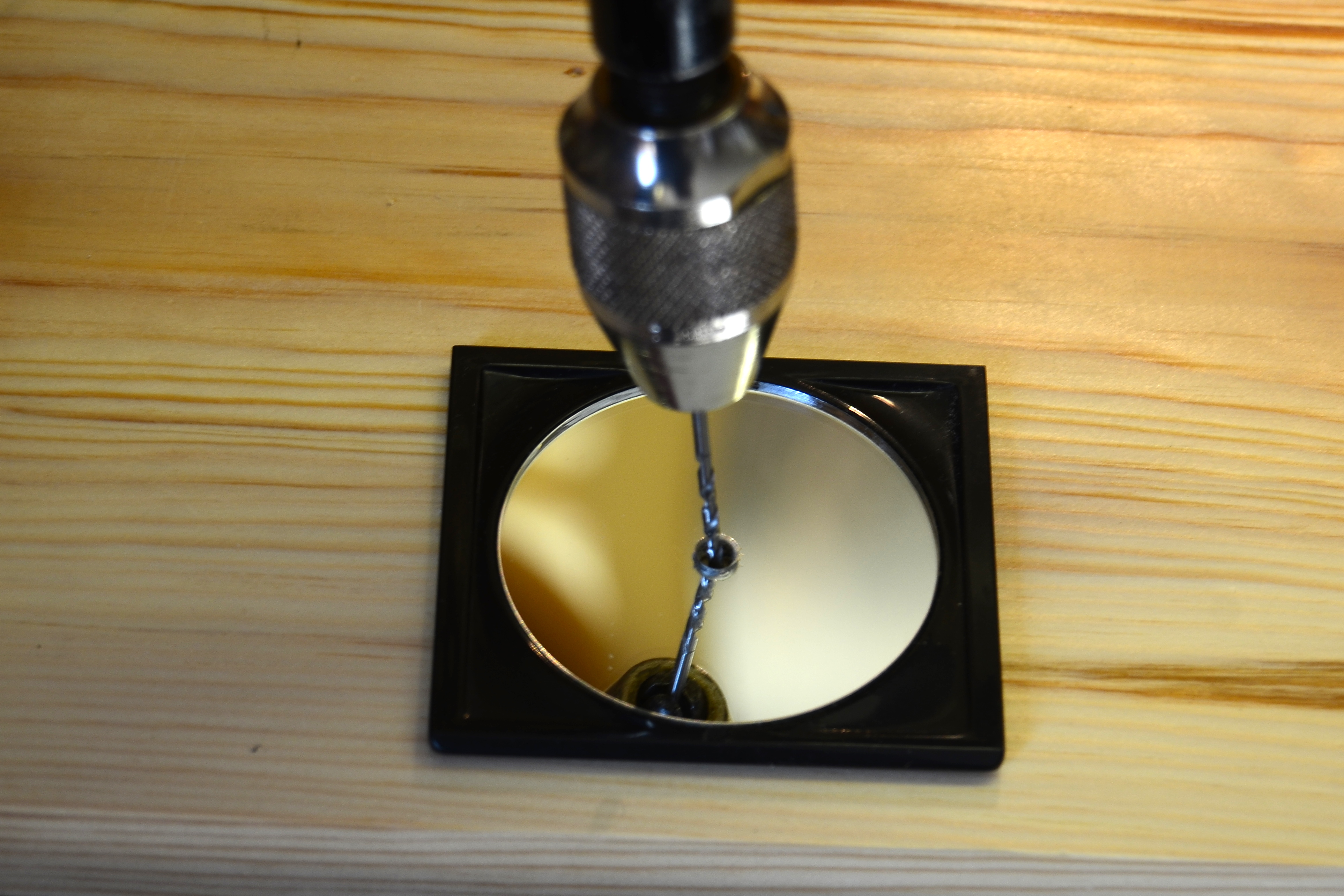
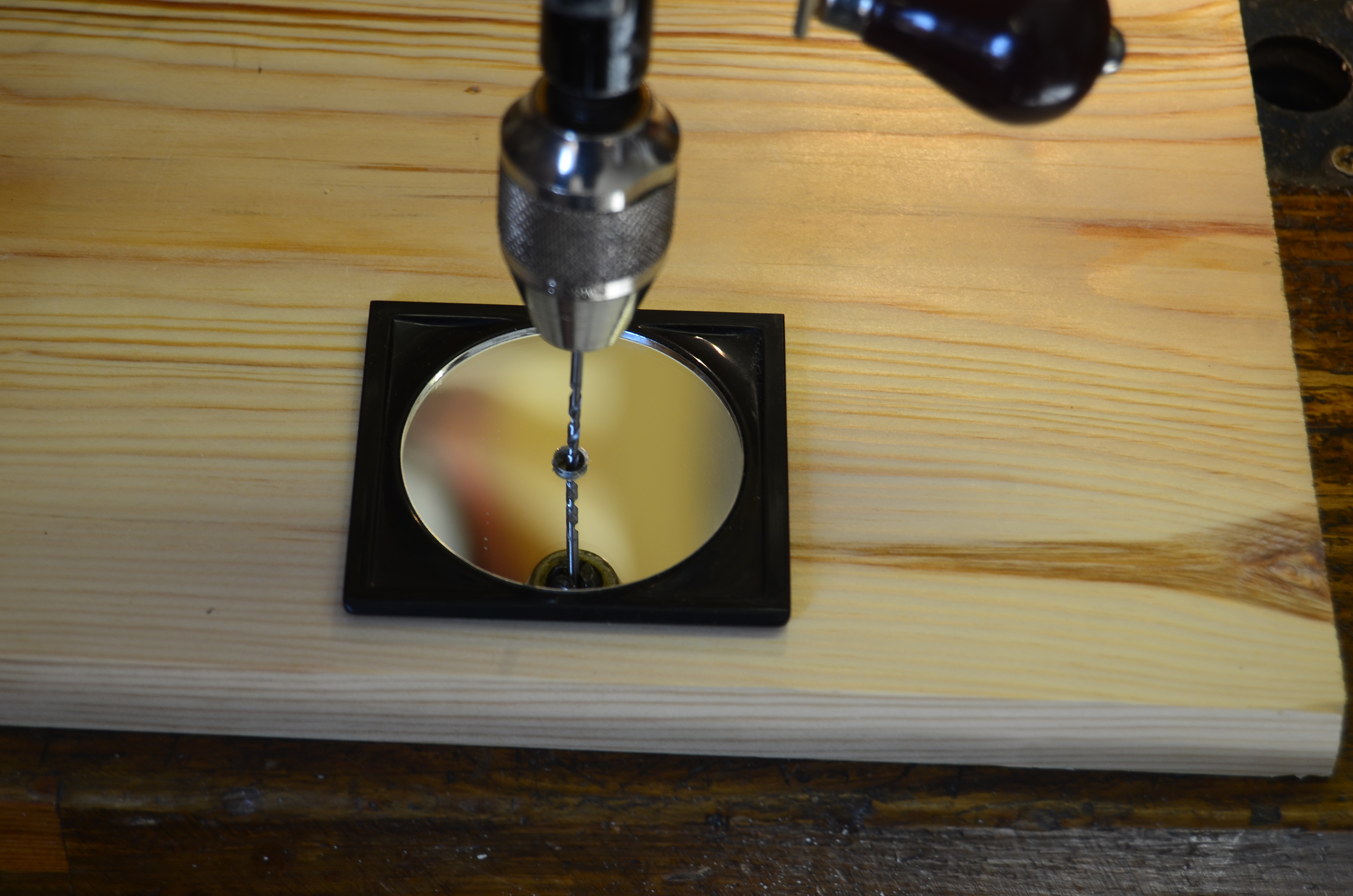
So I ground a small hole in the centre of the other mirror and tried it out.

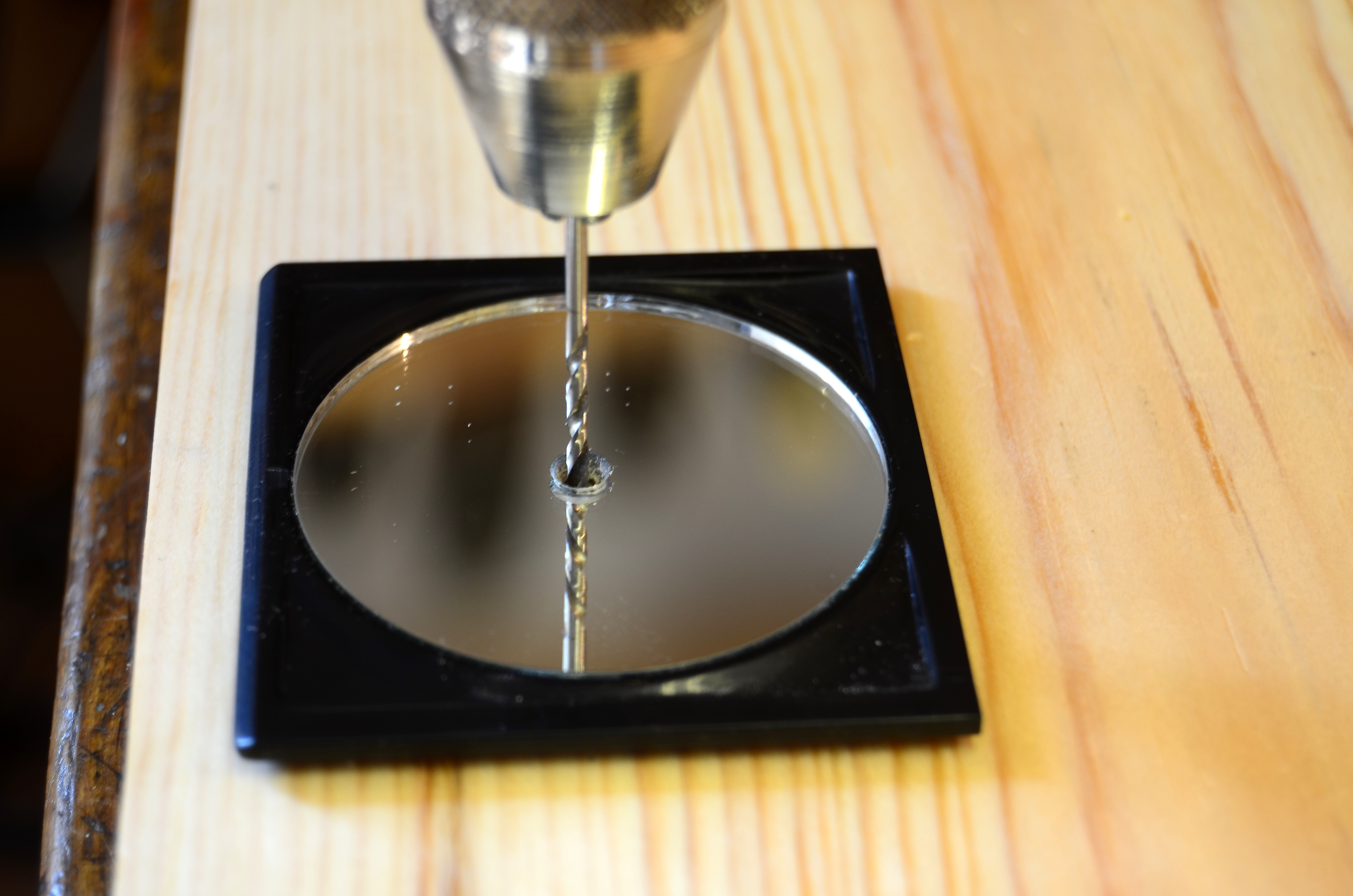
This is the view when the drill is vertical.

And when it’s miles off.

Of course, you don’t need a mirror to see when the drill is as far out as that. The benefit is that it makes it easy to spot small deviations from vertical.

Does it work in practice? As a test, I drilled ten 2mm diameter holes at 10mm intervals along a line in a piece of MDF and stuck cocktail sticks into them.

Not perfect – but not bad either. Certainly better than I was able to do in a repeat of the experiment when I used a small try square instead of the mirror as a guide, as you can see below.

Obviously, the best way to drill a truly vertical hole is to use a drill press. But there are occasions when this is impossible because the work piece is too large or too awkwardly shaped. It’s then that this trick with mirrors might come in handy.

A trip this summer took me to Stein am Rhein in northern Switzerland, where I visited the museum of the abbey of St Georgen – a place both fascinating and frustrating. Fascinating because of the interest of the buildings and their contents. Frustrating because there was so little explanation: no convincing narrative about how or why the place, which ceased to be a religious foundation 500 years ago, still exists.

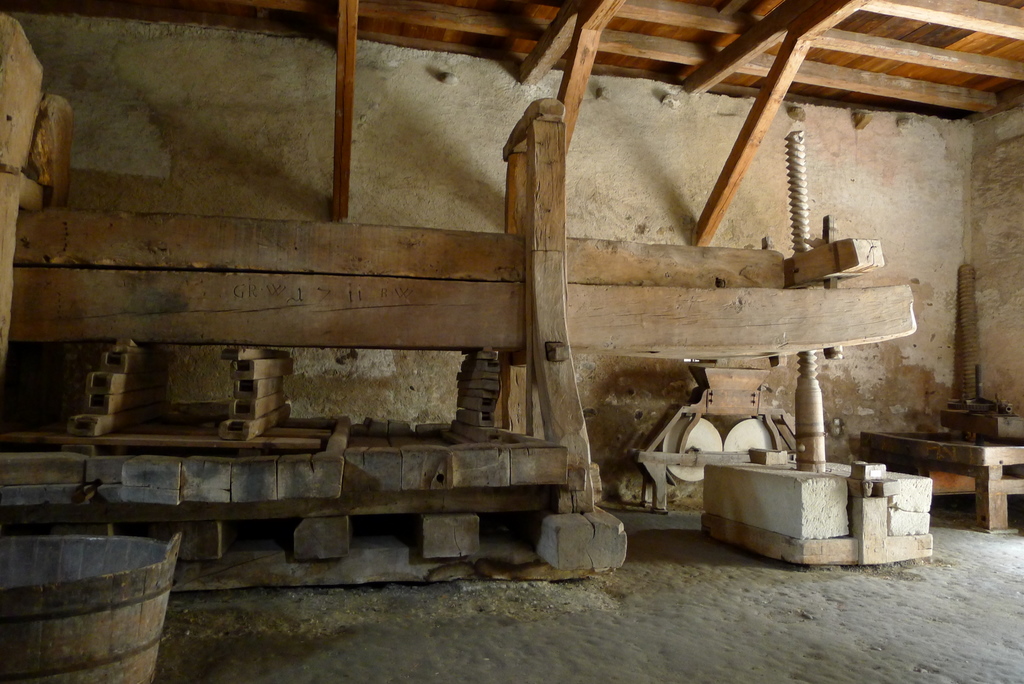
Even so, it contained several things to interest woodworkers. Here are three: the first was this enormous wine press which, if the carving on the main beam is to be believed, was built in 1711. Maybe it’s an attraction of opposites but, as an instrument maker who has to fuss about tenths of a millimetre, I couldn’t help thinking what fun it would be to chop out mortices and tenons on this sort of scale.

The second was this fine chest decorated with paint and chip carving. It too, had a date carved in it – 1697, just visible bottom right – which seems plausible enough. But what on earth was it doing in an abbey that had stopped functioning as an institution during the reformation in the early 1500s?

The last was this remarkable repair to the bottom of a pine cupboard. Rot and wood worm must have got into it, but someone thought that that it was worth saving and, perhaps inspired by the Alps which aren’t too far away, scarfed in a new footing. I’d never seen anything like it. Please write if you know of other examples or can explain more about the technique.

This is the back way in to the Ca’ del Duca, a palace off the grand canal of Venice, begun in 1467 but never fully completed. The stylish way to get there is by water taxi but it’s quite as nice and a lot cheaper to walk, which is what I did to see Luxembourg’s exhibition at this year’s Venice Biennale – Le Cercle Fermé by Martine Feipel and Jean Bechameil.

Like most of what was being shown in the Biennale, it turned out to be an installation rather than a conventional exhibition but I have to admit that it provided a mildly amusing experience. You walked along corridors with undulating walls, got disorientated by halls of mirrors and nearly lost your balance navigating wonky floors. It was supposed to challenge our notions of stable constructed space and to make us look differently at the world when we leave. There are more photographs (and some pretentious artspeak) here.

Two of the rooms were especially interesting to furniture makers. Chairs and chests of drawers had been made to look as if wood had a melting point and they’d been left too close to the fire. They were still recognisably chairs or drawers, although obviously you couldn’t use them for sitting on or keeping things in. Indeed, part of the point was that they’d be completely useless for any practical purpose.

I shall leave you to decide whether this is a clever way of encouraging us to think in a fresh way about familiar objects or whether Feipel and Bechameil are just playing a prank.

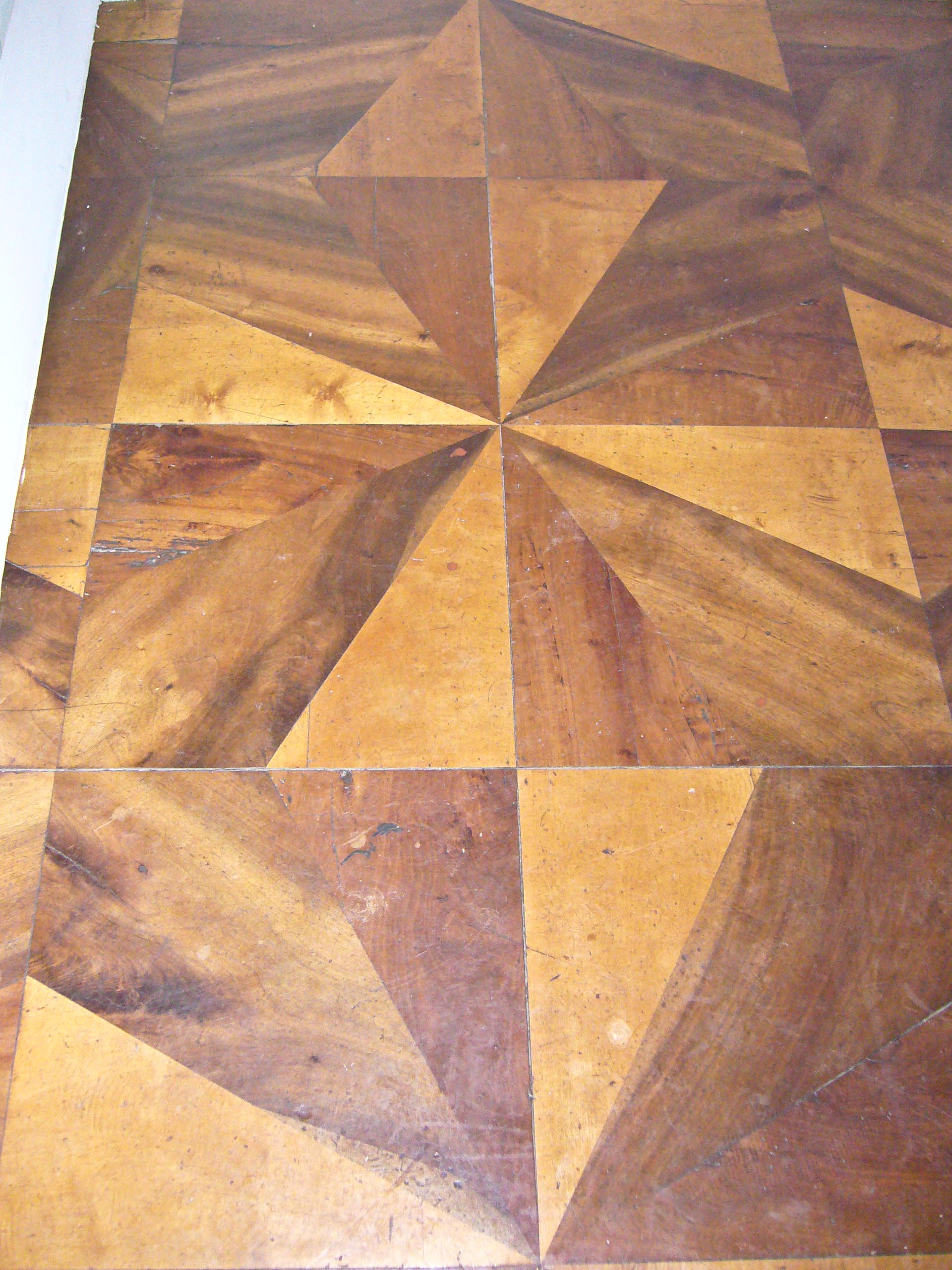
There was however, a wonderful floor in one of the rooms. Not a wonky one to throw you off balance but a laid wooden floor that had been part of the Ca’ Del Duca in its days of glory. It hadn’t been looked after very well and my photograph isn’t very good but I couldn’t help thinking that it was rather more interesting (and enduring) than the chairs.

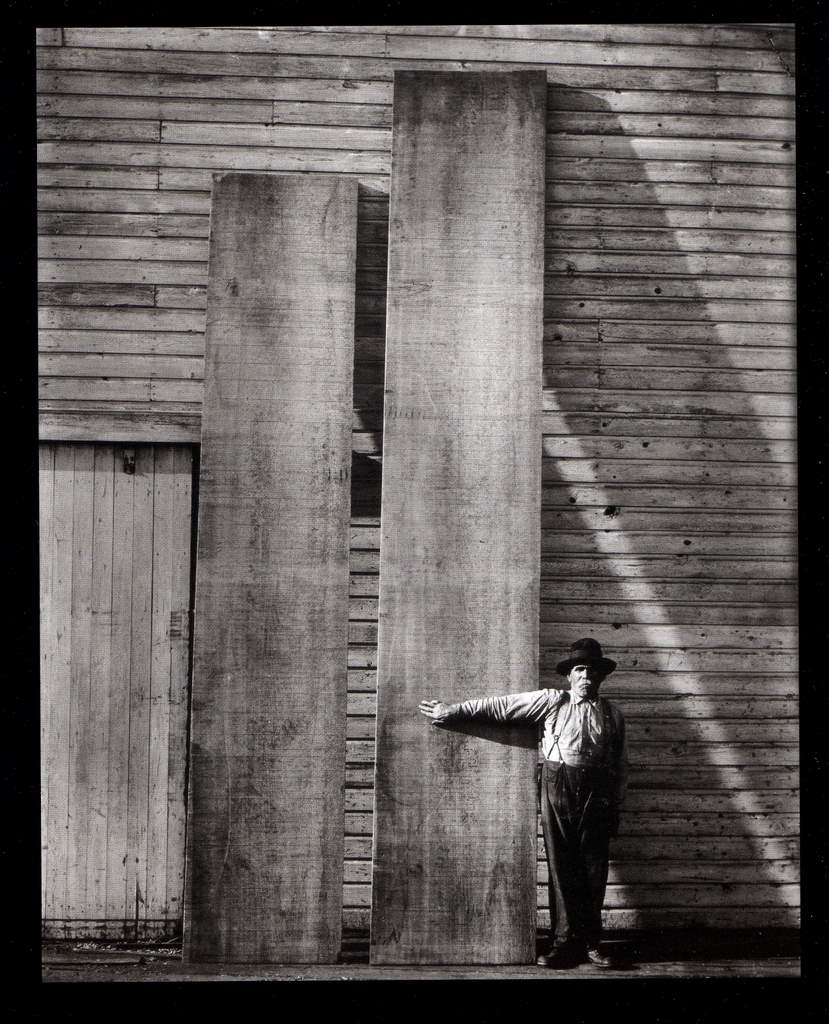
This splendid photograph was taken by John Runk¹ in Stillwater, Minnesota on an 8 x 10 plate camera in 1912. I came across it in a book, The Photographer’s Eye written by John Szarkowski. Unless the chap in the hat is unusually short, these pine boards must be around 3 feet wide and 15 – 18 feet long. The saw marks run straight across the boards which made me wonder how they had been cut – not with a circular saw obviously. Were large bandsaws in operation at the beginning of the 20th century?

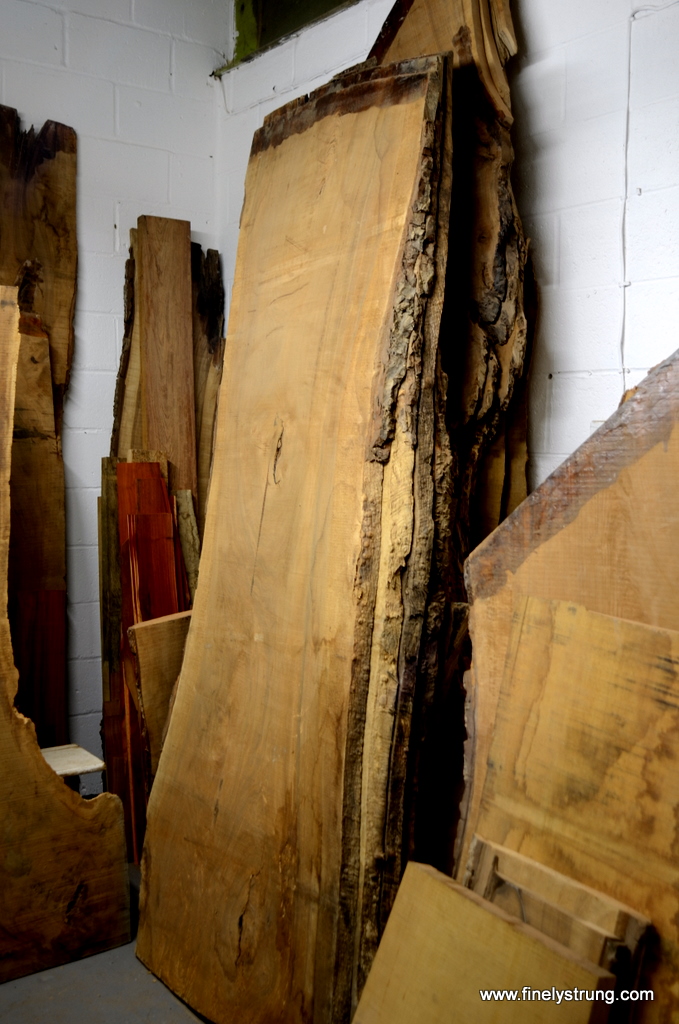
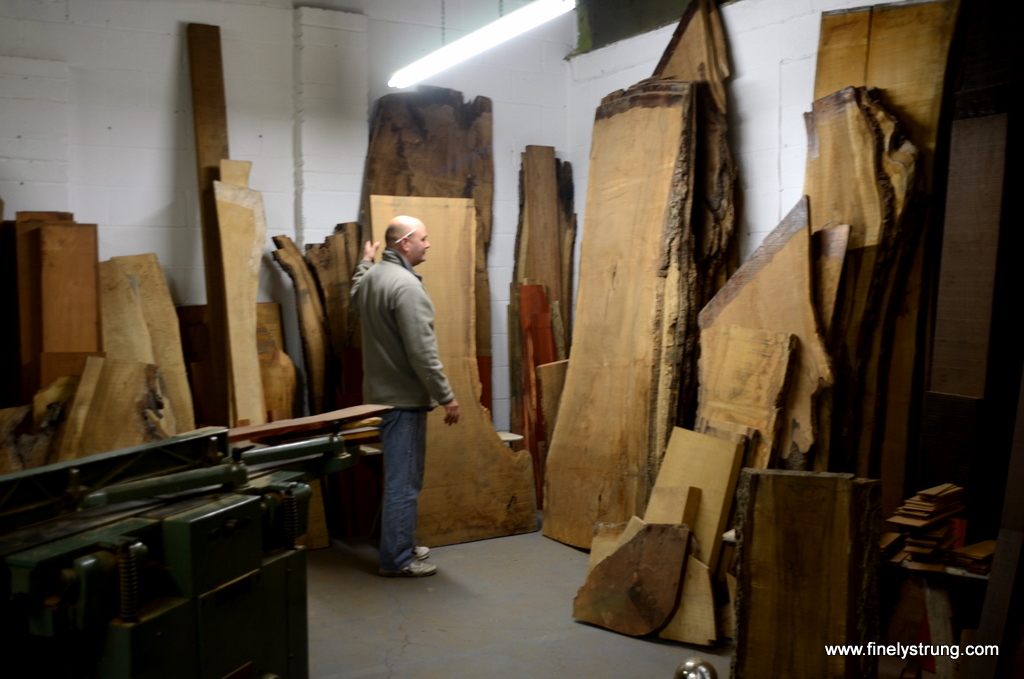
Buying wood a few months ago, I realised that I didn’t know much about modern methods of conversion of timber either. Here are a couple of photographs taken in Andy Fellows’ wood store in Gosport, Hants². He has supplied me with quite a lot of the wood that I’ve used in recent guitars including the Madagascan rosewood for this nylon string guitar and the beautiful walnut for this copy of a 19th century guitar by Panormo. These boards aren’t quite as large as those in Runk’s photograph but they’re still pretty big and I’ve only the vaguest idea of how he goes about transforming them into the book matched guitar sets from which he lets me pick and choose. Next time I visit, I shall try to find out a bit more.

Sometimes, when handing over an completed instrument to its new owner, I catch myself wondering whether they have any idea of the time and trouble that has gone into making it. (Of course, it’s enjoyable time and trouble so I’m not complaining. Even so … ) But I suspect that instrument makers and woodworkers aren’t any better. When we buy wood we’re more likely to whinge about the price than to acknowledge the efforts and skills of the people who selected the log and converted it into sets of conveniently workable dimensions like those below.

1. There’s a brief biography of John Runk here.

2. Andy Fellows also sells wood at his on-line shop, Prime Timbers.

Having established, to my own satisfaction at least, that it would be asking for trouble to make a steel string guitar without a truss rod, the next question was which type to use and whether to arrange to get access to it at the top of the neck or the heel.

My friend Peter Barton, who makes beautiful steel string guitars in Yorkshire, recommended the Hotrod, which is a 2 way adjustable truss rod available from Stewart-MacDonald and looks like this.

But there were a couple of reasons why I had misgivings about this device. One was that it weighs over 100g and I thought it might make a small or medium sized instrument too heavy in the neck. The other was that it’s 11 mm deep and, although it would be easy to rout a deep enough slot to accommodate it, there wouldn’t be room to glue a fillet over it. The top of the slot would have to be covered by the bottom of the fingerboard and I worried that, when the rod was tightened up it might split the fingerboard or cause a bump.

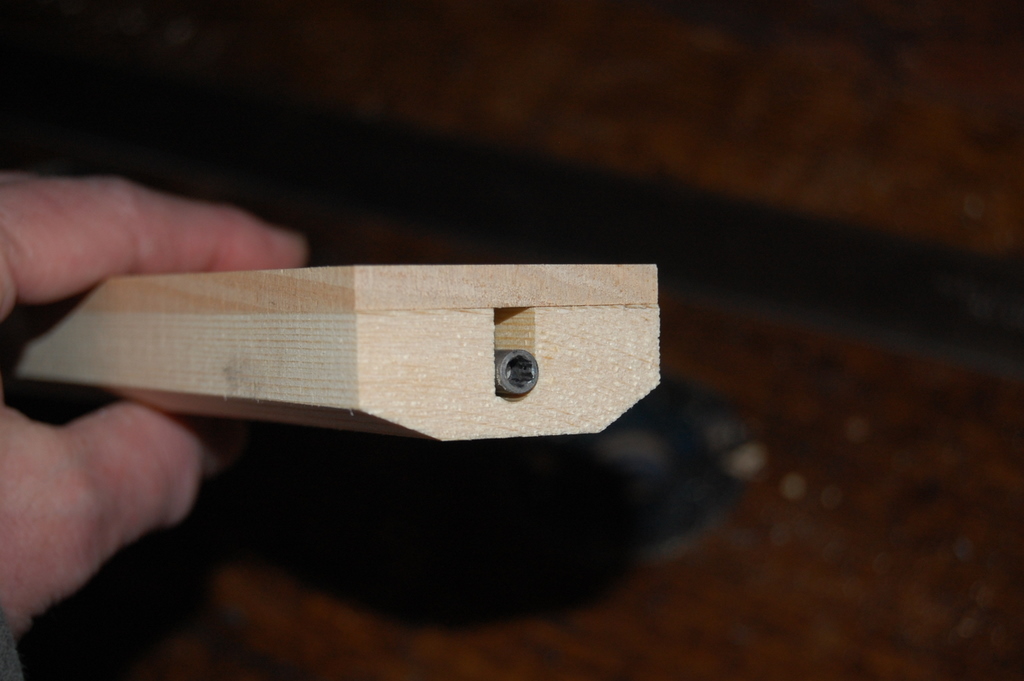
To check, I made a model guitar neck out of a scrap of softwood, routed out a slot, installed the hotrod, glued on a pine ‘fingerboard’ and tightened up the trussrod as hard as I could.

It worked fine. My anxieties were unfounded: no splits or bulges in the fingerboard, even though it was made of nothing more substantial than cheap pine, and I could put a curve in the neck in either direction.

Still, there’s no getting away from that fact that it’s heavy.

An alternative, which is less than half the weight of a hotrod, is a simple tension rod. This what’s recommended by Jonathan Kinkead in his book Build your own Acoustic Guitar (ISBN 0-634-05463-5), where he gives instructions how to make and install it. I liked this idea because of its simplicity and light weight, and because it’s easy to arrange to adjust it through the soundhole, which means that there’s no need to excavate the headstock to provide access to the nut.

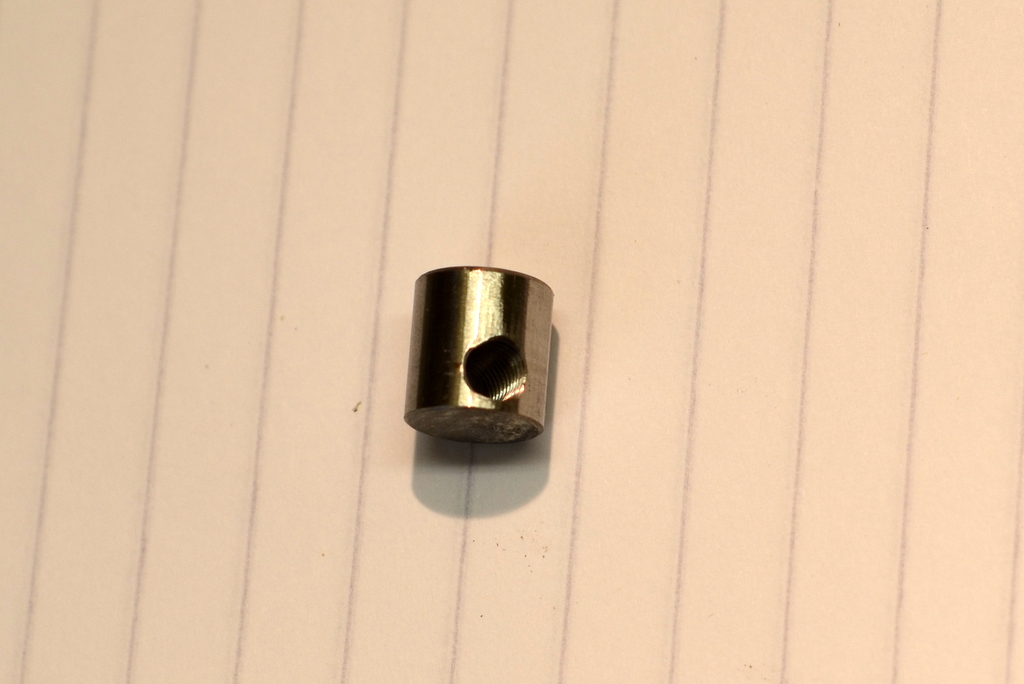
If you go for this solution, you have to find a way to anchor the rod at the top of the neck. Kinkead recommends a metal dowel tapped to receive the threaded end of the rod. I made one out of silver steel and repeated the earlier experiment.

It’s easy to install, although it’s important to judge the depth of the hole for the dowel accurately to avoid drilling right through the neck.

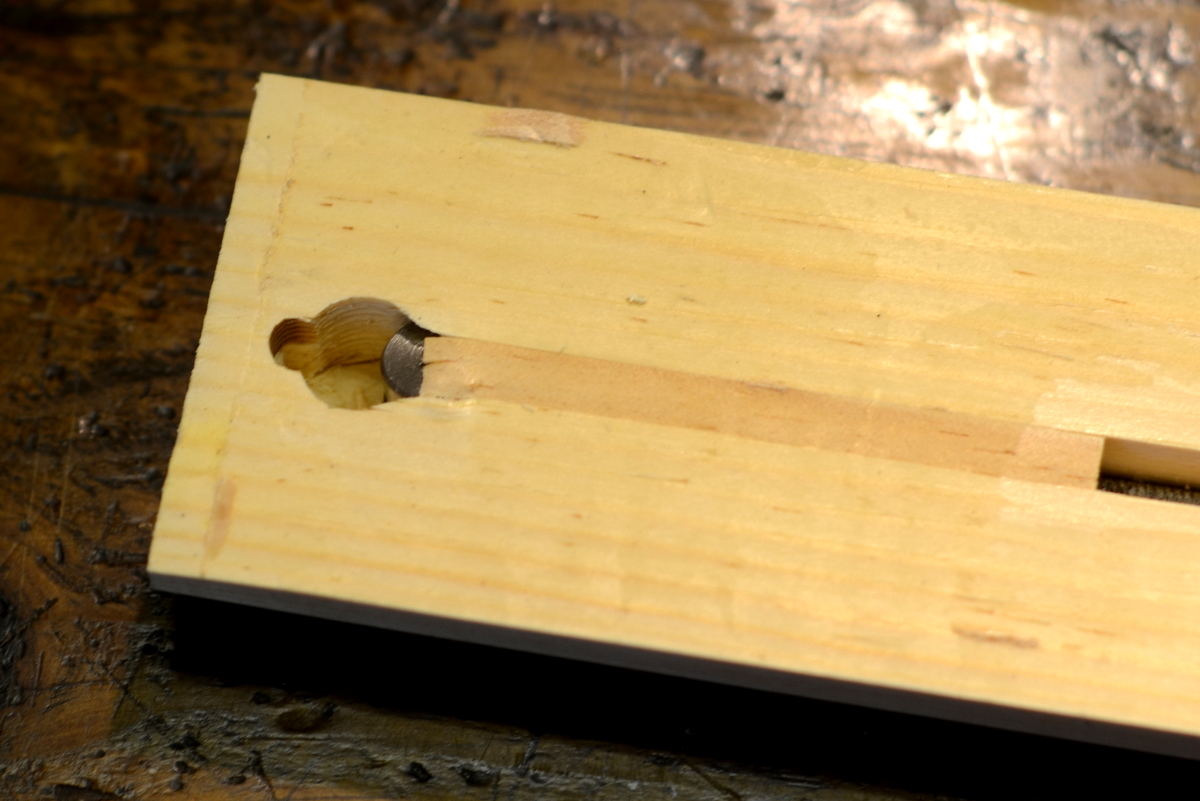
And it seemed to work OK too, although obviously it’s only able to bend the neck in one direction. However, when I took the fingerboard off, this is what I saw.

The fixing at the top end of the neck had been pulled out of its cavity and had begun to travel down the neck. Of course, this experimental neck is made of softwood and the problem might be less severe in a real mahogany neck. Even so, I thought there had to be a better solution.

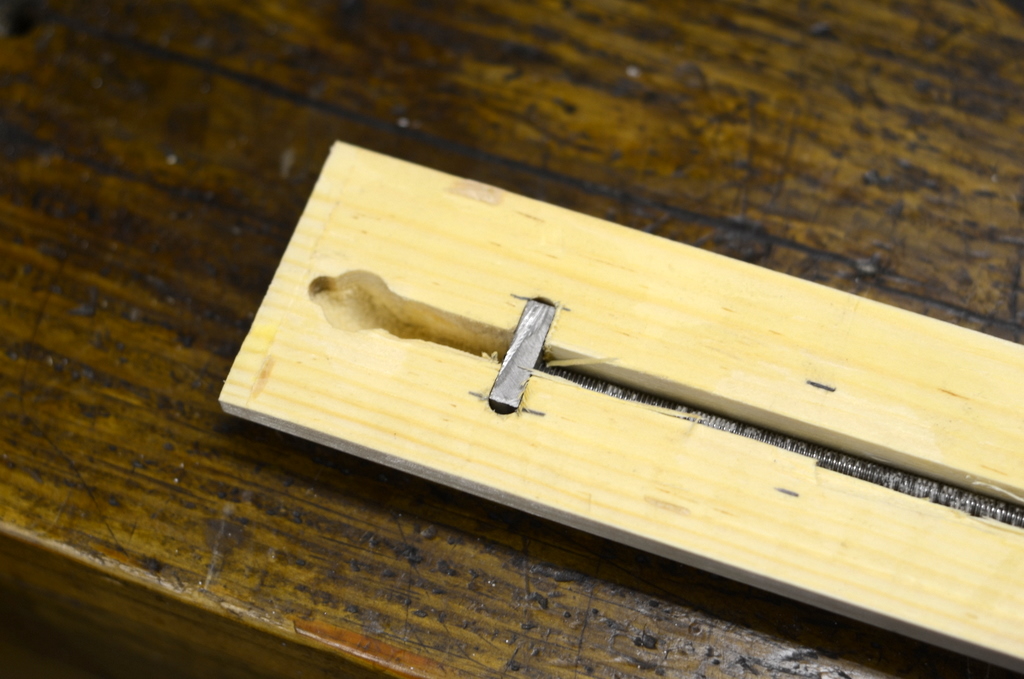
It was the shape that was wrong. The cylindrical nut had acted a bit like a wedge. When I made a rectangular shaped nut out of mild steel, it stayed put.

As you can see, the first nut was unnecessarily wide. A narrower version worked just as well.

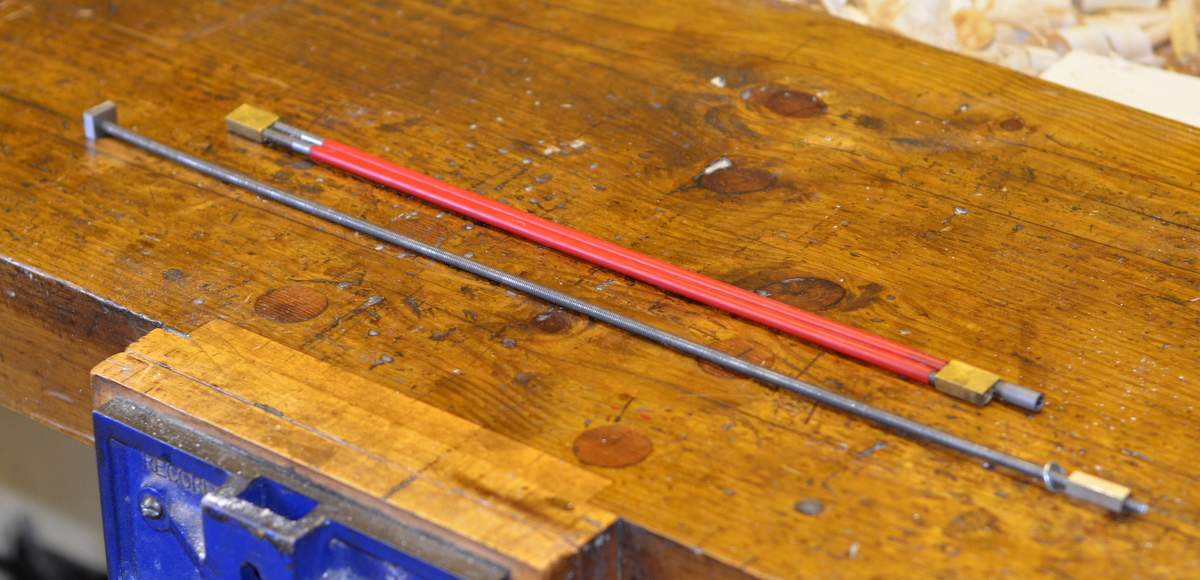
That’s what I decided to use in this guitar: a tension rod made of 5mm studding, anchored at the top of the neck with a square nut and adjusted through the soundhole. The nut at the top of the neck was silver soldered to the studding to prevent it moving during any adjustments at the lower end. Tension in the rod is controlled by turning a 5mm column hex nut bearing on a substantial washer at its lower end.

This arrangement worked well in the finished instrument and was more than powerful enough to keep the neck straight against the pull of the strings. Next time I make a steel string guitar, I shall be tempted to use 4mm studding instead of 5mm, which would mean even less weight in the neck.

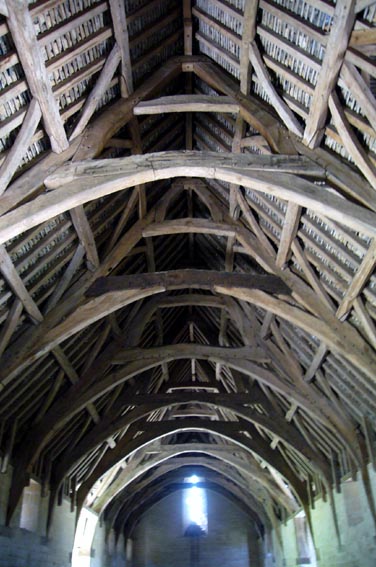
As you’ll have gathered from my last post, I’ve been making a steel string guitar recently. That’s something I hadn’t done for a long time, and it got me thinking about truss rods. One puzzle is how they got their name. Doesn’t the word truss conjure up something like the Forth bridge or the roof structure of this magnificent medieval tithe barn¹?

Wikipedia says that, used in an engineering context, a truss is a structure comprising one or more triangular units constructed with straight members whose ends are connected at joints referred to as nodes. So it’s surely an exaggeration to call a rod in the neck of a guitar a truss. Still, it’s not seriously misleading and I expect that most readers will think I’m quibbling.

Another puzzle surrounds the purpose they serve. As far as I know, no classical guitar maker finds them necessary. So why is it that steel string guitar makers never build a guitar without one? The straightforward answer is that steel strings exert more tension when tuned up to pitch than nylon strings and that a truss rod is necessary to counteract this extra force.

But I wondered if this explanation really held water. Using information provided by d’Addario, a reasonable estimate of the combined tension of 6 nylon guitar strings is about 40 kgs, while 6 steel strings exert nearly double that at 70kg. A load of 70 kgs certainly sounds a lot – the weight of an adult man – but don’t forget that it’s acting at a mechanical disadvantage when it comes to bending or breaking the neck of a guitar. The pull is only a few degrees away from parallel to the neck’s longitudinal axis and the compressive forces will be substantially greater than the bending forces.

Using simple beam theory, I made some rough calculations to get a sense of how much the string tension of a steel string guitar would bend the neck. These calculations didn’t attempt to take the taper of the neck into account – I simply pretended that the dimensions of the neck at the first fret remained constant all the way along the neck until it joined the body of the guitar – and they ignored the fact that the fingerboard and the neck are of different woods that have different material properties. (More details of the calculation are given at the end of this post in a footnote, if anyone is interested enough to check².)

The answer turned out to be that, tuned up to pitch, string tension would deflect the nut end of the neck about 1.6 mm forwards of its unloaded position. Although this is bound to be an over-estimate (because the calculation neglected the stiffening effect of the fingerboard and the increasing dimensions of the neck as it descends), I was surprised how large the deflection was. And I wondered if I’d got something seriously wrong. To check, I made a primitive model of a guitar neck to make some actual measurements. As you can see in the photographs below, the experimental neck is smaller in cross section than a real neck but it’s modelled realistically with an angled headstock and nut. Loaded with a 14lb weight, I measured a deflection of 1.47 mm at the nut, which compared fairly well with a theoretical value of 1.26mm derived using the dimensions of the model neck. So I’m moderately confident that my calculations for a real guitar neck aren’t too far out.

It looks as if the obvious answer is at least partly right. You almost certainly do need a truss rod to counteract the bending effect of string tension on the neck of a steel string guitar.

I suspect there’s another reason for truss rods too, and that is to prevent creep. Wood that bears a constant load for a long period tends to deform gradually even when the load is far short of its breaking strain. This is the reason why the ridges of old roofs tend to sag in the middle. In his book, Structures, J E Gordon explains that it’s also the reason why the Ancient Greeks took the wheels off their chariots at night. The wheels were lightly built with only 4 spokes and a thin wooden rim. If left standing still for too long, the wheels became elliptical in shape.

So perhaps I’ve ended up proving something that most guitar makers knew already. However, I don’t feel that the exercise has been a complete waste of time. Musical instruments shouldn’t contain anything that isn’t either necessary or beautiful. Since truss rods certainly don’t fit into the latter category, it’s good to know that they qualify for the former.

Footnotes

1. Thanks to Kirsty Hall for the image of the tithe barn.

2. Details of calculation of neck deflection.

Neck: width = 44mm; depth = 21.5mm; length (to 14th fret) = 355mm
Force exerted by string tension = 700 N
Nut taken as being 8mm above centroid of neck
To work out the area moment of inertia, I assumed that the neck was semi-elliptical in cross section and that the neutral axis ran through the centroid.
Modulus of elasticity of the neck was taken as 10,000 MPa.
Deflection was calculated as Ml²/2EI, where M = moment exerted by strings at the nut, l = length of neck to neck/body join, E = modulus of elasticity of material of neck (taken as 10,000 Mpa) and I = area moment of inertia of neck (assumed to be a half ellipse).

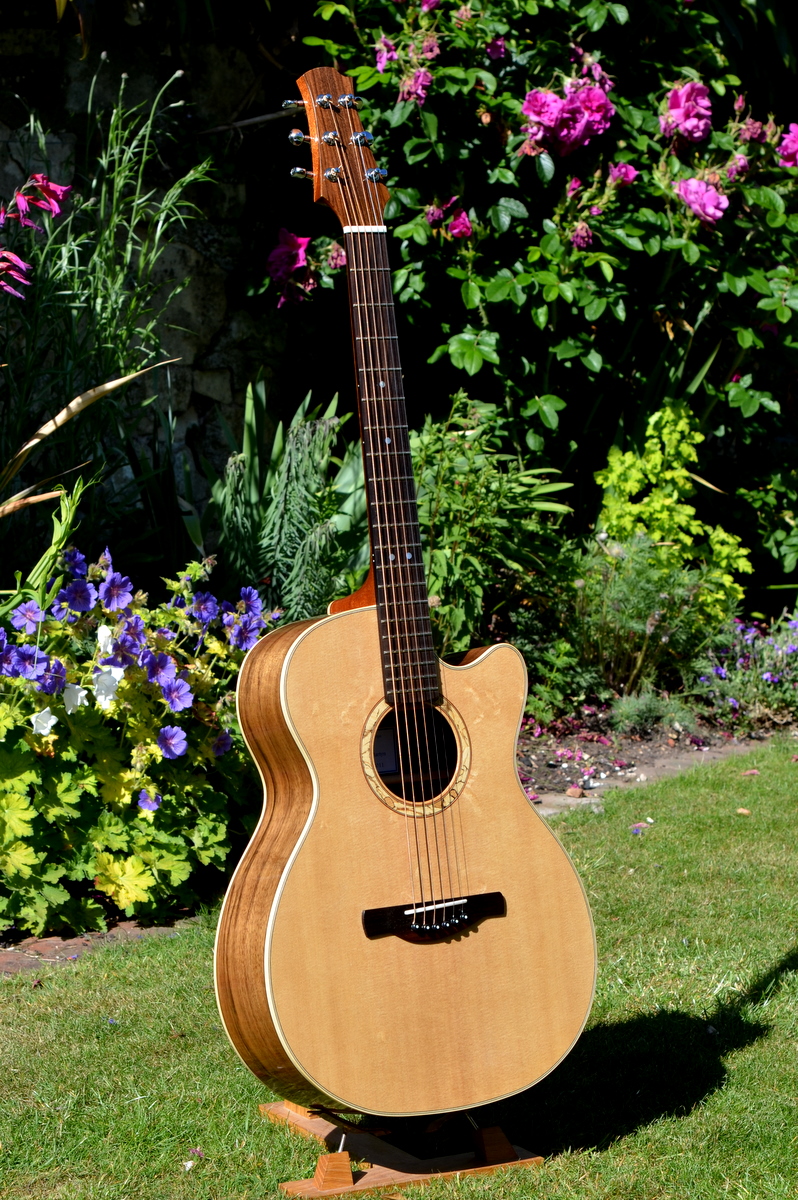
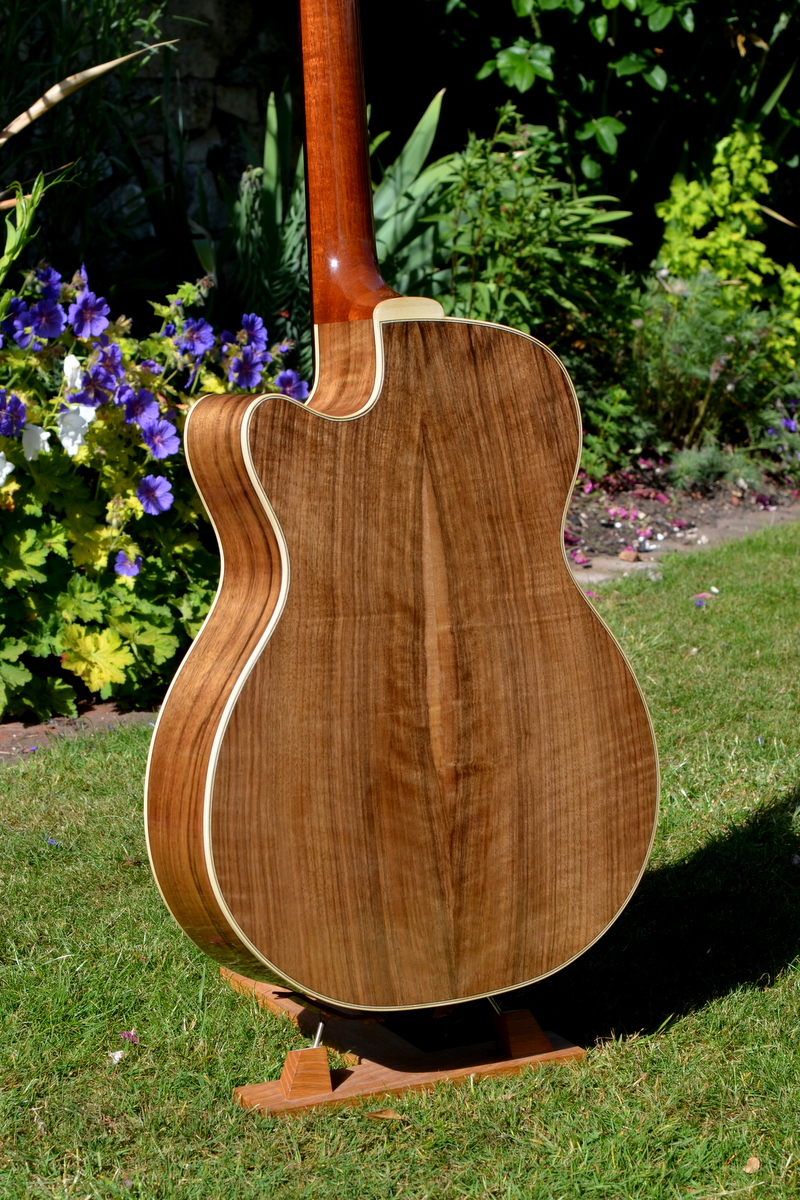
Here are a few photographs of a recently completed steel string guitar. It’s based on a Martin ‘OO’ model but I’ve added, although that’s surely the wrong word, a venetian cutaway. The soundboard is Sitka spruce and the back and ribs are English walnut. I used holly for the bindings and tail stripe, and Rio rosewood for the bridge.


My friend, Dave Crispin, came to the workshop to try it out a few days ago and while he was playing I captured a few moments on an Edirol recorder.


This tool, designed and made by Brian Hart, is a purfling marker. As violin makers will know, when moved around the edge of a violin plate, it marks closely spaced parallel lines a few millimetres inside the perimeter to guide the subsequent cutting and chiselling-out of the narrow channel into which the purfling is laid.

If necessary, the distance between the lines can be altered by placing shims between the marking blades and there’s a screw mechanism to change the offset of the blades and allow precise adjustment of the distance of the purfling channel from the edge of the plate. A feature of the design is that the handle and centre of gravity are below the marking blades. I find that this makes it easier to use than the usual design of purfling marker, which has the handle on top.

Here’s the corner of a cello where the purfling was marked out using this tool.

But of course it only works where there’s an edge. It’s no use if you want to imitate the Brescian makers and create an elaborate pattern of the sort seen on the violin below.

(I’m grateful to Andrew Sutherland, a violin maker and restorer in Lincoln, for providing this photograph and information about the violin. It was made in Dresden, Germany around 1870. Andrew reckons that the ornamentation was done by a purfling specialist in the workshop where the instrument was made after it had been completed and varnished. There are more photographs here.)


A possible solution occurred to me when I read Jeff Peachey’s description of how he sharpened the tips of a pair of jeweller’s forceps to make a tool to cut thin strips of tissue for book restoration. I wondered if the same idea could be adapted to make a freehand purfling marker.

Here I’ve re-shaped the tips of a pair of stainless steel forceps using a slip stone to create bevels on the inner faces, and drilled and tapped a hole for a small machine screw.

With the addition of a fold of brass shim stock between the blades, the width of the gap between the tips of the forceps can be adjusted precisely.

It works fairly well and can be used either freehand or to scribe around a template. I found it best to make one pass with the marker and then use a knife to deepen the cuts rather than trying to use the forceps to cut deeply. Here are some first experiments.

A little decoration goes a long way and not everyone believes that violins are improved by a double line of purfling and stylised floral motifs. On the whole, I think this ornamentation works better on cellos and viols than it does on smaller instruments. Still, there are times when a flourish is desirable – the fingerboards and tail pieces of baroque violins, for example – so my new purfling marker will probably be used occasionally.

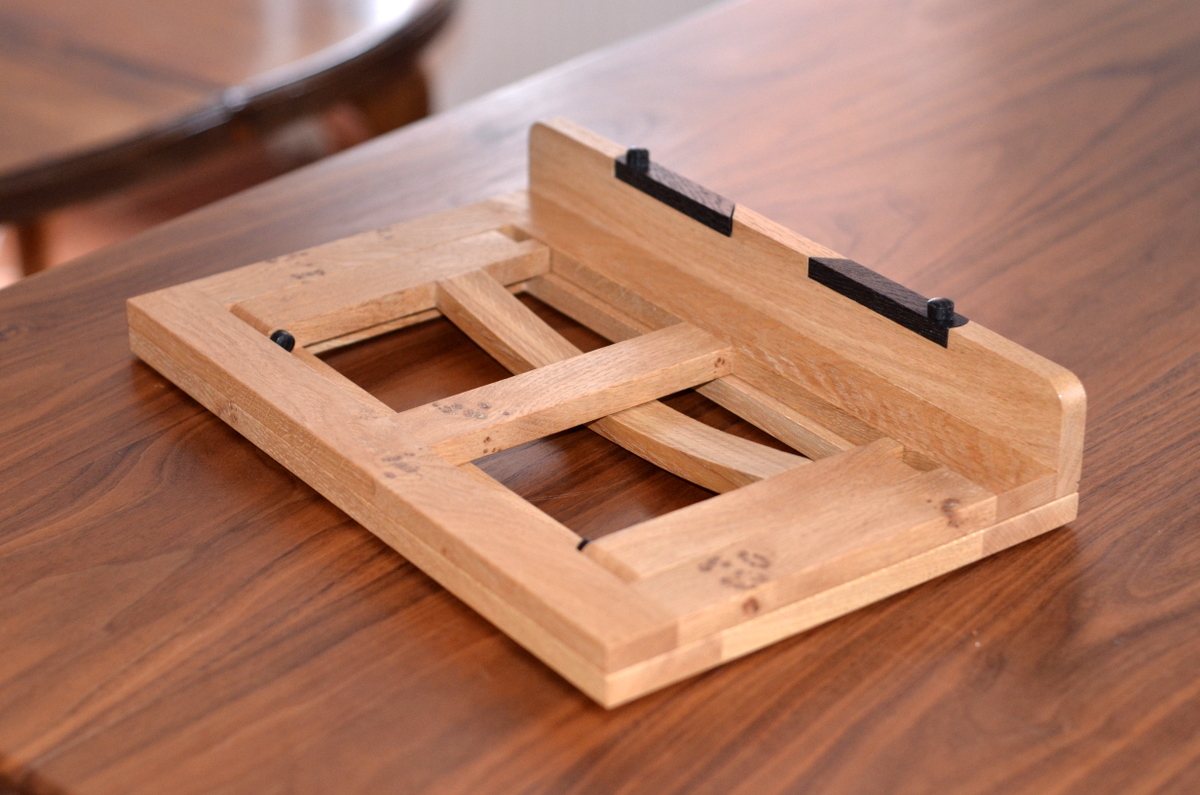
Recent posts have been about experiments or jigs or tools so, to make a change, here’s a folding book (or music) stand in pippy English oak.

I’ve made quite a few of these in various woods and various sizes. After the curves of violins and guitars, it’s a pleasure to make something based on a right angle. They make good presents for musicians and bibliophiles. And people who like to cook find them useful for holding recipe books open.


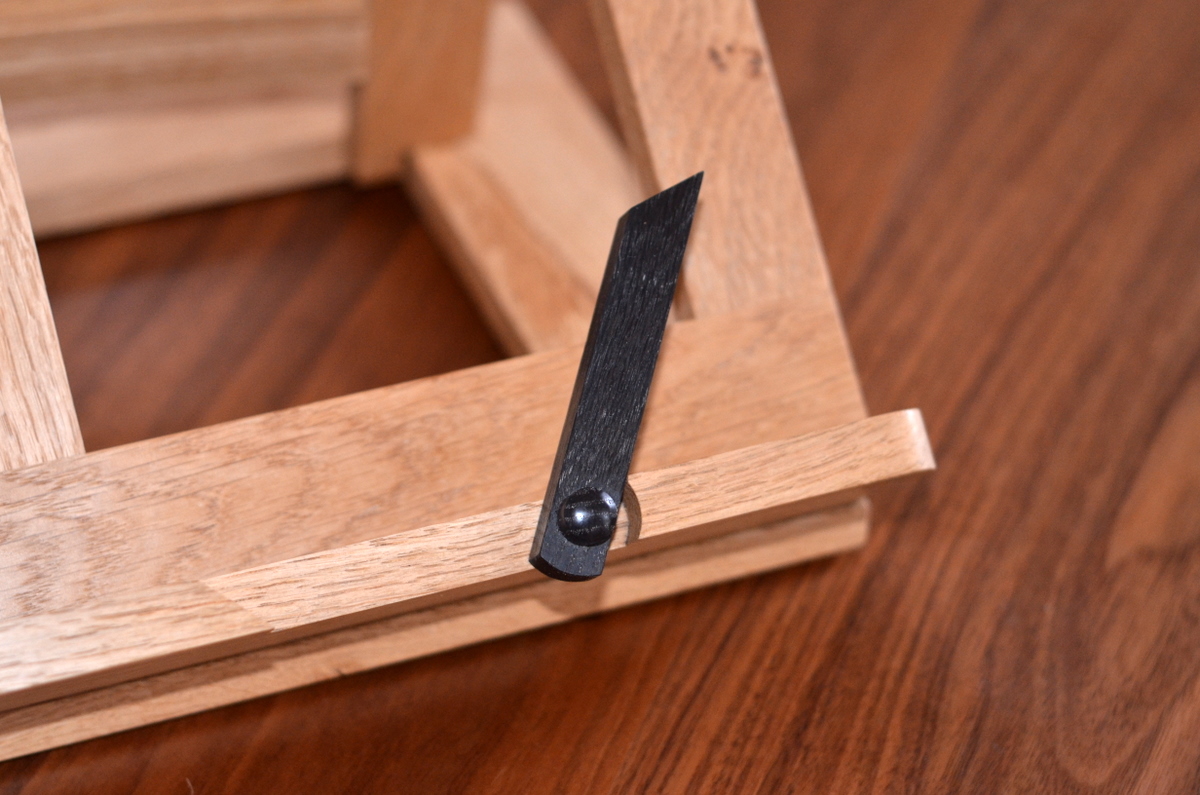
The arms that hold the pages open are in bog oak…


… and so are the dowels which act as hinges for the frame that props the stand open.


Here are a couple more. The one on the left is is sycamore, with page holding arms and dowels of laburnum.


The construction is fairly straightforward. The only tricky bits are in making a neat job where the arms that keep the book open fit into the bottom ledge and in constructing the curved stretcher of the frame that allows the stand to fold up when not in use. I’d be happy to give more details if anyone is interested.

A comment on the previous post asked about setting the honing angle.

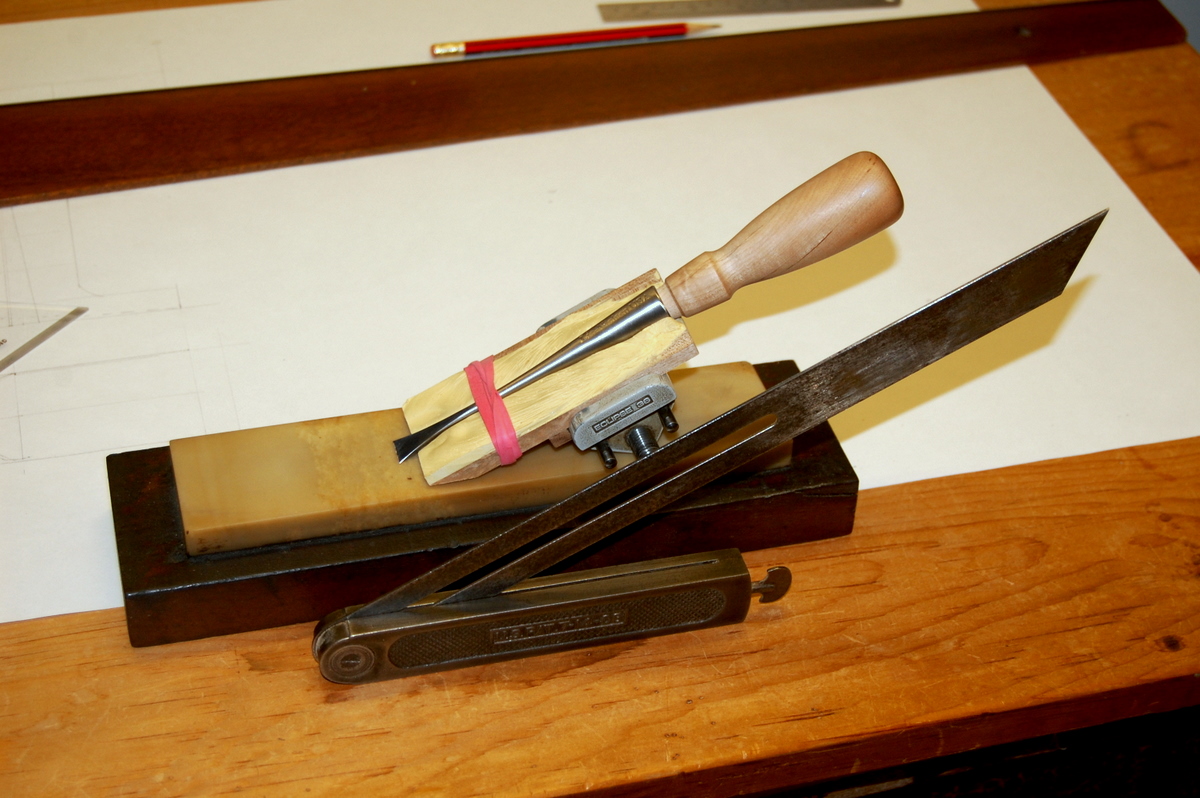
Here’s one way of doing it. Set a sliding bevel to the angle you’re after. (I chose 30°.) Then, after fitting the chisel into the mould, adjust the position of the mould in the honing jig, by eye, so that the longitudinal axis of the chisel runs parallel with the blade of the sliding bevel.


I glued a strip of wood across the underside of the mould so that it can be located in the honing jig at the same angle every time. And that’s it.


Eventually, I suppose, repeated honing will shorten the chisel and increase the angle of the secondary bevel. That will mean that it’s time to regrind the primary bevel and repeat this process to restore the angle of the secondary bevel.

A point I forgot to mention in the earlier post is that it’s worth creating a stop in the moulding at its upper end to prevent any tendency for the chisel to slide up while it’s being honed. Here you can see a stop formed by the lip that mirrors the indentation between the socket and the handle of the chisel.


A pair of chisels reground with left and right skewed edges is almost essential for cleaning out the sockets of lap dovetails. These chisels are useful for other tasks as well – tidying up the inside of the pegbox of a violin or cello, for example. I’ve got several pairs in different sizes and, although I don’t use them everyday, there are jobs where no other tool will do.

Actually, that isn’t quite true. A fishtail chisel makes a good substitute and, because it can work into both left and right pointing corners, you only need one tool rather than a pair. Last Summer, visiting Mark Bennett in his workshop in Yorkshire (see below) I saw him using one made by Lie-Nielsen. It was such an attractive looking tool that, even though I didn’t really need it, I couldn’t resist buying one to try.

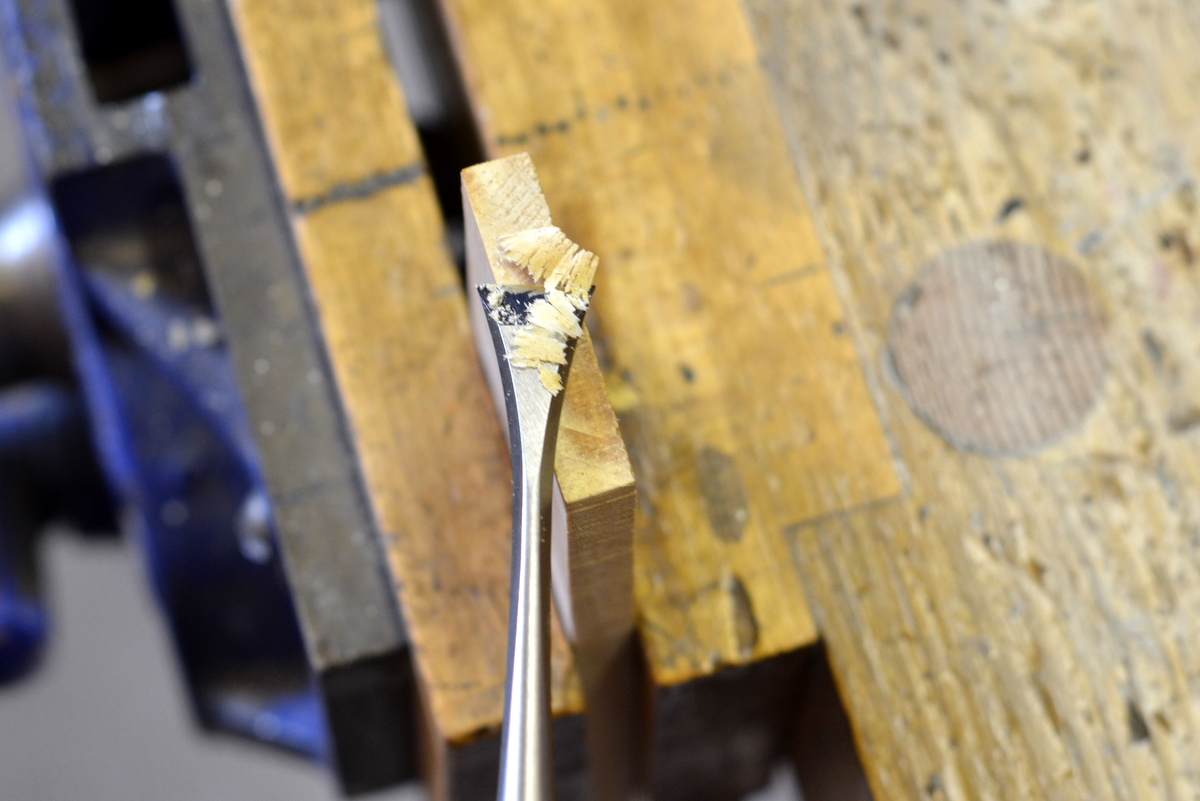
After it arrived, I honed it, maintaining the 25° angle of the original grind. Perhaps it was my lack of skill – keeping such a small bevel flat on the stone wasn’t easy – but I never managed to get it properly sharp. What’s more, the edge that I did achieve didn’t stand up to use on hardwoods.

Of course, there’s an obvious solution to both these problems: create a secondary bevel at a slightly steeper angle. Indeed, Lie-Nielsen recommend exactly that in the leaflet that comes with the chisel.

However, I was reluctant to do this freehand because, although I was sure that it would work well enough the first few times, I knew that in the long run I’d be unable to maintain the same angle. This would mean that I’d end up with a rounded secondary bevel that would require more and more honing with each sharpening to get a decent edge. And, quite apart from the extra time this would take, it’s a bad idea to hone or grind a fishtail more than absolutely necessary. There isn’t much metal there in the first place and with each grinding the cutting edge gets progressive narrower. 

A honing jig would have solved the problem, except for the fact that I couldn’t make  the conical shape of the shaft of the tool  fit securely into any of the jigs in my workshop.

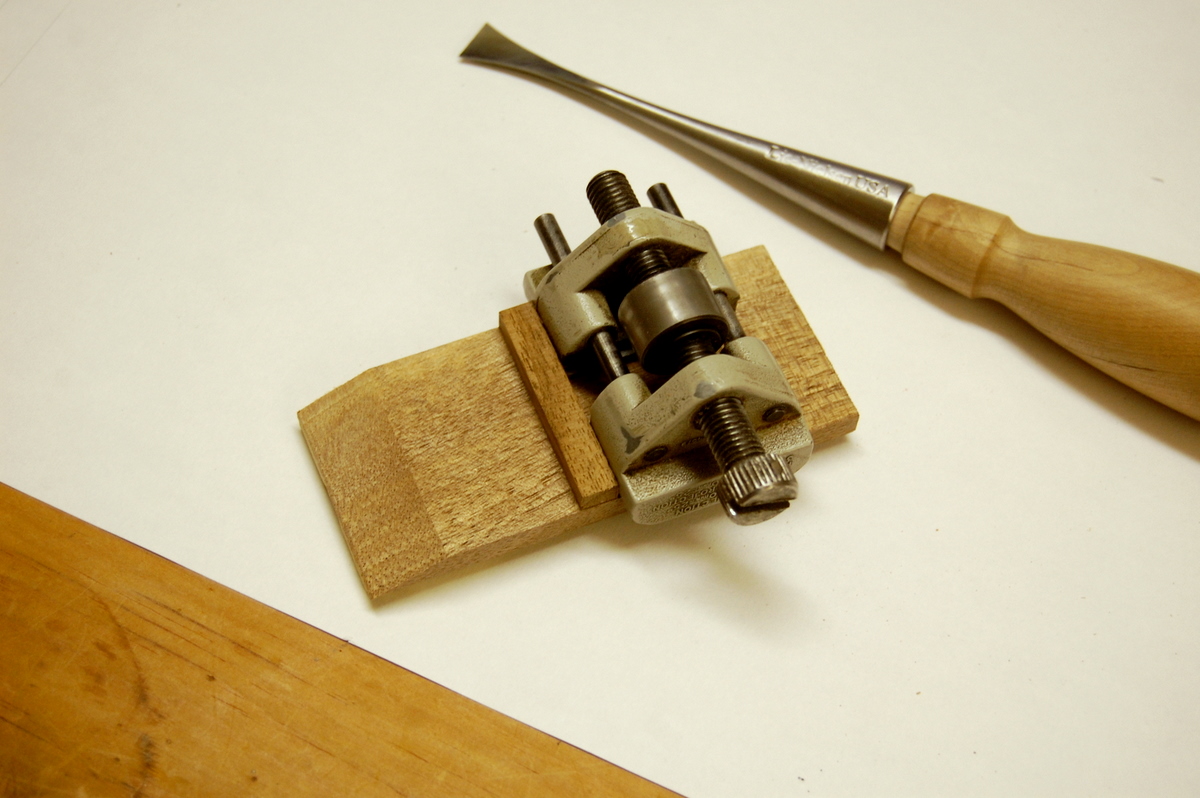
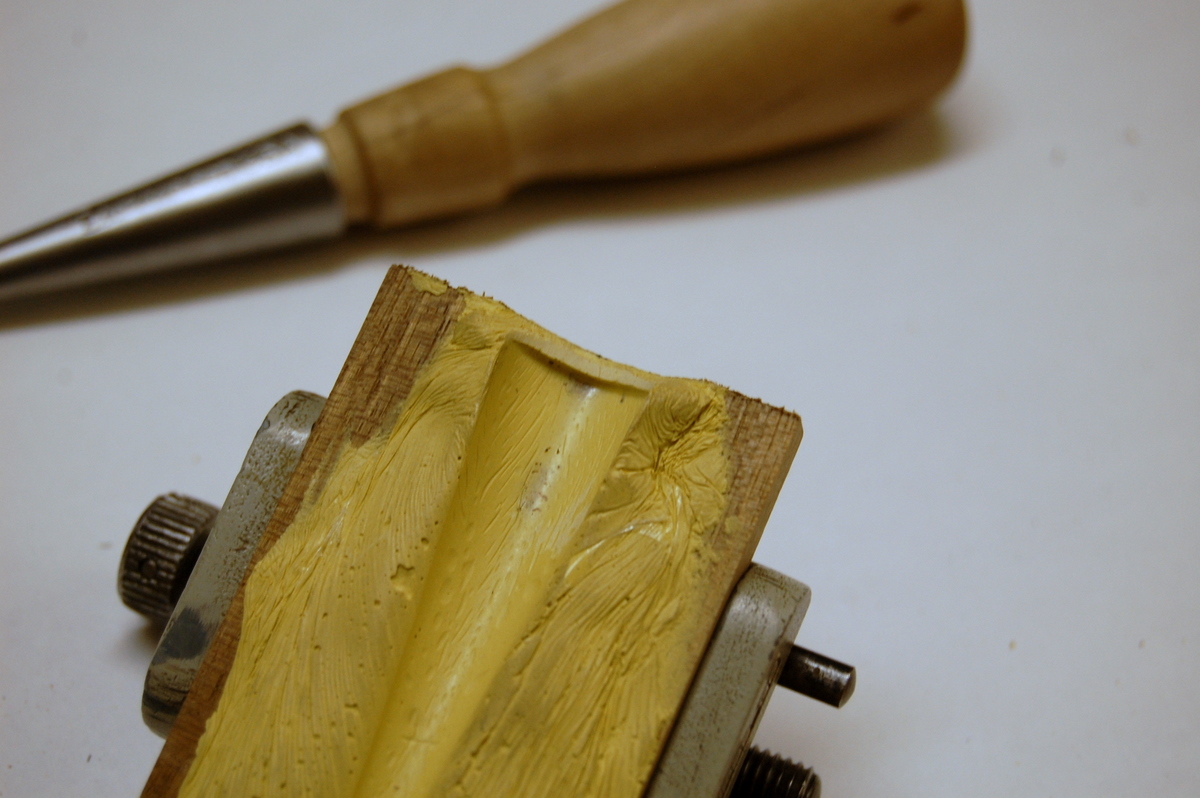
In the end, I got around this difficulty by casting a mould out of the sort of two-part wood filler that sets hard in about 30 minutes. I’ve written about this technique for holding awkwardly shaped object before (scroll down in the Tools and Jigs section of the website) so I won’t go into it in detail here. But briefly, you mix a generous quantity of the filler, spread it on a board (in this case a thin piece of wood of a size that would fit into an Eclipse honing jig), cover with a layer of cling film, and press the object you want to mould into it, holding it place with a weight or a clamp until the filler sets. Then, of course, you can take it out and get rid of the cling film.

I’m hoping that the photographs below will the idea clear:

And it worked – at least for one of the objectives. The edge on the chisel was keen enough to slice soft paper towel and to pare endgrain.

Whether it will achieve the second objective of minimising attrition of the blade with repeated sharpenings is another matter. Time will tell.

A couple of years ago, I wrote about a simple device that made it easy to plane a taper on small pieces of wood – something that’s hard to do accurately if you try to hold the wood in a vice. (The piece is still available in the Tools and Jigs section of the website.) After I’d posted it, Jeff Peachey, who specialises in the conservation of books, sent me a photograph of a rather similar jig that he had made, which had the advantage of an adjustable endstop. I’ve been meaning to incorporate this modification ever since, but have only now got around to it. Below is a photograph of the original jig with a glued endstop of 1.5mm plywood.

To add a adjustable endstop, I inserted two short lengths of 6mm studding, drilling the pilot holes under size and then tapping the holes before screwing in the studding. Because the studs are inserted into endgrain, I was doubtful if they would hold so I glued them in too. And, to be doubly sure, I cross drilled the studs in situ and popped in a nail shank, the end of which is visible on the side of the jig.

Then I cut slots in a small piece of maple to make the endstop and fixed it in place over the studs with washers and nuts.

Here is the modified jig, ready for action.

A worthwhile improvement, I think. It will be possible to match the height of the endstop to the size of the end of the wedge and, should the endstop get damaged, it will be easy to true it up again.

In the meantime, Jeff Peachey has made a much bigger and better device, which is primarily intended for planing thin boards although it can cope with wedges too. There’s photograph of it on his website here.

James Gordon, an engineer, materials scientist and naval architect, wrote two books that I highly recommend. I was about to write …to woodworkers but, actually, I highly recommend them to anyone who has the slightest interest in buildings, ships, aeroplanes or other artefacts of the ancient and modern world. My copies have been read and consulted so often that they’re falling apart. They are The New Science of Strong Materials or Why you don’t fall through the floor (first published in 1968, but still in print: ISBN-13: 978-0140135978) and Structures or Why things don’t fall down (first published in 1978 and also still in print: ISBN-13: 978-0140136289). Both are written for a non-expert readership and there’s very little algebra or mathematics. They’re fun too: Gordon writes clearly, wears his learning lightly and the text is spiced by his whimsical sense of humour.

The New Science of Strong Materials has many interesting things to say about the properties of wood and why it’s such a wonderful and versatile material. There’s stuff about how wood is able to cope with stress concentrations and limit crack propagation, about how glues work, the distribution of stress in a glued joint, and many other things of deep background interest, if not of immediate practical significance, to people who use timber.

The second book, Structures, is equally gripping. It explains how medieval masons got gothic cathedrals to stay standing, why blackbirds find it as much of a struggle to pull short worms out of a lawn as long ones, and the reason that eggs are easier to break from the inside than the outside. Of more direct relevance to woodworkers is its straightforward account of how beams work – which means that, if you’re thinking of making something like a bed or a bookcase, you can calculate whether the dimensions of the boards that you’re planning to use are up to the load they will have to bear, which is obviously useful in making sure that your structure is strong and stiff enough.

Slightly less obviously, it’s also helpful in giving you the confidence to pare down the amount of material that you might otherwise have used. A common fault of amateur woodworkers, it seems to me, is that when designing and making something small, they tend to use wood that is far thicker than it needs to be, which means that the finished object looks heavy and clumsy. Conversely, when making something large, they tend to use wood that is less thick than it should be, and the structure often ends up rickety and unstable.

Knowing a bit about beams might also be advantageous for guitar and violin makers. Here’s an example: take a strut or harmonic bar, rectangular in section, that you’re intending to glue onto the soundboard of a guitar. How is its stiffness related to its shape and its dimensions? What’s the best way to maximise stiffness while minimising weight?

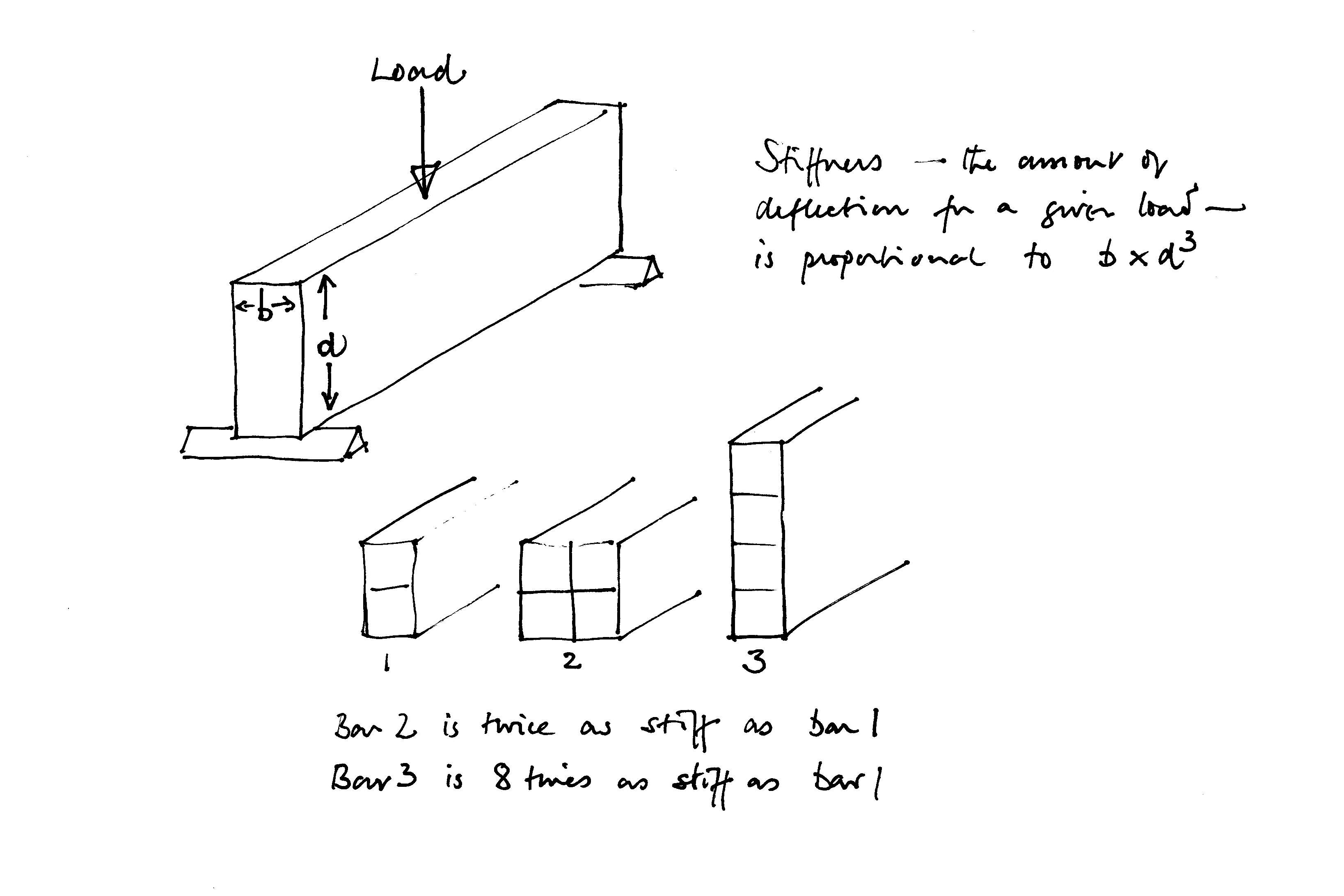
Elementary beam theory tells us that, for a given length, stiffness is proportional to the width of the beam and to the cube of its depth. So if you double the width, the stiffness also doubles. On the other hand, doubling the depth, increases stiffness 8 times. If stiffness is what you’re after, it’s a lot more efficient to make the bar deeper than it is to make it wider.

This cubic relation between depth and stiffness could be something worth keeping in mind when planing down soundboard braces after they’ve been glued. If a brace is, say, 6 mm high to start with, planing it down by 1.5 mm to a height of 4.5mm will reduce its stiffness to less than a half of what it was originally. And shaping the braces to make them triangular or arched in cross section also reduces their stiffness considerably.

Mind you, like so many attempts to understand guitars from a scientific point of view, things rapidly get complicated. A structural engineer with whom I discussed the matter agreed with what I’ve just said about the depth of the beam being a powerful determinant of its stiffness. But he pointed out that where a beam is an integral part of a structure, the stiffening effect is much greater than you would guess from calculations that assume the beam is simply supported at its ends. This is certainly the case of guitars, where the braces are glued to the soundboard along their entire length and clearly count as an integral part of the soundboard structure. In such circumstances, he explained, the overall stiffening effect provided by multiple braces will be large and might well overwhelm the influence of the stiffness of any individual brace.

I thought that this was a very interesting idea and that it might begin to explain why so many different bracing systems work remarkably well. In Roy Courtnall’s book, Making Master Guitars, he give plans of soundboard strutting taken from guitars by a number of famous makers. Superficially they’re fairly similar, all being based on a fan-like pattern of 5, 7 or 9 struts. There are minor variations, of course. Some are slightly asymmetrical, some have bridge plates and closing bars and so on. But the  biggest differences lie in the dimensions of the braces. Courtnall shows a soundboard by Ignacio Fleta that has 9 fan struts and 2 closing bars which are 6mm in depth and an upper diagonal bar 15mm depth. By contrast, a soundboard of similar size by Santos Hernández has only 7 fan struts 3.5mm in depth and triangular in section. Applying simple beam theory would lead one to guess that Fleta’s bracing would add more than 10 times the stiffness that Hernández’s does. But perhaps that’s a misleading way to look at it. If one were able to measure or calculate the stiffness of the whole structure, by which I mean the soundboard with its bracing when attached to the ribs, the difference in stiffness between them might turn out to be much less.

It’s a question that might be tackled by finite element analysis and I’d be glad to hear from anyone who has tried. Some work along these lines has been done on modelling a steel string guitar, which at least shows that the approach is feasible.

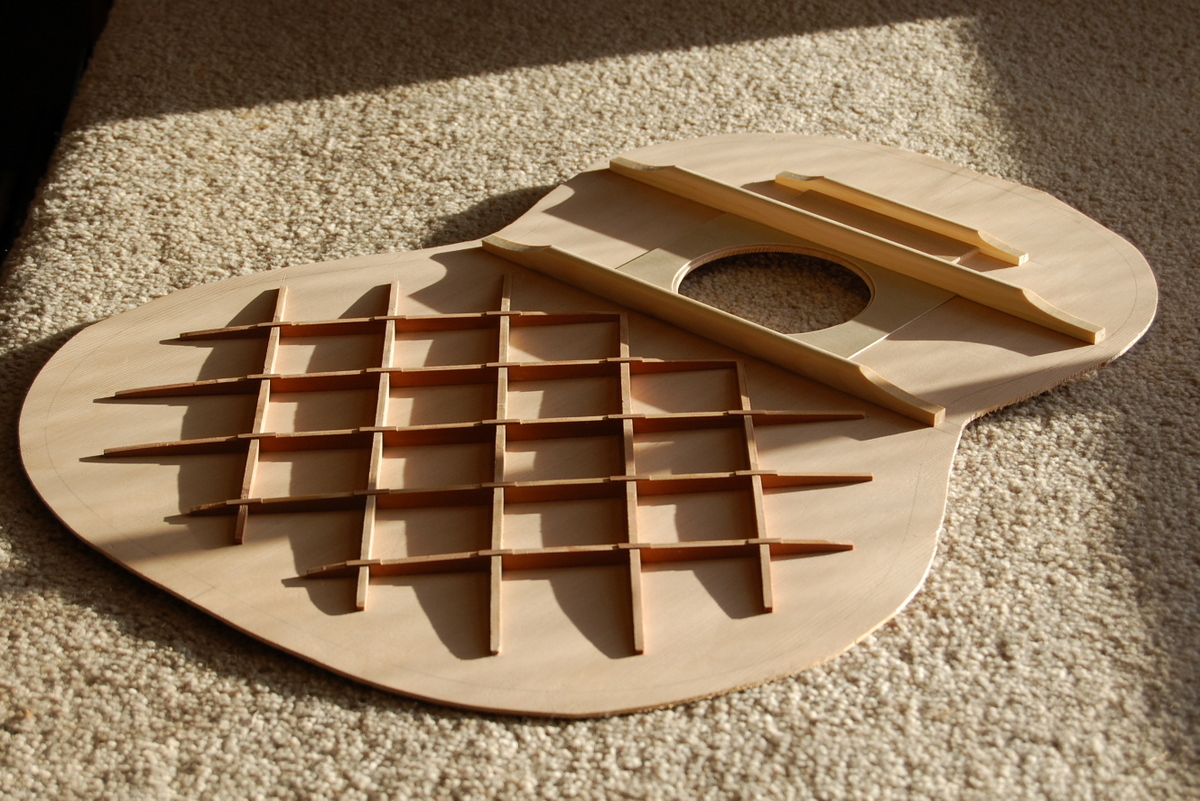
In the meantime, without a proper theory, we’re stuck with the primitive method of trial and error. Below are some of the bracing patterns that I’ve experimented with. All produced decent sounding instruments but I’d be at a loss if I were asked which particular tonal characteristics were produced by each of the different patterns. It may be that William Cumpiano was right when he wrote (in his book, Guitarmaking, Tradition and Technology):

Specific elements of brace design, in and of themselves, are not all that important. One has only to look at the myriad designs employed on great guitars to recognise that there is no design secret that will unlock the door to world-class consistency.

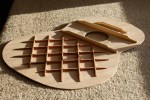
All this means that I’ve been arguing in a circle. Perhaps the conclusion is that beam theory isn’t very useful to guitar makers after all. Still, if you take up the recommendation to get hold of Gordon’s books, the time you’ve spent reading this post won’t have been entirely wasted.