Skip navigation

Category Archives: guitars

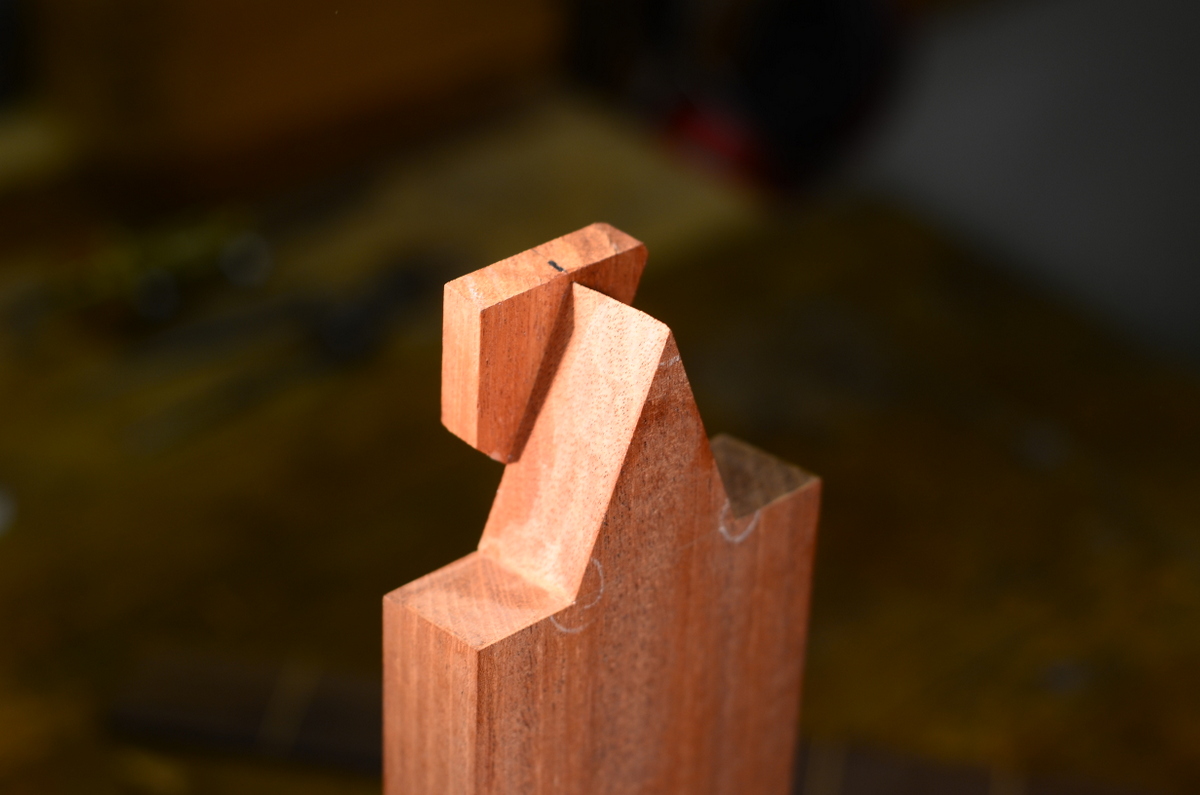
Moving on from my previous post about marking out a V joint, it’s time to cut and trim it to shape.

First, I saw out the V in the headstock, keeping close to the lines but being careful not to saw past them. I try to be brave in sawing up to the line at the narrow end of the V because that’s the hardest part to clean up later.

Next, I stop to put a fresh edge on the chisel that I’m going to use. When it will slice through tissue paper, I reckon that it’s sharp enough.

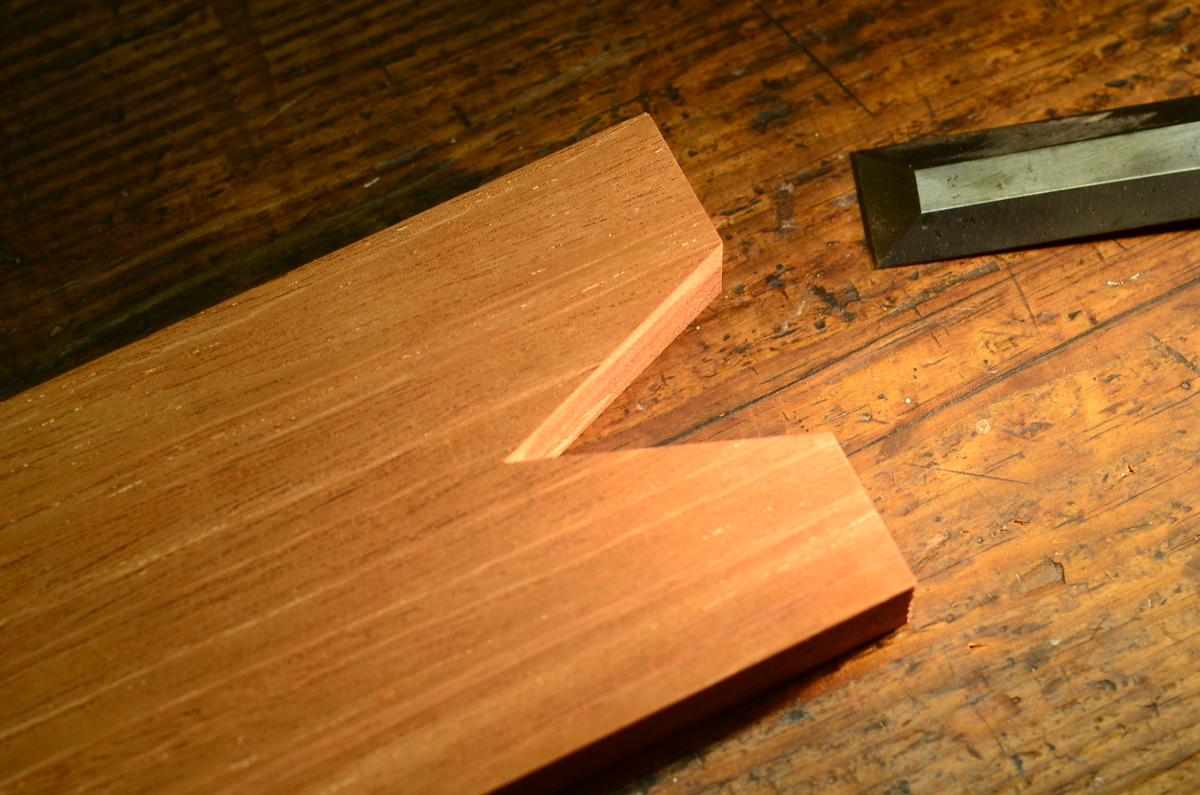
I clean up the V, paring from both sides towards the middle. Final cuts are carried out with the chisel resting in the knife line that marked out the joint. A small square is useful to check that the sides of the V are flat. The most difficult part of the joint is the apex of the V but a slicing cut with the corner of the chisel will remove the last bit of waste.

Here’s the female part of the V joint in the headstock finished. It shouldn’t be necessary to touch it again.

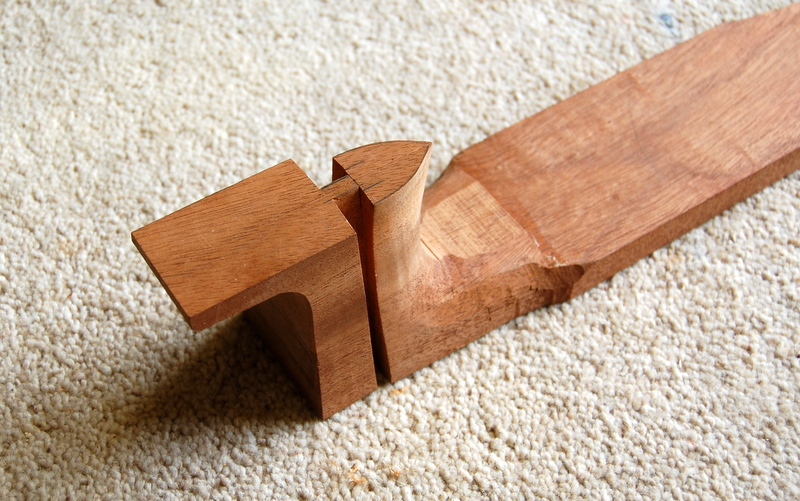
Now I cut the male part of the joint on the neck, starting with the angled shoulders. I chisel out a ramp for the saw in the usual way…

… and then saw down to the V, keeping clear of the lines.

I mark the starting point of the cuts for the sides of the V on the endgrain…

… place the neck in a vise, tilting it so that the cut will be vertical, and …

saw off the sides of the V with a tenon saw.

I mark and keep the pieces that I’ve just sawn off. They’ll be useful later.

Now I clean up the V and its shoulders with a chisel, paring in from both sides as I did for the headstock.

Here it is almost finished.

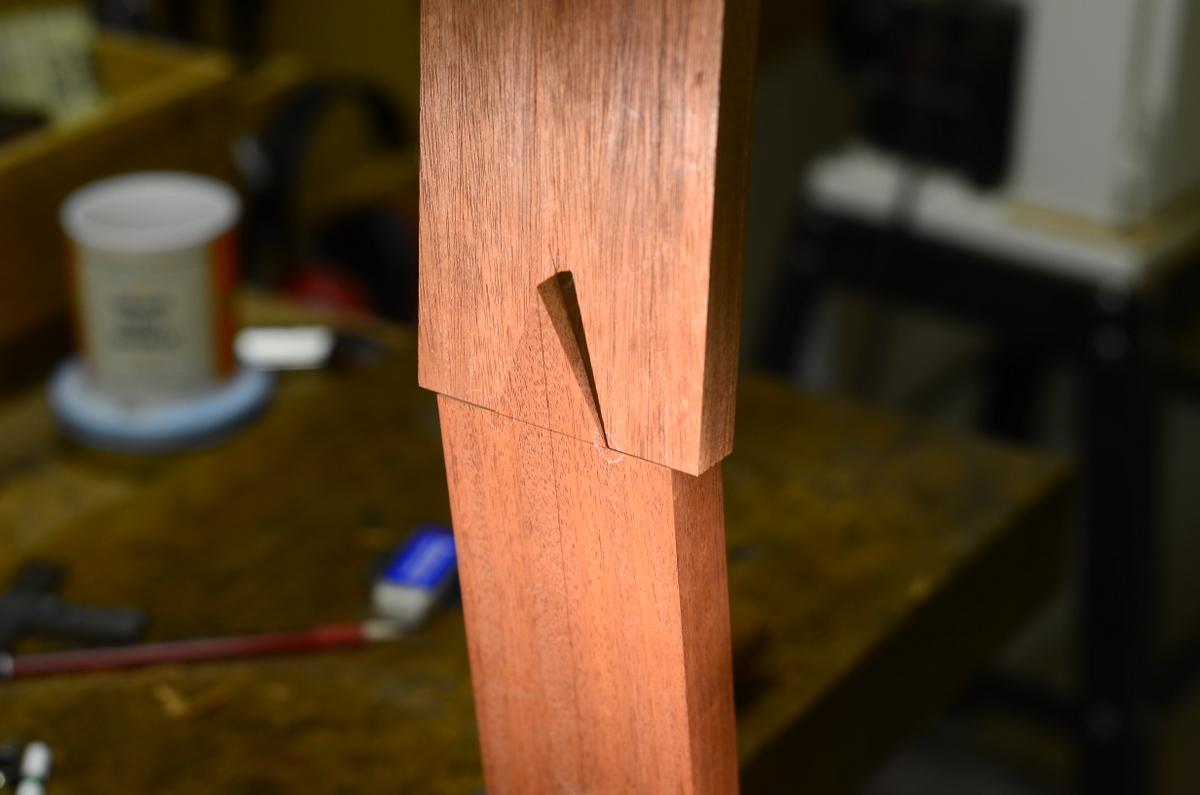
The neck and headstock are now tested for fit. Below is the view from the fingerboard side of the neck.

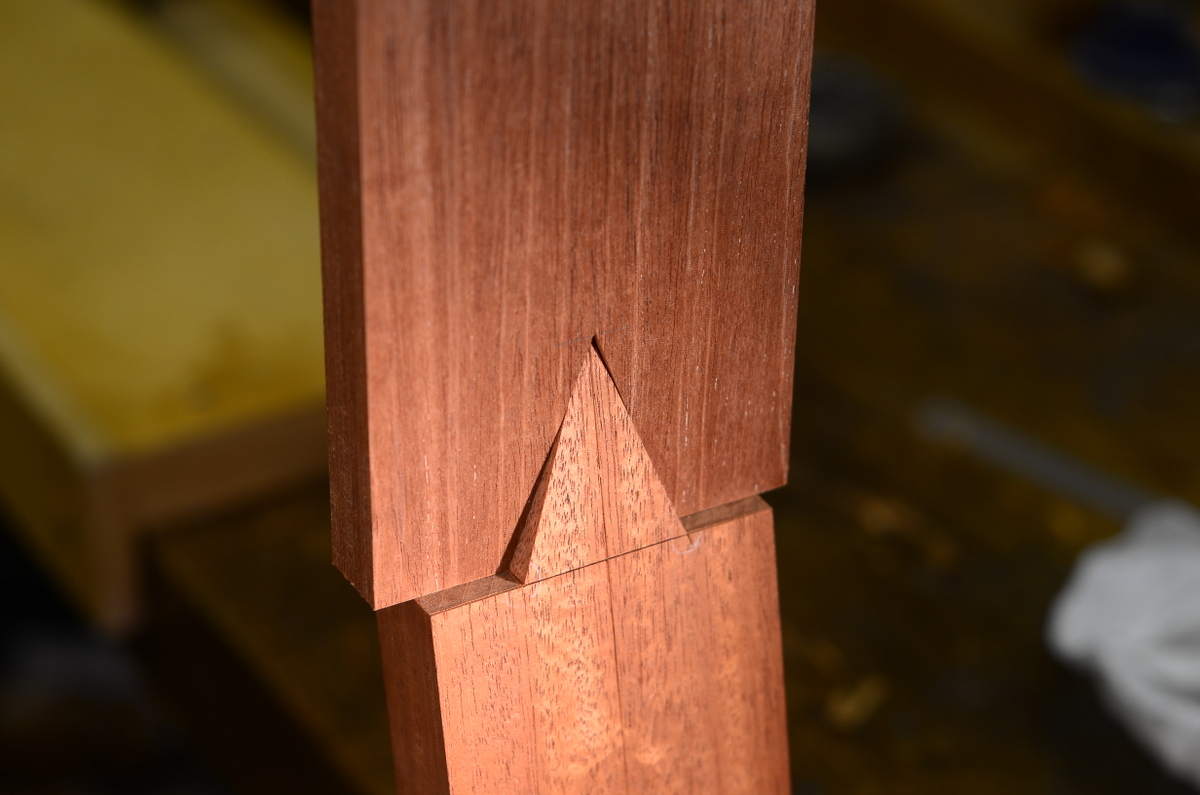
And here’s the view from the back of the neck.

As you can see, there’s a problem at the apex of the V, where a shadow shows that the neck isn’t quite deep enough to fill up the whole of the female part of the joint in the headstock. (My stock of mahogany for necks is planed up at a thickness of 25mm which means that I always run into this difficulty.)

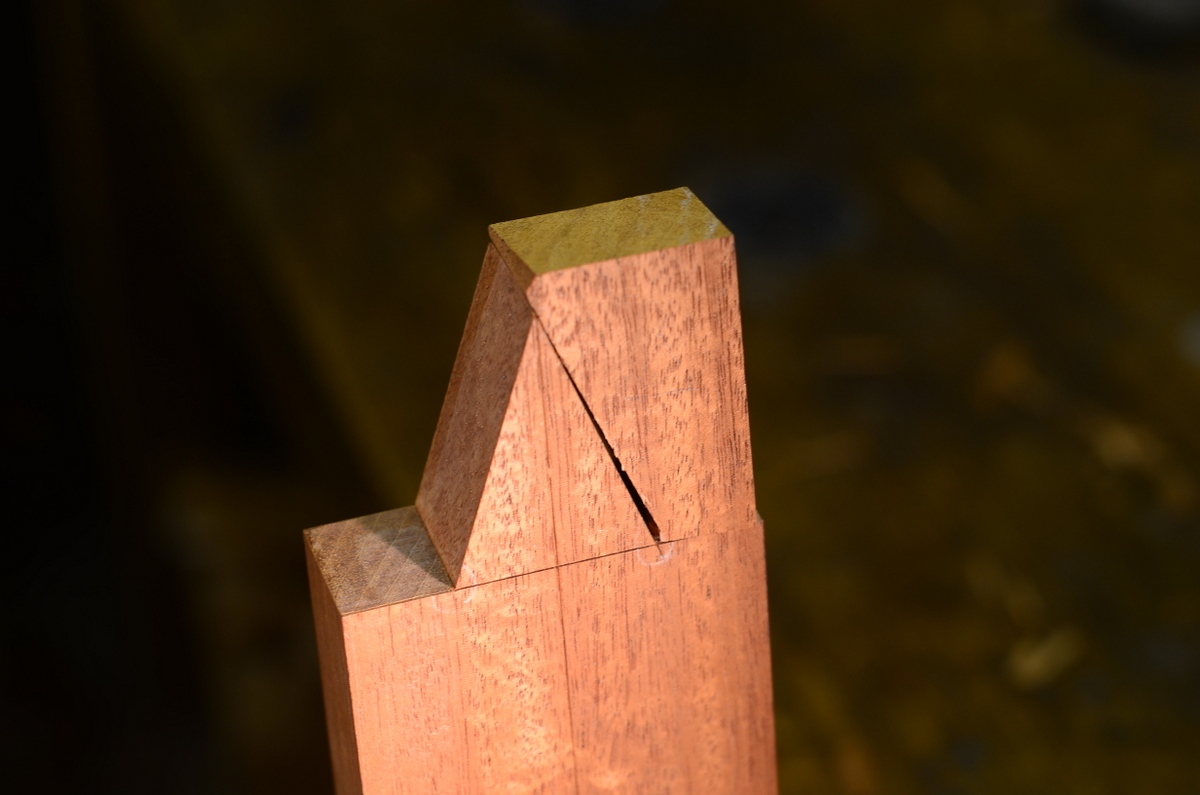
The solution is to add a little extra depth at the apex of the V. This is where the offcuts that I saved come in handy. I prepare a small piece from one of these…

and glue it on, taking care that the direction of the grain in the extra piece is orientated in the same way as the grain of the neck.

When the glue is fully hard…

… it’s sawn roughly to shape…

… and trimmed with a chisel. This addition will be invisible in the completed joint.

The last step is to make sure that everything fits to perfection before glueing up. I’ll discuss how to do that in the next post.

Click on any of the thumbnails below for larger pictures.

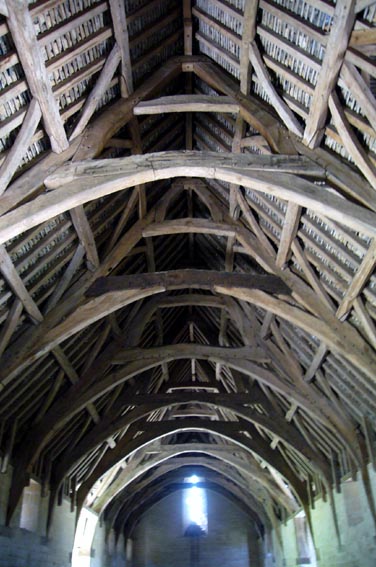
As you’ll have gathered from my last post, I’ve been making a steel string guitar recently. That’s something I hadn’t done for a long time, and it got me thinking about truss rods. One puzzle is how they got their name. Doesn’t the word truss conjure up something like the Forth bridge or the roof structure of this magnificent medieval tithe barn¹?

Wikipedia says that, used in an engineering context, a truss is a structure comprising one or more triangular units constructed with straight members whose ends are connected at joints referred to as nodes. So it’s surely an exaggeration to call a rod in the neck of a guitar a truss. Still, it’s not seriously misleading and I expect that most readers will think I’m quibbling.

Another puzzle surrounds the purpose they serve. As far as I know, no classical guitar maker finds them necessary. So why is it that steel string guitar makers never build a guitar without one? The straightforward answer is that steel strings exert more tension when tuned up to pitch than nylon strings and that a truss rod is necessary to counteract this extra force.

But I wondered if this explanation really held water. Using information provided by d’Addario, a reasonable estimate of the combined tension of 6 nylon guitar strings is about 40 kgs, while 6 steel strings exert nearly double that at 70kg. A load of 70 kgs certainly sounds a lot – the weight of an adult man – but don’t forget that it’s acting at a mechanical disadvantage when it comes to bending or breaking the neck of a guitar. The pull is only a few degrees away from parallel to the neck’s longitudinal axis and the compressive forces will be substantially greater than the bending forces.

Using simple beam theory, I made some rough calculations to get a sense of how much the string tension of a steel string guitar would bend the neck. These calculations didn’t attempt to take the taper of the neck into account – I simply pretended that the dimensions of the neck at the first fret remained constant all the way along the neck until it joined the body of the guitar – and they ignored the fact that the fingerboard and the neck are of different woods that have different material properties. (More details of the calculation are given at the end of this post in a footnote, if anyone is interested enough to check².)

The answer turned out to be that, tuned up to pitch, string tension would deflect the nut end of the neck about 1.6 mm forwards of its unloaded position. Although this is bound to be an over-estimate (because the calculation neglected the stiffening effect of the fingerboard and the increasing dimensions of the neck as it descends), I was surprised how large the deflection was. And I wondered if I’d got something seriously wrong. To check, I made a primitive model of a guitar neck to make some actual measurements. As you can see in the photographs below, the experimental neck is smaller in cross section than a real neck but it’s modelled realistically with an angled headstock and nut. Loaded with a 14lb weight, I measured a deflection of 1.47 mm at the nut, which compared fairly well with a theoretical value of 1.26mm derived using the dimensions of the model neck. So I’m moderately confident that my calculations for a real guitar neck aren’t too far out.

It looks as if the obvious answer is at least partly right. You almost certainly do need a truss rod to counteract the bending effect of string tension on the neck of a steel string guitar.

I suspect there’s another reason for truss rods too, and that is to prevent creep. Wood that bears a constant load for a long period tends to deform gradually even when the load is far short of its breaking strain. This is the reason why the ridges of old roofs tend to sag in the middle. In his book, Structures, J E Gordon explains that it’s also the reason why the Ancient Greeks took the wheels off their chariots at night. The wheels were lightly built with only 4 spokes and a thin wooden rim. If left standing still for too long, the wheels became elliptical in shape.

So perhaps I’ve ended up proving something that most guitar makers knew already. However, I don’t feel that the exercise has been a complete waste of time. Musical instruments shouldn’t contain anything that isn’t either necessary or beautiful. Since truss rods certainly don’t fit into the latter category, it’s good to know that they qualify for the former.

Footnotes

1. Thanks to Kirsty Hall for the image of the tithe barn.

2. Details of calculation of neck deflection.

Neck: width = 44mm; depth = 21.5mm; length (to 14th fret) = 355mm
Force exerted by string tension = 700 N
Nut taken as being 8mm above centroid of neck
To work out the area moment of inertia, I assumed that the neck was semi-elliptical in cross section and that the neutral axis ran through the centroid.
Modulus of elasticity of the neck was taken as 10,000 MPa.
Deflection was calculated as Ml²/2EI, where M = moment exerted by strings at the nut, l = length of neck to neck/body join, E = modulus of elasticity of material of neck (taken as 10,000 Mpa) and I = area moment of inertia of neck (assumed to be a half ellipse).

James Gordon, an engineer, materials scientist and naval architect, wrote two books that I highly recommend. I was about to write …to woodworkers but, actually, I highly recommend them to anyone who has the slightest interest in buildings, ships, aeroplanes or other artefacts of the ancient and modern world. My copies have been read and consulted so often that they’re falling apart. They are The New Science of Strong Materials or Why you don’t fall through the floor (first published in 1968, but still in print: ISBN-13: 978-0140135978) and Structures or Why things don’t fall down (first published in 1978 and also still in print: ISBN-13: 978-0140136289). Both are written for a non-expert readership and there’s very little algebra or mathematics. They’re fun too: Gordon writes clearly, wears his learning lightly and the text is spiced by his whimsical sense of humour.

The New Science of Strong Materials has many interesting things to say about the properties of wood and why it’s such a wonderful and versatile material. There’s stuff about how wood is able to cope with stress concentrations and limit crack propagation, about how glues work, the distribution of stress in a glued joint, and many other things of deep background interest, if not of immediate practical significance, to people who use timber.

The second book, Structures, is equally gripping. It explains how medieval masons got gothic cathedrals to stay standing, why blackbirds find it as much of a struggle to pull short worms out of a lawn as long ones, and the reason that eggs are easier to break from the inside than the outside. Of more direct relevance to woodworkers is its straightforward account of how beams work – which means that, if you’re thinking of making something like a bed or a bookcase, you can calculate whether the dimensions of the boards that you’re planning to use are up to the load they will have to bear, which is obviously useful in making sure that your structure is strong and stiff enough.

Slightly less obviously, it’s also helpful in giving you the confidence to pare down the amount of material that you might otherwise have used. A common fault of amateur woodworkers, it seems to me, is that when designing and making something small, they tend to use wood that is far thicker than it needs to be, which means that the finished object looks heavy and clumsy. Conversely, when making something large, they tend to use wood that is less thick than it should be, and the structure often ends up rickety and unstable.

Knowing a bit about beams might also be advantageous for guitar and violin makers. Here’s an example: take a strut or harmonic bar, rectangular in section, that you’re intending to glue onto the soundboard of a guitar. How is its stiffness related to its shape and its dimensions? What’s the best way to maximise stiffness while minimising weight?

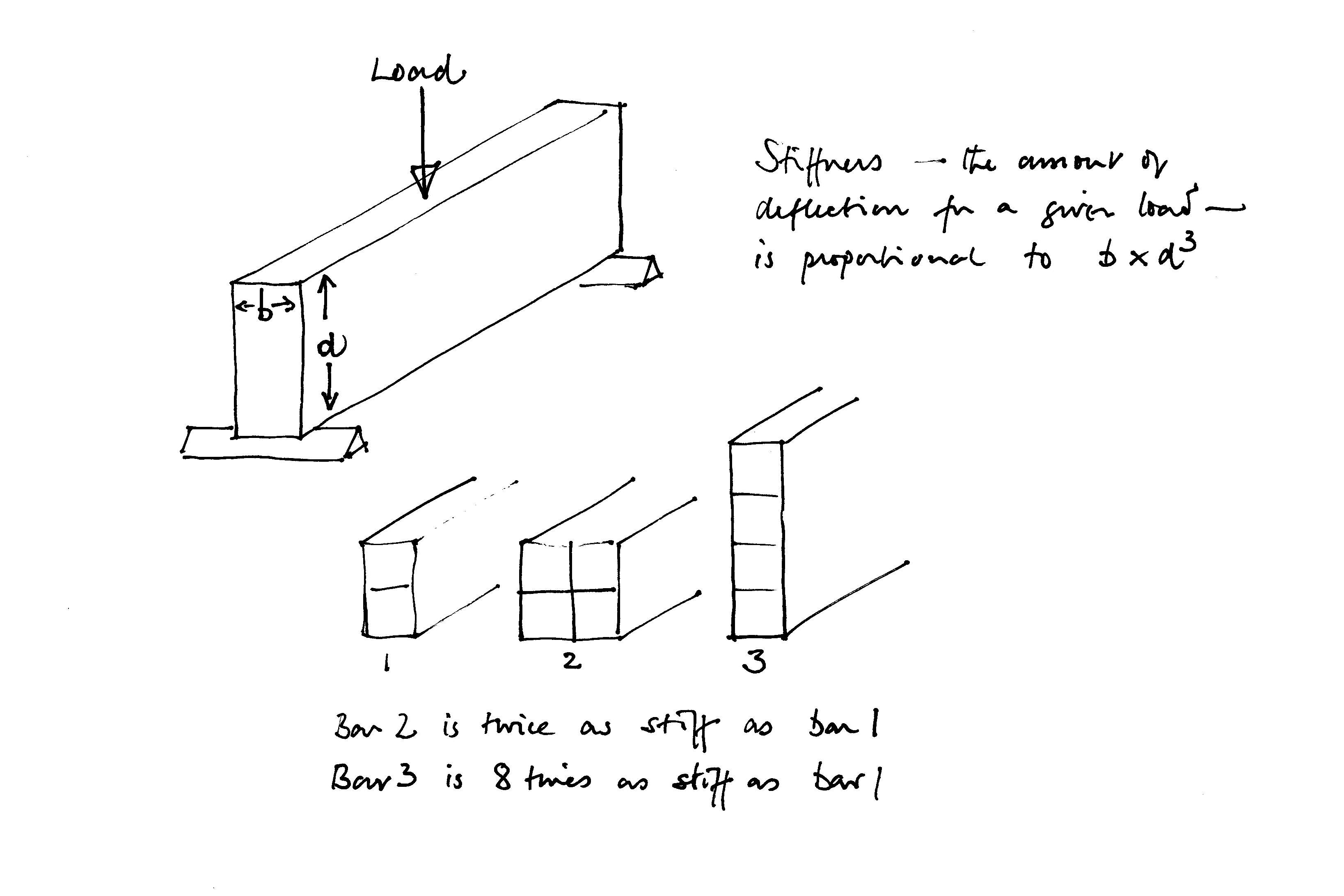
Elementary beam theory tells us that, for a given length, stiffness is proportional to the width of the beam and to the cube of its depth. So if you double the width, the stiffness also doubles. On the other hand, doubling the depth, increases stiffness 8 times. If stiffness is what you’re after, it’s a lot more efficient to make the bar deeper than it is to make it wider.

This cubic relation between depth and stiffness could be something worth keeping in mind when planing down soundboard braces after they’ve been glued. If a brace is, say, 6 mm high to start with, planing it down by 1.5 mm to a height of 4.5mm will reduce its stiffness to less than a half of what it was originally. And shaping the braces to make them triangular or arched in cross section also reduces their stiffness considerably.

Mind you, like so many attempts to understand guitars from a scientific point of view, things rapidly get complicated. A structural engineer with whom I discussed the matter agreed with what I’ve just said about the depth of the beam being a powerful determinant of its stiffness. But he pointed out that where a beam is an integral part of a structure, the stiffening effect is much greater than you would guess from calculations that assume the beam is simply supported at its ends. This is certainly the case of guitars, where the braces are glued to the soundboard along their entire length and clearly count as an integral part of the soundboard structure. In such circumstances, he explained, the overall stiffening effect provided by multiple braces will be large and might well overwhelm the influence of the stiffness of any individual brace.

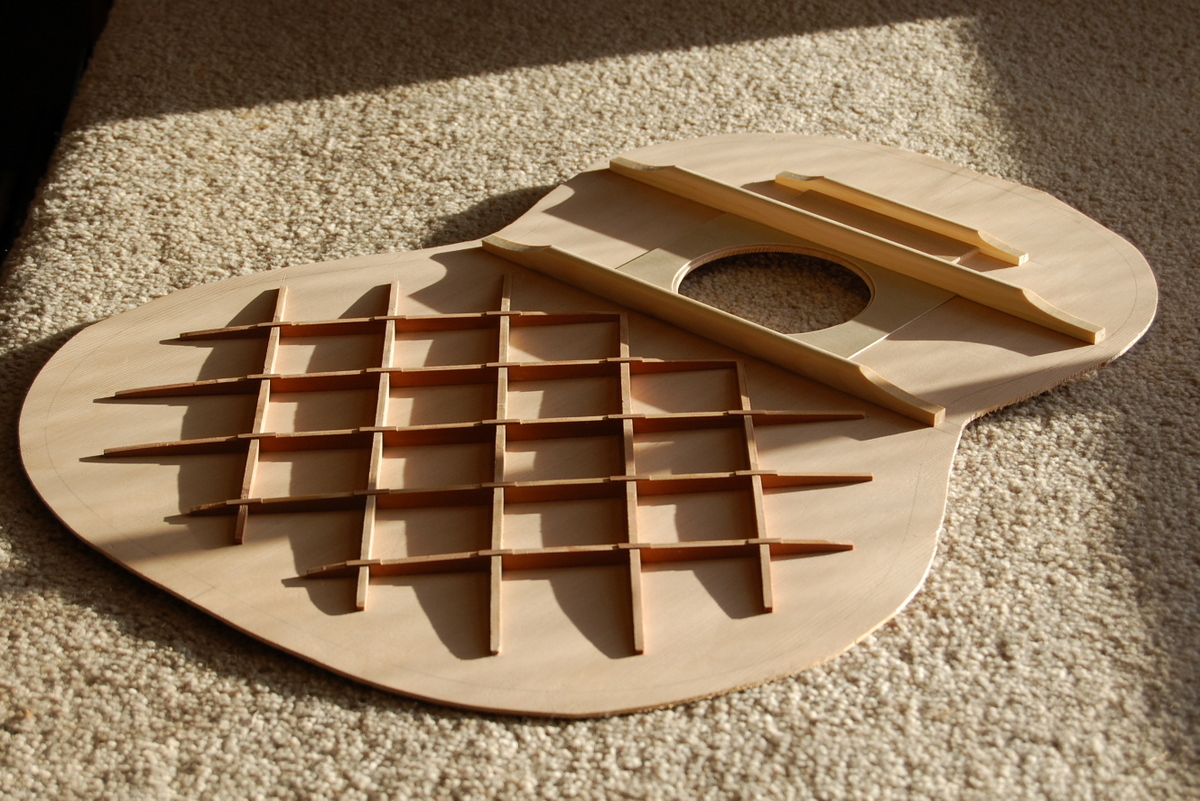
I thought that this was a very interesting idea and that it might begin to explain why so many different bracing systems work remarkably well. In Roy Courtnall’s book, Making Master Guitars, he give plans of soundboard strutting taken from guitars by a number of famous makers. Superficially they’re fairly similar, all being based on a fan-like pattern of 5, 7 or 9 struts. There are minor variations, of course. Some are slightly asymmetrical, some have bridge plates and closing bars and so on. But the  biggest differences lie in the dimensions of the braces. Courtnall shows a soundboard by Ignacio Fleta that has 9 fan struts and 2 closing bars which are 6mm in depth and an upper diagonal bar 15mm depth. By contrast, a soundboard of similar size by Santos Hernández has only 7 fan struts 3.5mm in depth and triangular in section. Applying simple beam theory would lead one to guess that Fleta’s bracing would add more than 10 times the stiffness that Hernández’s does. But perhaps that’s a misleading way to look at it. If one were able to measure or calculate the stiffness of the whole structure, by which I mean the soundboard with its bracing when attached to the ribs, the difference in stiffness between them might turn out to be much less.

It’s a question that might be tackled by finite element analysis and I’d be glad to hear from anyone who has tried. Some work along these lines has been done on modelling a steel string guitar, which at least shows that the approach is feasible.

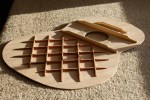
In the meantime, without a proper theory, we’re stuck with the primitive method of trial and error. Below are some of the bracing patterns that I’ve experimented with. All produced decent sounding instruments but I’d be at a loss if I were asked which particular tonal characteristics were produced by each of the different patterns. It may be that William Cumpiano was right when he wrote (in his book, Guitarmaking, Tradition and Technology):

Specific elements of brace design, in and of themselves, are not all that important. One has only to look at the myriad designs employed on great guitars to recognise that there is no design secret that will unlock the door to world-class consistency.

All this means that I’ve been arguing in a circle. Perhaps the conclusion is that beam theory isn’t very useful to guitar makers after all. Still, if you take up the recommendation to get hold of Gordon’s books, the time you’ve spent reading this post won’t have been entirely wasted.

When working on the top of a guitar, I put the instrument on a carpet covered bench and prop up the neck on a block of wood that has a shallow, foam-lined curve cut into the top – as you can see in the photograph above. But I’ve recently learnt a better method. The device below, made out of 2 semi-circles of 18mm plywood, radius about 3 inches, adjusts itself automatically to the taper of the neck and supports it in a far more stable way.

The danger when using the simple block is that it tips over if the instrument is moved along its longitudinal axis. Of course, one can always clamp the block, but with the new neck cradle there’s no need. I’m grateful to Richard Nice (who invented the plane that I wrote about in my last post) for this bright idea.

Continuing my experiments with smaller guitars led me back to the 19th century and the instruments made by Louis Panormo. One of his guitars, made circa 1840, is in the Edinburgh University Collection of Historic Musical Instruments and, rather helpfully, a workshop drawing is available. I had other assistance too. My friend, Peter Barton, who makes fine acoustic guitars in Addingham, West Yorkshire has a Panormo guitar in his collection, which he generously allowed me to handle and photograph. And Gary Demos has a series of photographs documenting his construction of a Panormo guitar copy on his website.

Here are some photographs of the instrument as it was being built. It isn’t, and wasn’t intended to be, a slavish copy. I felt no need, for example, to reproduce the inexplicable scarf joint at the heel end of the neck that was indicated in the drawing of the Edinburgh instrument and that you may just be able to see below in the Panormo guitar owned by Peter Barton. In the photograph, it runs more or less horizontally from where the neck joins the ribs to the back of the neck, ending around the 7th fret position. (Do tell me, if you understand why Panormo did this.)

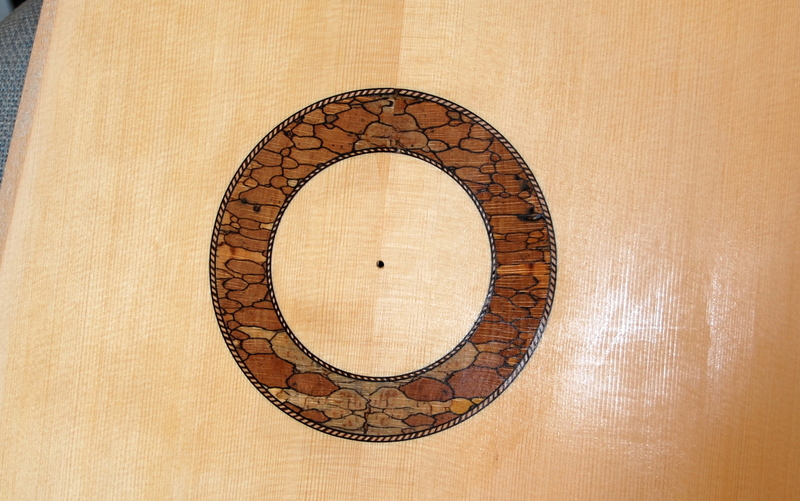
I also felt free to to inlay spalted beech for the rosette instead of the mother of pearl set in mastic of the original.

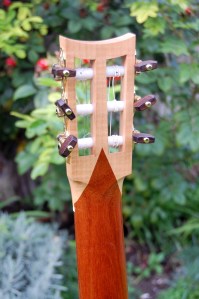
I did however, reproduce the V-joint between the neck and headstock, although the width of the headstock itself was increased slightly to accommodate modern tuning machines. Followers of this blog might recall an earlier post about making the V-joint.


.
.
.
.
.
.
.
.
.
.
.
.
.
.
.

The bridge design is more or less the same as Panormo’s, except that a slot was routed for a carbon fibre saddle to provide a little leeway for adjusting the action later on. His bridge has no saddle. Ebony bridge pins were turned to replicate the original way of fixing the strings.

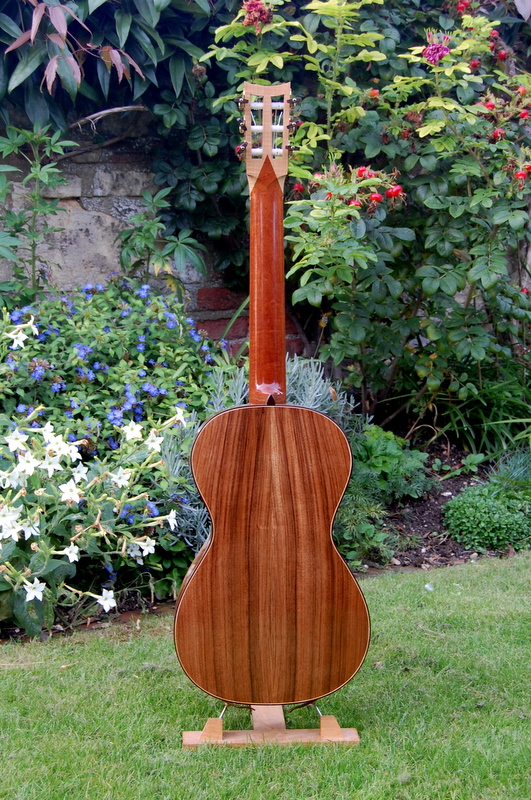
Here are 3 photographs of the completed guitar. The body length is 450mm, width across lower bout 290mm and scale length 630mm.


You can hear Gill Robinson, who now owns the guitar, playing three short pieces if you click on the titles below.

Allegro

The rain it raineth

Caleno costure me

Over a year ago, I wrote a post on this blog speculating that one reason why more men played the guitar than women was simply the dimensions of the instrument. It’s not that women aren’t attracted to the guitar; lots start to play it. But the trouble is that as they get better and the music gets more interesting, the stretches that they must make with their left hand become uncomfortably long, if not physically impossible, unless they have a unusually wide finger span.

No one seemed very interested in this theory (I don’t think I received a single comment) but, even so, I thought it would be worth making a smaller guitar with a shorter scale length, a narrower fingerboard and closer string spacing as an experiment. You can see photographs of the instrument here. It has been played by lots of guitarists both professional and amateur, both men and women. Most of them said they liked it and nobody complained that it made too small a sound, although a few of the men found that their fingers were too cramped at the nut end of the fingerboard.

And it did persuade someone to commission a similar instrument, shown below. It too, is a loose copy of a Hauser guitar. The soundboard is spruce and the back and ribs are of Madagascan rosewood (Dalbergia baronii). The bindings and bridge are of Rio rosewood and the rosette and headstock veneer are of English yew. The scale length is 630 mm; the width at the nut is 48mm; and the string spacing at the bridge is 56mm. I’m pleased both with how it looks and how it sounds and I hope its new owner will be too.


A while ago, I wrote about repairing the damaged soundboard of a cedar topped guitar. And I’ve recently had to deal with a similar problem, this time caused by the lid of the case falling on the guitar as it was being lifted out. The damage wasn’t structural but it did leave some conspicuous dents.

The soundboard had been finished by French polishing and I reckoned that simply re-polishing the damaged area would be almost enough. However, first, using a hot (but not too hot) iron and some wet kitchen paper, I steamed out the dents. When dry, I lightly sanded the area before brushing several coats of clear shellac into the places where the polish had been chipped off. After a couple of days to allow it harden, I sanded again with 1500 grit paper to level the area and then re-polished the whole of the lower part of the soundboard in the traditional way using a pad to apply the shellac. Another few days for the shellac to harden, a quick buff up with some burnishing cream and damaged area was almost invisible.

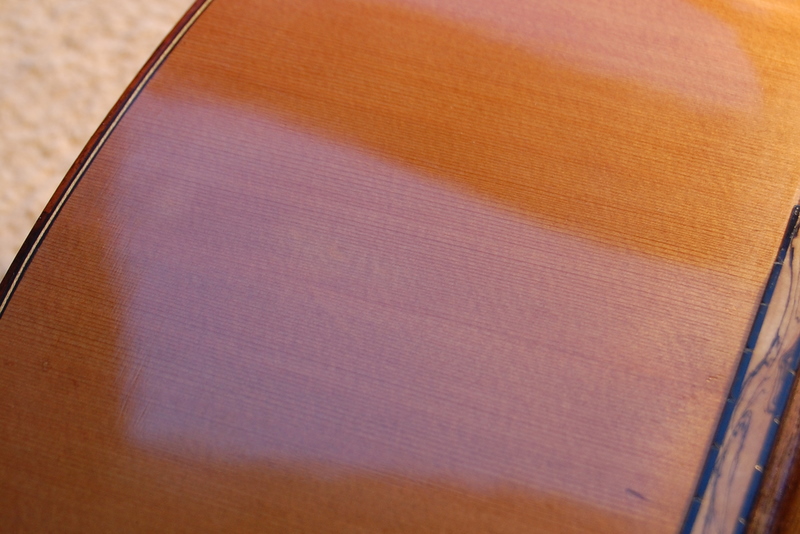
But not completely invisible because, viewed in certain lights, the repaired areas were just identifiable as slightly paler patches. You can see them in the photograph below. I had exactly the same problem with the last repair and I don’t know how to eliminate it. This time I tried exposing the bare wood to UV light for a few hours before applying any shellac but I’m very doubful that it made any difference. Maybe I should have left it under the UV light for longer. If anyone has a better idea, I’d love to hear from them.

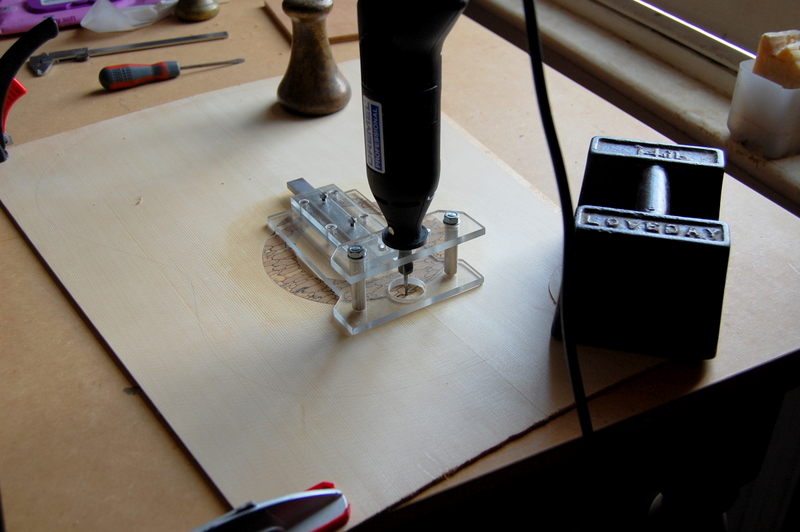
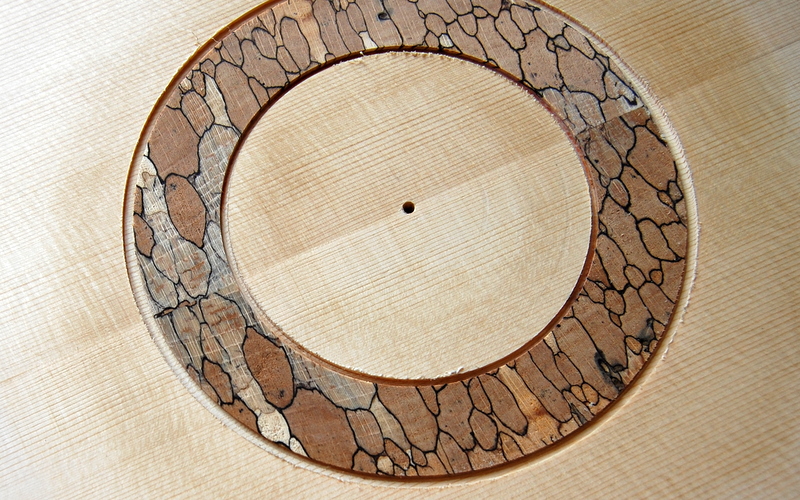
All that remains at this stage is to cut the inner and outer circles to make the annulus of the rosette. I start by drilling a hole in the centre of the work piece…

… and then use a Dremmel mounted in a shop-made jig to cut the circles. (More details of the jig are available in the ‘Tools and Jigs’ section of this site.)

Here are the two rosettes that I’ve talked about in early posts in this series cut out.

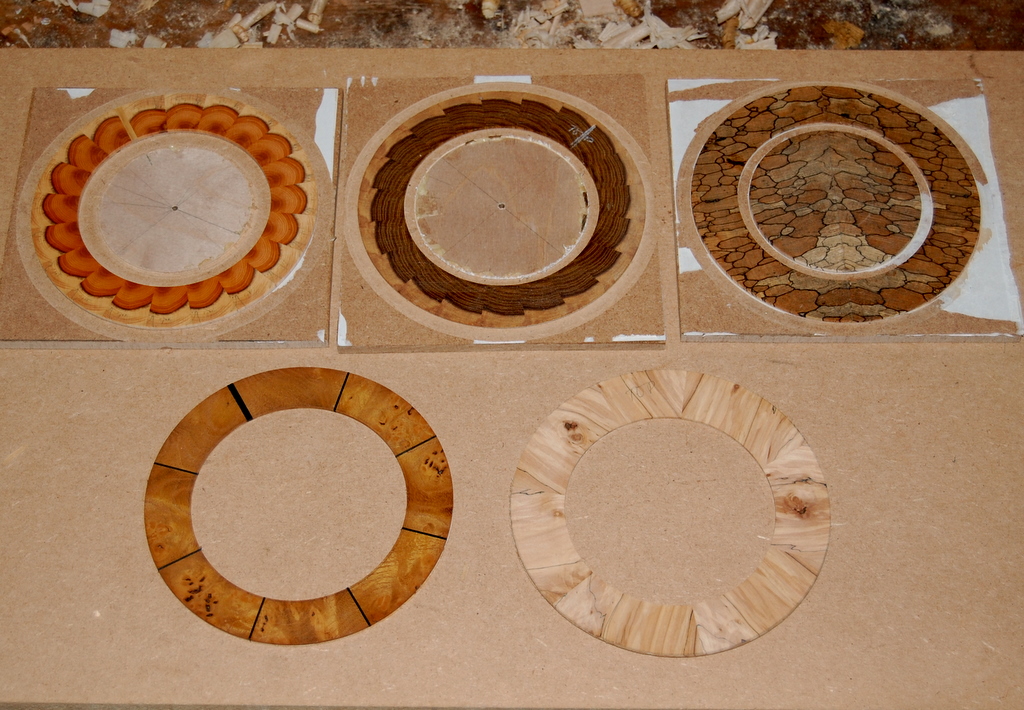
And here are a few more. Going clockwise from top left, they’re made of English yew, laburnum, spalted beech, spalted crab apple and mulberry burr.

It’s probably best to leave them attached to their base until you’re ready to install them on the soundboard but, as you can see from the two rosettes at the bottom, I don’t always heed my own advice.

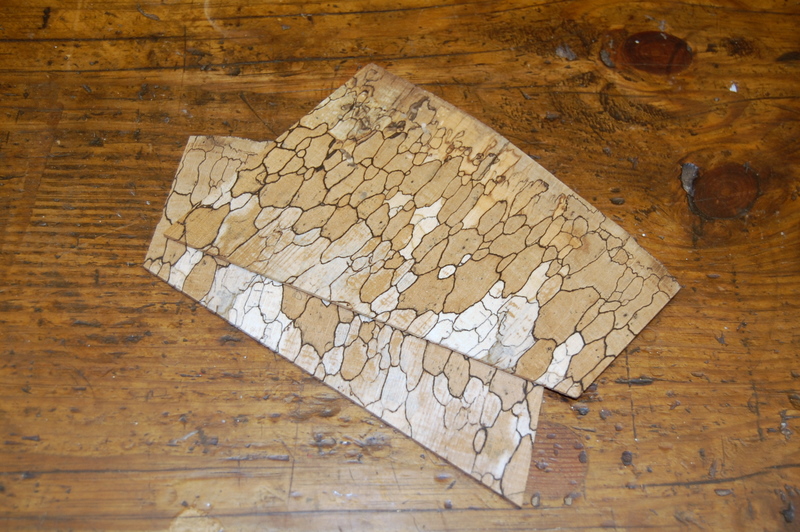
One of the rosettes is going to be a replica of the one used for the zebrano guitar that I made last year from this remarkable lump of spalted beech.

I used a bandsaw to cut 2 thin (3mm) slices …

… and trimmed and book matched them to create a symmetrical pattern.

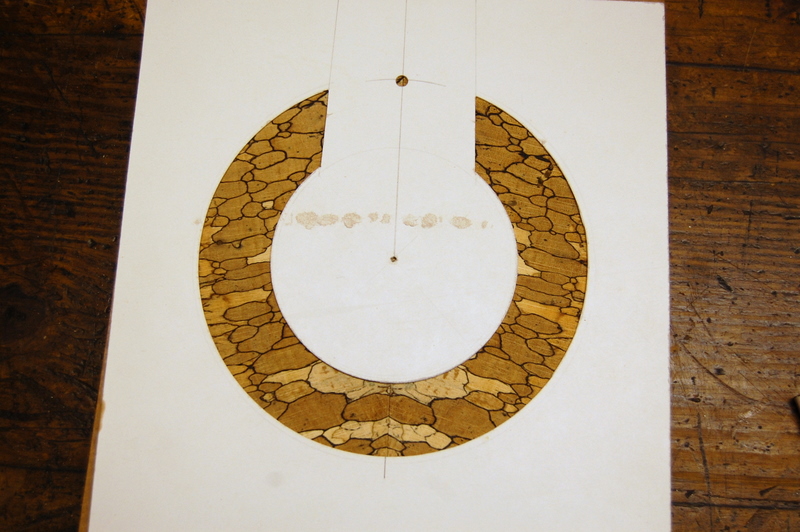
A card with a rosette shaped cut out helps give an idea of what the finished rosette will look like.

I use veneer tape to keep the two pieces in registration while they are glued to the base that I described in the previous post.

Clamping up.

Out of the press and ready to be planed flat and cut into shape. The veneer tape comes off easily if a little hot water is brushed on.

The next post will be about the construction of a different sort of rosette.

Last July I wrote a couple of posts about making a guitar rosette from spalted beech. But I missed the opportunity to photograph some of the details of its construction and, since I’ve been making some similar rosettes recently, I thought it might be useful if I had a second attempt at explaining the method.

For reasons that I’ve discussed before, I like the visual effect of rosettes made by inlaying wood with contrasting colours or a striking figure and often use this technique when making guitars.

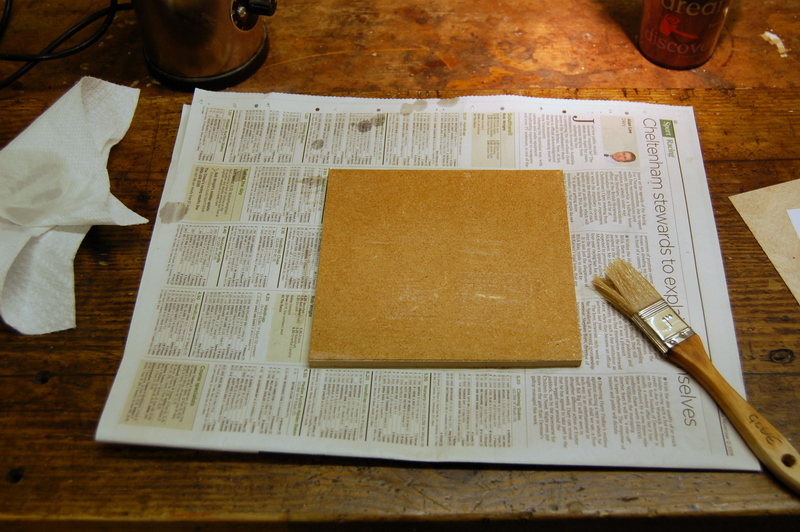
These rosettes are made from at least 2, and usually many more, individual pieces and I’ve found that it’s much easier to assemble them accurately on a base of thin birch plywood (0.4mm or 0.6mm thick*) than it is to inlay them directly on the soundboard. Because the plywood is so thin, it too needs a stable base during the assembly process. But, of course, it must be possible to remove this base when assembly is complete. I start with a square of 6mm MDF, a similarly sized sheet of clean paper and the square of  plywood that will be the permanent base of the rosette.

One surface of the square of MDF is given a thin coat of hot hide glue.

The sheet of paper is then smoothed down…

…before adding a second coat of glue…

Glueing up 3

and the layer of plywood.

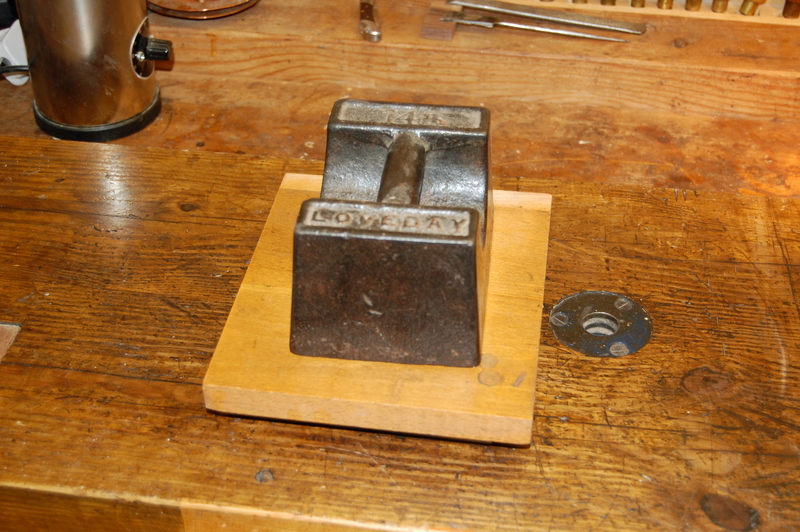
The whole thing is then clamped up in a nipping press and left to dry overnight.

If you don’t have a press, a flat board and a weight work just as well.

The point of the paper and the hot hide glue is that, after it has been assembled, the rosette is easy to detach from the MDF base. In another post, I’ll show the next stages of the process.

*This sort of plywood is used by model makers and, at least in the UK, is easily available from the sort of shops that supply materials for people who build model aeroplanes.

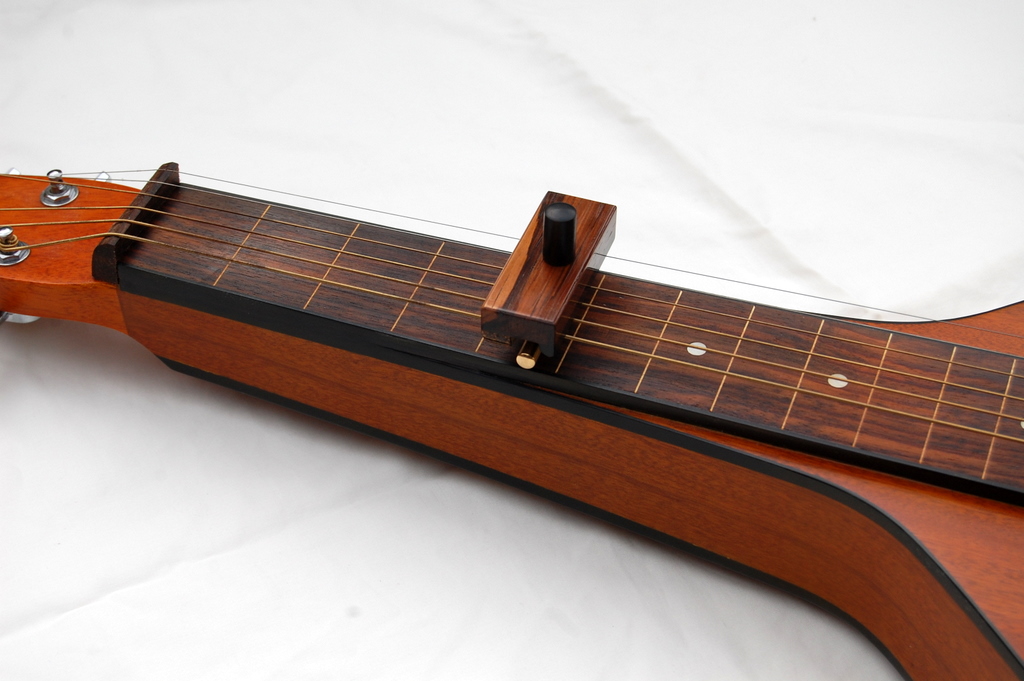
A while ago, a friend bought himself a lap steel guitar – the sort with a hollow neck, square in section – but became frustrated because he couldn’t find a capo that would fit it. He couldn’t use the usual type of capo, of course, because the hollow neck of the guitar was too thick and too fragile to allow the clamp to work and because the strings were too high over the fingerboard. So I made him this device, which is easy to fit and adjust and works well.

DSC_0007

In case anyone else has a similar problem, I thought it might be worth explaining how it’s made. You’ll need a scrap of hardwood roughly 2.5 x 1 x 3/8 inches in size; a piece of bone or ebony to make the inverted nut; some cork or leather to damp the strings on the headstock side of the capo; a 2.5 inch length of round bar in brass or steel of 1/4 inch diameter; a short length of threaded rod of 1/8 inch diameter; and a small piece of wood or metal or plastic to make a knob with which to turn the threaded rod. You’ll also require a matching tap to cut a thread in the hole of the brass bar.

The photographs below should make the construction clear, so I’m not going to give details. If you have any queries, please email me at info@finelystrung.com. The only thing to watch out for is that the threaded rod that pulls the bar against the underside of the strings shouldn’t be too long or it may damage the fingerboard.

To fit the capo, loosen the screw holding the metal bar – but not so far that the bar becomes detached. Hold the capo with its long axis parallel to the strings and insert the bar between the two middle strings. Then rotate both the capo and the bar through 90 degrees, making sure that the nut side of the capo is orientated to face the bridge. Slide the capo to the desired position and screw it up just tightly enough to produce a clear sound from all the strings.

DSC_0001-1

DSC_0004-1

DSC_0003-1

DSC_0005

DSC_0013

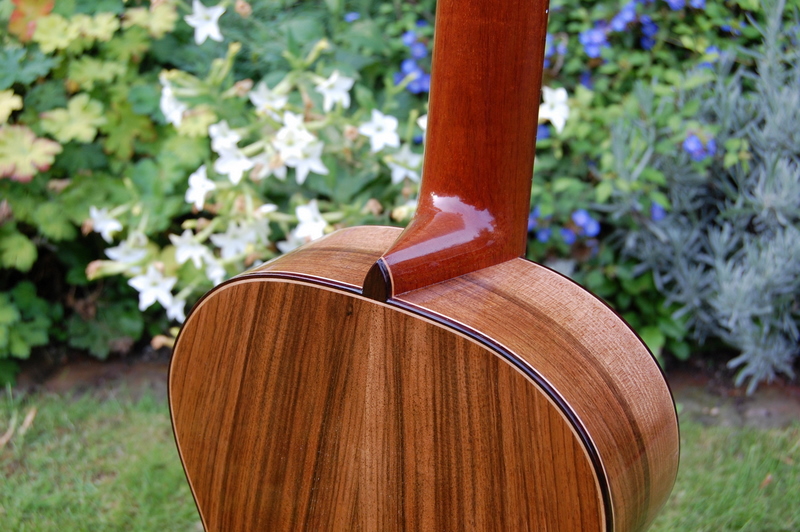
The guitar that I have been writing about in my last few posts is now, more or less, completed. It’s finished with French polish, which will benefit from a final burnishing in a couple of weeks time when it has got fully hard. But I couldn’t wait any longer to string it up and hear how it sounds. The back and ribs are zebrano and the soundboard is European spruce. The binding is Rio rosewood and maple, and the soundhole rosette and headstock veneer are spalted beech. I’m pleased with how it has worked out, though perhaps I got carried away when it came to the rosette, which might have been more elegant if the diameter had been a little less. Below are a few photographs of the completed instrument.
-0002

-0009

-0011

-0014

-0007

Last week I made a bridge for the guitar that I’m building at the moment. Here’s a photograph taken while it was being French polished. It’s in Rio rosewood and the tie block is inlaid with a strip of spalted beech to echo the rosette that I wrote about a little while ago.

DSC_0006

To cut the channel for the saddle and for the recess behind the tie block, I used this very simple router table. The idea came from an article in Fine Woodworking (No 182, February 2006) where Doug Stowe described how he made something rather similar for a full size router. There’s a brief description of his table here where there’s also a link to a full explanation and downloadable free plans.

DSC_0013

In my table, the Dremmel is mounted overhead on a cantilever. The table itself is a board of mdf. The adjustable fence is simply a straight strip of wood that pivots at one end and that is clamped at the other – an arrangement that allows a remarkable degree of precision. Depth of cut is controlled by the position of the router bit in the collet. The Dremmel isn’t powerful enough to cut slots to their full depth in one pass so, to avoid the fiddly business of repeatedly having to change the position of the router bit in its collet, I place a shim of 1.5mm thick plywood under the workpiece for each subsequent pass.

DSC_0012

The only bit about making the table that’s not straightforward is how to mount the Dremmel firmly and vertically in the cantilever in a way that allows removal. I solved the problem by buying a 3/4 inch diameter 12tpi tap, which matches the thread on the nose of the Dremel when the collar above the collet is removed. Then it was only a matter of drilling an undersized hole and tapping it out.
DSC_0007

The table is quick and easy to set up and it doesn’t take up much room in the cupboard when it’s not being used. It isn’t big enough to deal with anything very large, of course, but for making guitar bridges it works fine.

In Roy Courtnall’s book, Making Master Guitars, there’s an interview with José Romanillos in which he talked about some of techniques he uses. To attach the ribs to the foot of the neck, he prefers a wedged joint over the usual 2mm wide slot cut at the 12th fret line. Apparently, he got the idea from seeing such a joint in a 17th or 18th century French guitar. He gives some rudimentary instructions about how to make it:

‘You cut a wide tapering slot, then fit the rib tight up against the front end. Then you drive a wedge down, which matches the taper exactly. It is very strong.’

Well, I haven’t had any problems with strength of the joint when the ribs are housed in conventional narrow slots. But I’ve never found it easy to cut these slots to exactly the right width with a hand saw. If you want to do it with a single cut, you need to adjust the set of a back saw so that it cuts a kerf 2mm wide. Quite apart from the fact that it’s hard to do this without breaking the teeth, it makes the saw almost useless for any other purpose. The alternative is to do it by making two cuts. After the first cut, you can place a piece of plastic or plywood in the kerf to guide the saw for the second cut. But it’s not a very satisfactory solution because it’s too easy to cut into the plastic or wood and end up with a slot that’s too narrow near the bottom. You can get around that problem by substituting a sheet of metal, such as a cabinet scraper, but it doesn’t do the saw much good. Things get even more difficult if you want the slot to be 2.5 or 3.0mm wide to accommodate laminated ribs.

So I was interested to learn about Romanillos’ wedge technique and decided to try it out in the guitar that I’m making at the moment, which does have laminated ribs – zebrano lined with maple with a finished thickness of about 3mm.

The 2 photographs below show the wide tapering slots cut and chiselled out in the foot of the neck before the heel has been shaped.

DSC_0004

DSC_0003

Here, I’ve roughly shaped the heel and lower part of the neck.

DSC_0005

Then I cut the wedges and adjusted them to fit. Obviously, it’s particularly important that they draw everything up tight before the narrow end of the wedge reaches the soundboard end of the slot. I deliberately made them too long initially to give plenty of room for error.

DSC_0009

This is a dry run before gluing to make sure that everything fits perfectly. I discovered that another advantage of making the wedges too long at the beginning was that it provided something to grip when wriggling them out.

DSC_0014

And this is the finished joint, glued and cleaned up. As you can see, I’ve already started attaching the ribs to the soundboard with tentellones.

DSC_0018

Altogether, this turned out to be a useful experiment. The wide slot presented no problems to saw or chisel out. Indeed, it was significantly easier than cutting the conventional narrow slot. There’s a bit of extra time and trouble preparing the wedges but, as long as you have the right jig (see here) it’s not difficult. Gluing up was easy: plenty of room to coat all the surfaces before putting them together and sliding in the wedge. A couple of taps with a light hammer and it’s done. I’m fairly sure that I shall be using this technique again.

This is the second half of the story, started in my last post, about making a rosette from spalted beech.

The next step was to cut the channels around the edge of the rosette to receive the border strips. Again, I used my jig mounted Dremel for this.

DSC_0014
DSC_0015

Here the channels have been cut and the decorative strips bent more or less to the right curvature on the bending iron ready for glueing in.

DSC_0016
DSC_0022

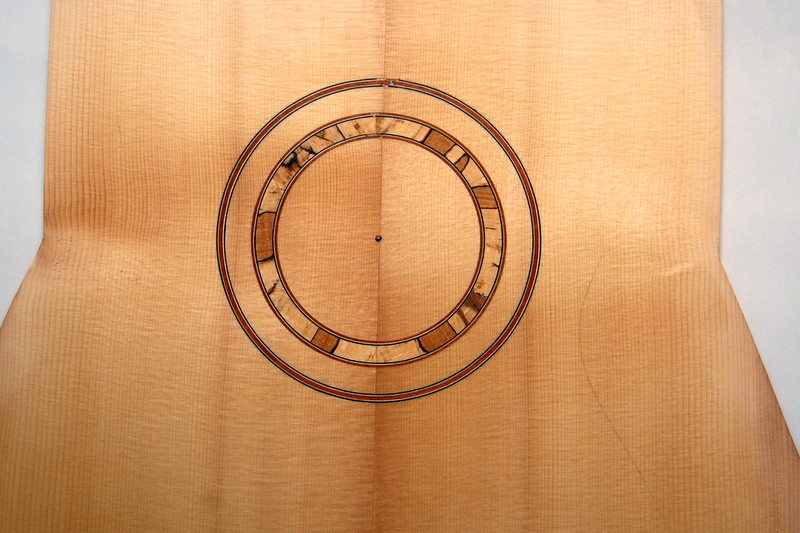
And here is the finished rosette, planed flush with the soundboard and given a wipe of shellac. I shan’t cut the soundhole until I’ve planed the soundboard down to it final thickness.

DSC_0026