Skip navigation

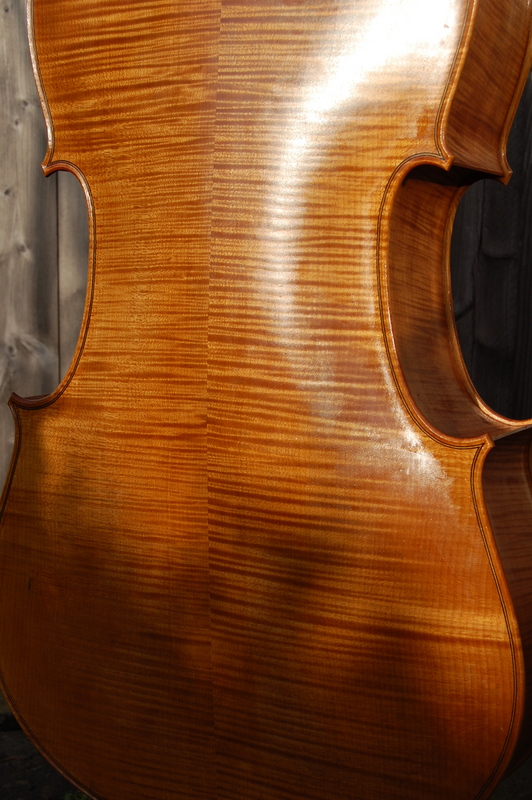
I’ve made a start on the varnishing, aiming at a warm honey colour for the finished instrument and trying to bring out the figure of the maple to its best advantage. At this time of year in England, there isn’t much sunlight and unless you have access to a drying cabinet, which I don’t, it’s necessary to leave a long time between coats. Still, it seems to be going fairly well, even if fairly slowly. The photographs below were taken outside on a rare sunny day. (Click on a thumbnail for a more detailed view.)

The cello is now finished, although not yet varnished. I made a short fingerboard and a tailpiece out of bird’s eye maple, turned an endpin out of boxwood to match the nut and saddle, fitted a baroque bridge and strung it up. It’s always an exciting moment when one first tries it out. Will it sound as good as one hopes or will it be a disappointment?

Fortunately, it has turned out well, producing a warm resonant tone with an even response across the strings. I’m no cellist, but the person I made it for has tried it and we’re both pleased with the sound that it makes. Almost inevitably, there’s a ‘wolf’ – on this cello it’s somewhere between f and f sharp on the 3rd string – but I don’t think it will prove to be a serious problem.

Of course, it was necessary to unstring the instrument to varnish it but, before I did so, I took a couple of photographs.

dsc_0002-41

dsc_0008-21

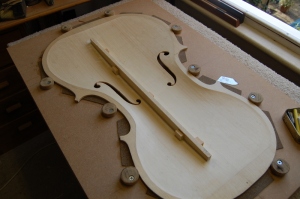
The front, like the back, is made from two book-matched pieces – but this time of spruce rather than maple. Here they are, joined and cut out and being roughly shaped.

dsc_0020-1

The arching has been completed and the position of the f holes sketched in place.

dsc_0005-2

The hollowing of the inside is now finished.

dsc_0007

Blocks have been glued into place so that the bass bar can be fitted. They’re a temporary scaffolding and will be removed later.

dsc_0009

The next stage of fitting the bass bar.

dsc_0010

Below is a photograph of the front being glued onto the instrument.

dsc_0023

The starting point for the back was two pieces of nicely figured book-matched maple.

dsc_0005

I glued them together and cut out the outline roughly on the band saw. Then followed quite a lot of hard work, finalising the outline and establishing the arching – at first roughly with a gouge, but later smoothly and precisely with thumb planes and scrapers.

dsc_0130

Here a channel has been cut for the purfling.

dsc_0131

After hollowing the back to a thickness of around 6mm in the centre and 3.5mm at the edges, the weight of the plate had been reduced to 630 grams and the tap tone had fallen to somewhere between C and C sharp and I was ready to glue it to the rib and neck assembly completed earlier.

dsc_0015-1

After the clamps have come off, it begins to look something like a cello.

dsc_0022

Unlike modern cellos, which have their necks morticed into the top block, baroque cello necks are simply glued and nailed. I say ‘simply’ but it’s a slightly nerve racking business partly because there’s little opportunity for later adjustment if the neck position isn’t absolutely right but also because, if the neck splits as the nails are driven in, a good deal of work is wasted. You drill pilot holes first, of course, but even so…

The first step is to prepare the neck and carve the scroll and pegbox.

dsc_0001-1dsc_0004-4

Then the partially completed neck is glued and nailed onto the top of the rib assembly. As the photograph shows, this is done upside down.

dsc_0011-3

It has been a shamefully long time since I wrote my last post and I apologise to anyone who has been waiting for  news of the cello. Although it has been progressing well, I became so absorbed in making it that I didn’t have enough energy left over to write about it. However, I did keep a camera nearby and I’ll sketch out the various stages of the instrument’s construction in photographs. Here’s the rib structure complete, with the corners trimmed.

dsc_0004-1

The top layer of the mould has been lifted off, exposing the inner sides of the ribs so that the linings can be glued into place.

dsc_0003-1

The lining of the C bout is morticed into the corner block

dsc_0004-2

And here is the rib structure complete and removed from the mould. I’m in the process of trimming the blocks down to their final size.

dsc_0013

The ribs were thicknessed to 1.8 mm first and then coaxed into their curves using a bending iron. Because this is a baroque cello, when the neck is fitted, it won’t be mortised into the top block but simply glued and nailed into position. So, to add strength and minimise the risk of the top block splitting when the nails are driven in, I used a continuous piece for the ribs of both upper bouts to avoid having a join at the top.

Here are a couple of photographs of the ribs being glued into position around the mould.

Some of my earliest posts when I started this blog at the beginning of the year were about making a clavichord. I recently went to see David Condy, who had commissioned the instrument, and had the great pleasure of hearing him play it. Although an accomplished pianist and organist, he told me that it had taken him a little while to get used to the different action of a clavichord keyboard. As you can hear if you click on the pieces below, he has succeeded magnificently. Clavichords make a beautiful but rather small sound, so don’t turn the volume up too high.

He’s playing a piece from Sweelinck’s Liedvariationem für Klavier, called Unter der Linden grüne. The first is just a snippet for anyone who wants to hear what a clavichord sounds like. The second, which lasts a little longer, comprises the theme and the first two variations. Click on the blue titles below to hear them (or use the audio player in the bar).

Clavichord piece

Unter der Linden grüne

A friend of mine, a writer by trade, but also a talented amateur musician, has asked me to make him a cello. He plays in a baroque ensemble and his current instrument, which has a modern set up and metal wound strings, doesn’t  make the right sort of sound for music of that period.

Although I was delighted to be asked, I’d never made a baroque cello before and I needed to do some research before starting. It turns out that accurate information is hard to come by. Any number of books and websites will explain some of the differences between a baroque and a modern instruments: the lack of an end pin, the shallower neck angle, the broader and shorter fingerboard and the lower bridge. While this is all correct, it’s not detailed enough to be of much use to a would be maker. However, I’ve found out most of what I need to know through the generosity of an experienced professional cello maker who has made lots of instruments in the baroque style and who patiently explained what’s required.  Thanks to his advice, I  feel confident enough to make a start.

I’m going to re-use the three layer mould based on the Stradivari Forma B that I made for my last cello. Here are the corner blocks (willow) being glued into position.

And here they’ve been shaped, ready for the ribs to be glued in place.

The responses that I’ve had to the last two posts on how to construct small planes for violin-making stimulated me to look around more widely for people who make their own planes.  The basic idea of constructing them as a ‘sandwich’ came from chapter 2 of James Krenov’s book, The Fine Art of Cabinetmaking. But there’s a much more detailed account of how to make these sorts of planes in Making and Mastering Wood Planes by David Finck (ISBN 0-8069-6163-5). As you’d guess from the title, this book also has stuff on sharpening plane irons  and using planes.

Derek Cohen, from Perth, Australia, has a website full of interesting stuff about tools and woodworking, mainly angled towards furniture makers.  Among other things, he describes how to make a large jointer and a plane to cut sliding dovetails.

Philip Edwards makes traditional wooden planes professionally in Dorset, England and very nice tools they are too. Better still, they’re very reasonably priced. I met him recently and he told me that he too, used the sandwich method of construction. You can just make this out if you look carefully the pictures at Philly Planes.

I’ve mentioned Konrad Sauer  before in this blog. He’s a Canadian planemaker who makes infill planes that are not only beautiful  but highly functional. He has re-invented the Norris adjuster and it works perfectly – which is more than can be said for the orginal version. However, it’s a website to visit for inspiration rather than instruction unless you are a highly skilled metalworker.

Bill Carter’s website falls into a similar category but it’s well worth a visit both to see his copies of rare mitre planes and the ingenious use he makes of discarded materials, especially the brass backs of worn out tenon saws.

Of course, if you want to buy a plane, there are many places to go – just search the web. But I hope these resources might be of use to people who want to make their own.


Pictures are better than words when it comes to describing how to make something. So yesterday, I made a curved sole finger plane, keeping a camera within reach to record each step. I hope these photographs will be a useful supplement to the written instructions in my last post. Read across the rows to stay in sequence and click on any of the thumbnails for a larger view and (sometimes) more detailed comments.

At the beginning of the year, in their Tools and Shops issue, Fine Woodworking included a short piece about some violin-making planes that I had made. Since then, several people have asked about them, and how they are constructed. A recent request prompted me into writing down some instructions and, in the hope that they might be useful to others, I’m going to post them here.

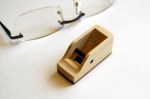
A few of these planes are shown below with a Record No 4 in the background to give a sense of scale.

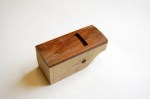
Side view

Three quarters view

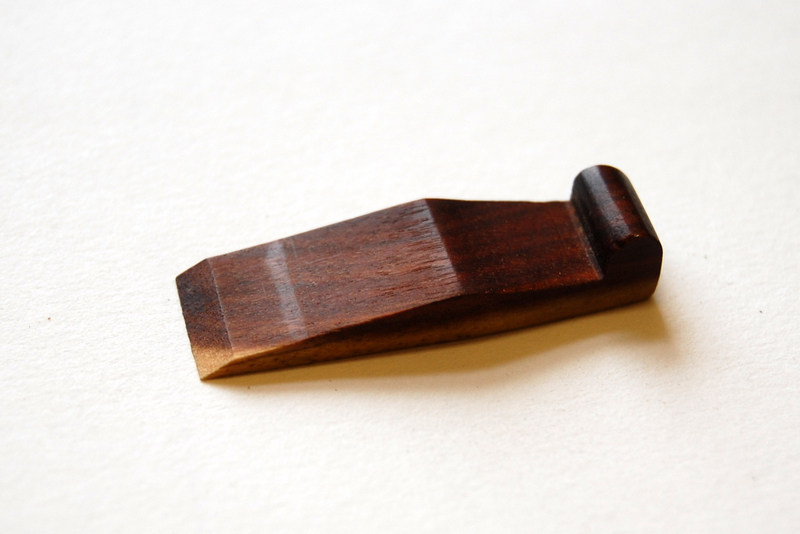
Close up view of wedge

I’ve used a variety of hardwoods: box, cherry, elder, hornbeam and beech and made a variety of shapes and sizes for different tasks. The longer plane lying on its side in the foreground is for shaping violin cornerblocks, for example, while most of the others are for the final stages of arching the top and bottom. Some of these have flat soles for planing flat or convex surfaces; others are gently rounded both across and along the sole and are used for refining concave areas of the arching.

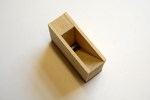
The design is extremely simple as from the photographs of this little plane, made of elder, show: just a body, a wedge and a blade. It’s quite possible to make a plane like this from a solid block of wood simply by chiseling out the required shape. But I’ve found that it’s easier and quicker to adapt the method James Krenov describes in his book ‘The Fine Art of Cabinetmaking’ for making much larger planes. Essentially, the idea is that you saw two slices off the block to make the sides of the plane, shape the bed and throat from the middle section, and then glue it back together.

Here’s an attempt at step by step instructions.

1. Find a suitable blade, around 0.5 inch inches in width and 2 to 2.5 inches long. It’s possible to make one out of an old chisel blade. Another idea is to use a blade that once was part of the set that accompanied a combination or plough plane (these sometimes turn up in second hand tool shops having parted company from the original tool). Or you can buy a new blade from a supplier of Ibex or Herdim violin planes.

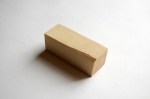
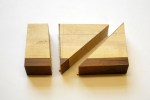
2. Now you need a small block of wood, preferably sawn on the quarter. Box, holly, elder, hornbeam, fruit woods and beech are all good. Plane all sides accurately square, though you need not worry about the endgrain faces (diagram, step 1). Then saw it into a sandwich (diagram, step 2) making sure that the layer in the middle (the filling of the sandwich, as it were) is a little wider than the blade you have chosen. Plane the sawn surfaces, keeping them square so that you will later be able to glue the sandwich back together without visible glue lines. The final width of the filling of the sandwich needs to be just a whisker greater than the blade.

Diagram of steps in making a finger plane

3. Saw the central section (the sandwich filling) across at 45° and 85° to make the mouth and throat of the plane (diagram, step 3). Keep the wedge-shaped waste piece because it will be useful later. File the 45° surface smooth, flat and square.

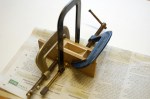
4. Glue the sandwich back together, adjusting the distance between the two filling pieces to give a tight mouth (diagram, step 4). Clamp up and allow plenty of time for the glue to cure.

5. Clean up.

6. Try the blade in position. You will probably need to plane something off the sole so that the mouth is just wide enough for the blade to peep out. Bear in mind that if the sole of the plane is going to be curved, the width of the mouth will initially be wider at the sides of the blade and you’ll eventually need to adjust the mouth to an even width by enlarging it centrally. So keep it on the tight side for now.

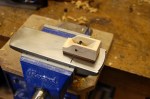
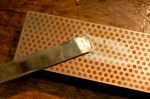
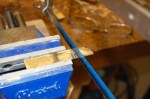
7. Plane or file the sole to the desired profile. This is most easily done by holding a block plane upside down in the vice and moving the workpiece (ie the plane you’re making) over it in the same way that a cooper’s plane is used, though on a much smaller scale – see photograph.

Using a block plane in a vice

Jig for holding wedge

Jig for holding wedge while planing

8. Rough out a wedge. A simple jig like the one in the photograph makes it easier. I like to use a wood of contrasting colour and, if possible, to include a streak of sapwood. But that, of course, is just a whim and of no functional importance. Make the wedge overlength to give leeway for later fitting and leave any fancy carving of the thick end until after the fit is perfected.

9. Put the wedge and blade into position and estimate where to drill for the crossbar that will hold them in place (diagram, step 5). The position isn’t critical but, if the bar is placed too low, it may tend to obstruct shavings as they emerge into the throat. I’ve found that placing the bar about half way up the finished plane works well. Measure the combined thickness of the blade and wedge at this point. Then use a mitre gauge to draw a line on the outside of the place corresponding to the position of the bed. Scribe a second parallel line in front of it (ie towards the toe of the plane). The distance between the two lines should correspond to the combined thickness of the blade and wedge. Draw a third parallel line 1.75 mm further forward again. This is to take account of the 3.5 mm diameter of the cross pin. Half way along this line is the point to drill. While it’s good to get this point placed as accurately as possible, don’t worry too much because you’ll be able to accommodate any inaccuracy by adjusting the wedge.

10. Drill a 3.5mm diameter hole centred on the position that you’ve just marked using a drill press. Before drilling, fit the waste piece that you’ve saved tightly into the gap between the sides of the plane. This will minimise breakout.

11. Turn a short length of hardwood to a diameter of 3.5 mm. Or make it using a dowel plate. Glue into position and trim it off when the glue is dry.

12. Using a coping saw, saw out the curve of the top of the plane. Refine the curve with a knife or file.

13. Then there’s rather a lot of fiddling about to do. Thin the sides of the plane. Adjust the length. Curve the ends. Fit the wedge. File or plane the final profile of the sole and then adjust the curve of the blade and the throat of the plane until you’ve got a tool that does exactly what you want it to do.

14. Obviously, the dimensions, bed angle and other details of the plane can be altered to suit your own requirements.

I’ve no doubt that there are many better, faster, easier and more ingenious ways of making finger planes than this. If you know of them or invent them, please let me know. In a later post, I’ll try to give a bit more detail and discuss modifications and refinements. (See here.)

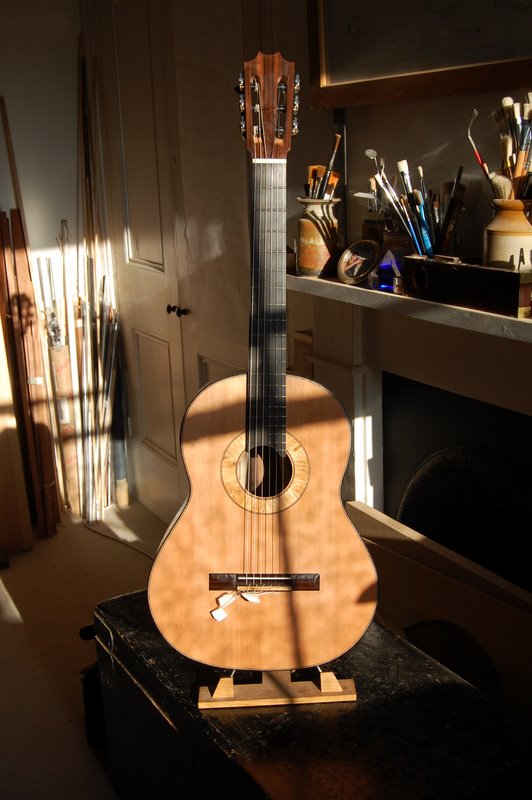
So far in this blog, I’ve been writing about how instruments are made and showing photographs of what they look like. But what matters most, certainly to players and listeners but to makers too, is what they sound like. The trouble is that it’s not easy to make recordings that do justice either to player or instrument. Having made that excuse, I’m going to try. So here, as a first step, are three short pieces played by Fiona Harrison on this cedar top guitar that I’ve written about before. Click on the labels to hear them.

Piece 1

Piece 2

Piece 3

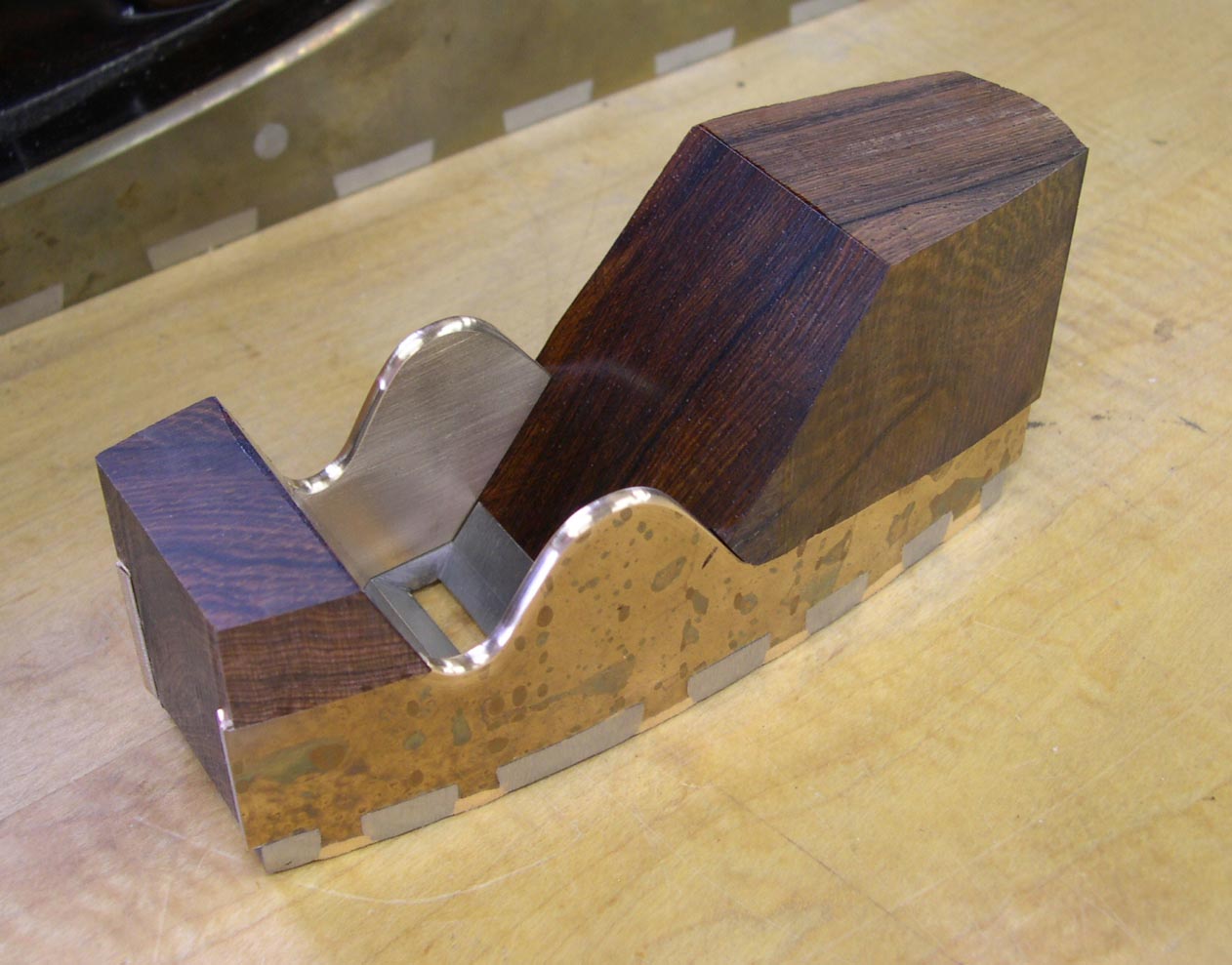
Back in February, I wrote about meeting the Canadian planemaker, Konrad Sauer, and trying out a plane that he had made. It performed so well and I liked it so much that I immediately asked him to make me one. Here’s a picture of the plane that I tried. He calls it the XS No4, which I imagine is short for extra small – although there may be another more complicated explanation. What attracted me to the plane, apart (obviously) from the fact that it worked so well, was its simplicity. No handle, no adjuster, no cap iron – just a thick blade pitched at 52.5° and a tight mouth.

xsno4quarterview.jpg

I was delighted to get an email from him a couple of days ago to say that he had started making it. And just to prove it, he attached these photographs.

For anyone interested in planes, his website (Sauer and Steiner Toolworks) is a fascinating place to visit. He also writes a blog that is well worth reading – not least for its intelligent comments on making and using hand tools. I particularly enjoyed his thoughts on dovetails written when he was in the middle of cutting a stack of them for drawers for cabinets that he was making for his own kitchen.

Making guitars means that there are often offcuts of attractively figured wood left over. One thing to do with them is to turn them into musical boxes. As well as making amusing presents, they demonstrate how even a tiny box and soundboard act to produce a surprisingly loud sound from a mechanism that, on its own, is whisper quiet.

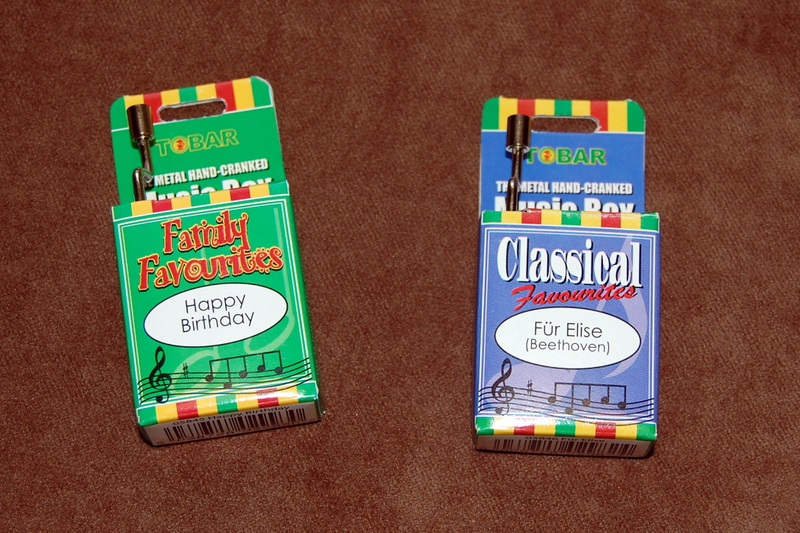
The musical mechanism can be bought from novelty shops quite cheaply. A range of tunes is available of which two are shown below.

The mechanism is a steel comb whose teeth are tuned to a scale. Rotating the hand cranked drum causes the raised pimples on it to ‘ping’ notes as they first bend a tooth and then release it.

Held in the hand, turning the handle produces a tune so quiet as to be almost inaudible. But pressed against something that can itself vibrate – even a table top or a wooden box – the volume of sound is substantially increased.

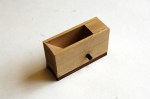
If you go to the trouble of mounting the mechanism on a thin plate of spruce (I simply glue it with a little epoxy), the sound is really quite loud. Here’s one in a walnut box. The mechanism is mounted upside down beneath the top and hidden inside the box so that only the handle protrudes.

And two views of another, this time with four mechanisms each playing a different tune.