Skip navigation

A while ago, I wrote about using a Millers Falls scraper plane to cope with some highly figured cocobolo that I was using for the back of a guitar. It’s an excellent tool for finalising the thickness and it leaves a clean finish even on the most awkward wood. The disadvantage however, is that it takes only the thinnest of shavings so if you’re starting with wood that’s way too thick, you’re in for a lot of time and effort to get to the right final dimensions.

Of course, the usual way to get around the problem is to run the wood through a drum sander. But I haven’t got one, partly because there isn’t room for it in my small workshop and partly because I’m allergic to sandpaper. I don’t mean it literally – I don’t come out in a rash if I touch the stuff – but I do think that there are nicer and quieter ways of shaping wood than grinding it into dust.

Another solution is to use a plane with a toothed blade. This won’t eliminate tear out completely but, should it happen, it’s limited and shallow and can easily be dealt with by a scraper later. Toothed blades work because the individual teeth are too small to grab enough fibres running in the wrong direction to rip out a large lump.

I use a No 4 Record bench plane fitted with a standard blade that I modified to look like this. Put the blade in the vice, cutting edge upward. Take a cold chisel and, against all your instincts, hammer a small gap into the cutting edge every 3 or 4 mm. Then sharpen the blade in the usual way.

DSC_0022

Another way of cutting the teeth is to use a thin grinding wheel in a Dremmel.

DSC_0007-1

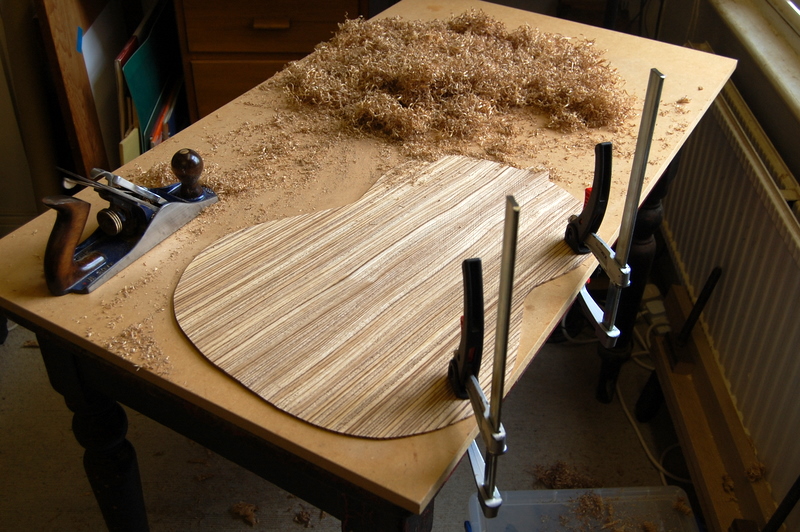
Here are a couple of pictures of a guitar back in zebrano being thicknessed with the toothed blade. If you’ve ever used this wood, you’ll know that the interlocked grain structure makes it very hard to work. With a toothed blade and a wipe of wax on the bottom of the plane, the task becomes a pleasure.
DSC_0019

The marks left by the toothed blade are just visible running diagonally from bottom right to top left. And you can see the linguine-like shavings that are produced.

DSC_0017

Switching over to the scraper plane for final adjustment of the thickness and to remove the corrugations left by the toothed blade.

DSC_0029

Last week in The Times, there was article about recipes in verse. The author reckoned that rhyming recipes were once common, which he attributed to the need for a way of memorising ingredients and cooking directions in the days when few cooks could read or write. He also quoted some modern verse about cooking, including this piece below.

Risotto by Mary Woodward

I’d work from recipes, measure carefully, hover
anxiously. Be so bored by the craft and science
I’d then lose all interest in eating it.
So I cooked risotto every night for a month,
made it instinctive, natural, a simple habit,
as if I’d grown up in a red tiled Italian town
where emerald basil sprouts wildly in the gutters.

Rice, onion, garlic abandoned into hot butter
without a thought. Pepper. Bubbling white wine.
Stock, slipping from a jug, uncalculated.
Dared break the cardinal rule never to leave it.
Judged by eye. Knew by the soft heaving gloss
when to let saffron or prawns or asparagus
fall from my heedless hands. Got it so perfect
I can start from scratch, soon be piling plates,
like breathing, like walking, like humming Puccini,
as if another woman, olive eyed, laughing
like Sunday church bells all the while, has done it.

I thought that this hit a nail on the head. The best way to cook good food isn’t by following instructions in a recipe book. It’s better to absorb the rhythm of the recipe, know what you are aiming for and just do it. Of course, you also need a repertoire of techniques that by practice have become second nature. These techniques aren’t difficult or complicated but having them in your head – as opposed to reading them as you go along – makes all the difference. So, as Mary Woodward says, the way to end up with a good risotto is to make ten – and throw the first nine away.

Just like woodwork really. Cut a set of dovetails every day for a month and then you’ll be able to make a decent drawer. I highly recommend it as an approach. Because you’re not actually making anything, not working on a real project, mistakes don’t matter. Indeed, they’re to be welcomed as a way of learning what not to do. And it’s satisfying because you get better so quickly.

Here are some of my practice pieces. Most of them aren’t very good and a couple are really poor. But it’s instructive to see how strong the joint is, even when made badly. I’ve kept them because small right-angled brackets often come in handy: glueing up mitred frames or boxes with mitred corner joints, for example; or holding the bottom block of a guitar vertical while glueing it to the soundboard.

DSC_0007

Although my technique still needed improving, I’d learnt enough about cutting dovetails to be able to enjoy making these drawers for a cabinet in English elm.

DSC_0012

Talking of improvement, there’s an interesting article on Konrad Sauer’s blog about how, after making a stack of drawers for his kitchen, he reached the point where his dovetails fitted straight from the saw. As a famous golfer once remarked, ‘The more I practise, the luckier I get’.

Browsing through the surprisingly detailed statistics that WordPress provides for bloggers, I was intrigued to see that some of my most popular posts were about the workshop construction of small finger planes with curved soles for violin and cello making. If you’re interested and want to find them, go to the bottom of the page and type plane into the seach box. Or click here, here and here. There’s also a short entry about them on the tools and jigs page.

For a slightly different approach, it’s worth taking a look at Alan Dunwell’s website. You’ll need to go to the Luthier pages and select Making finger planes. He shows how to make several of these planes in a single batch, shaping different profiles for the soles on a belt sander. Dunwell recommends nothing fancier than a penny nail for the crossbar that holds the wedge and blade in position.

This is the second half of the story, started in my last post, about making a rosette from spalted beech.

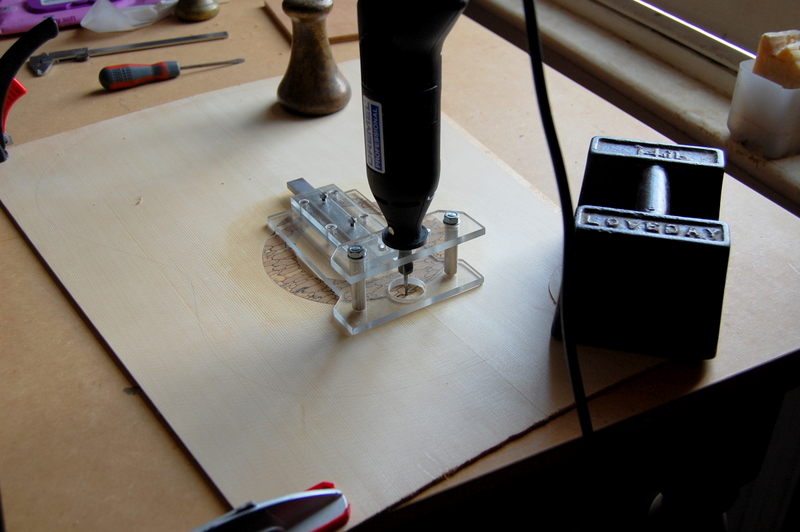
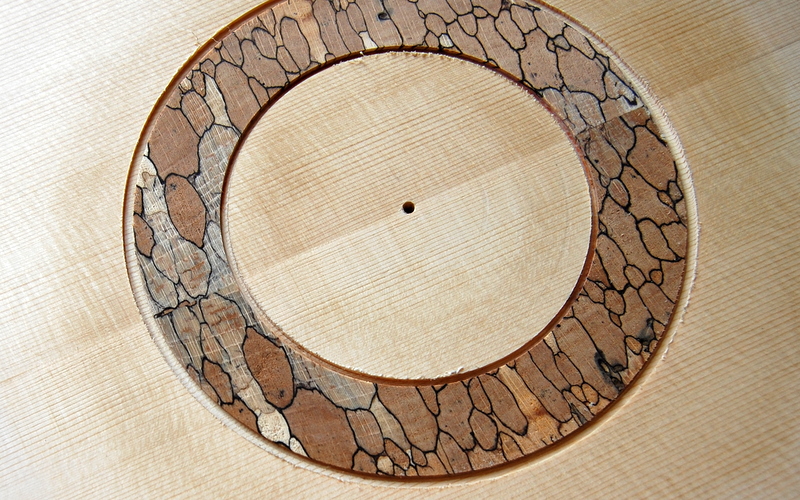
The next step was to cut the channels around the edge of the rosette to receive the border strips. Again, I used my jig mounted Dremel for this.

DSC_0014
DSC_0015

Here the channels have been cut and the decorative strips bent more or less to the right curvature on the bending iron ready for glueing in.

DSC_0016
DSC_0022

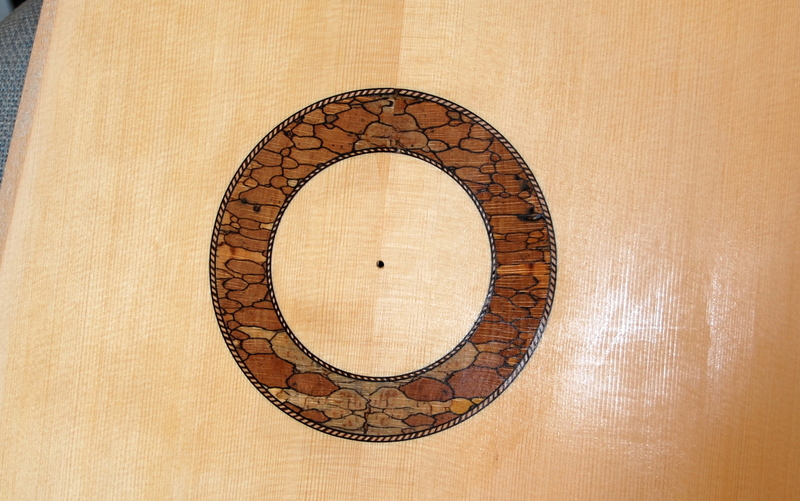
And here is the finished rosette, planed flush with the soundboard and given a wipe of shellac. I shan’t cut the soundhole until I’ve planed the soundboard down to it final thickness.

DSC_0026

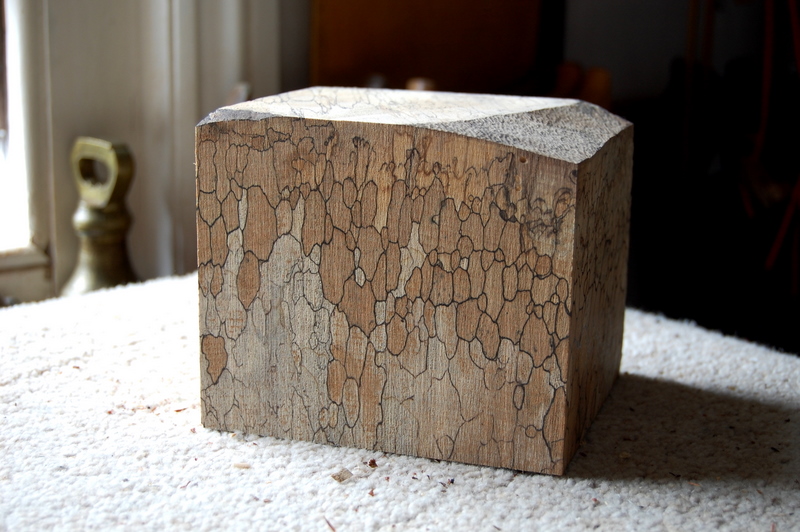
A few weeks ago, I bought a block of spalted beech from Mark Bennett and mentioned, in a previous post, that I hoped it would make some striking guitar rosettes. I’ve been trying out some ideas. Here’s the piece of wood that provided the starting point.

DSC_0001

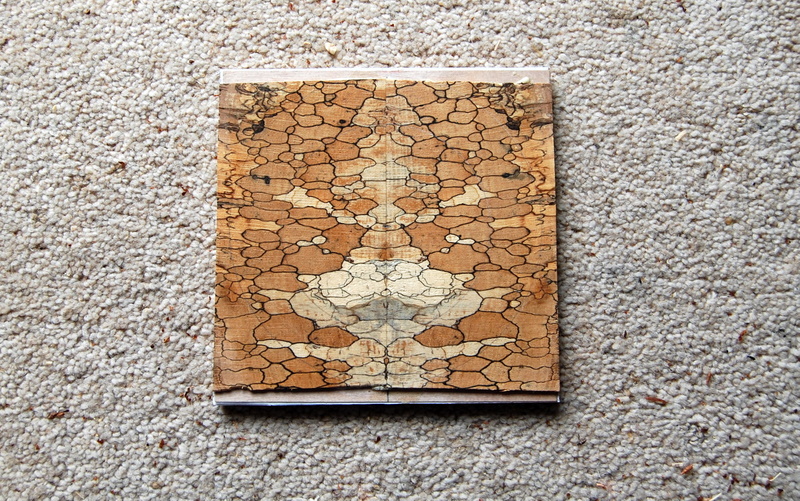
Having decided which face looked most attractive, I set up the bandsaw for a fine cut and sawed two veneers at about 4mm thickness. Then I book-matched them to create a more or less symmetrical pattern, by gluing them onto thin (1/64 inch) plywood for stability. Actually, there’s a bit more to it than that. First, using weak hot hide glue, I stuck a sheet of paper to a 6 by 6 inch square of 6mm MDF. Then I stuck a similar sized square of 1/64 inch thick plywood over that, again using thin hide glue, and weighted it down until the glue was dry. This provided the base onto which the veneers were glued.

DSC_0004

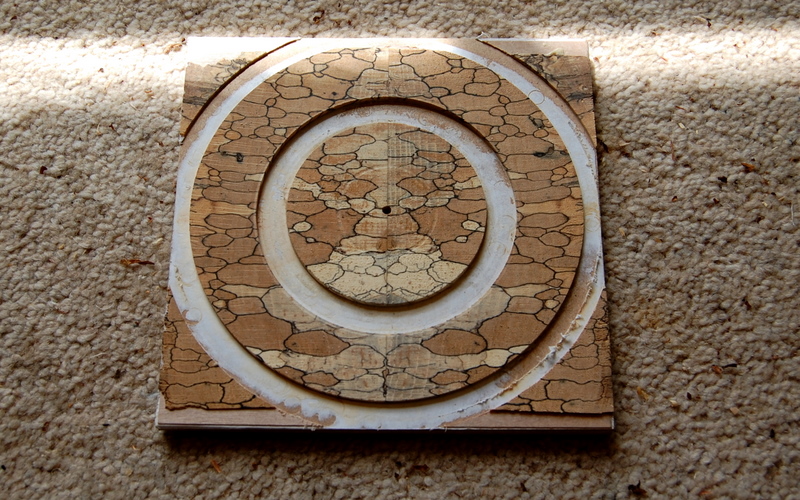
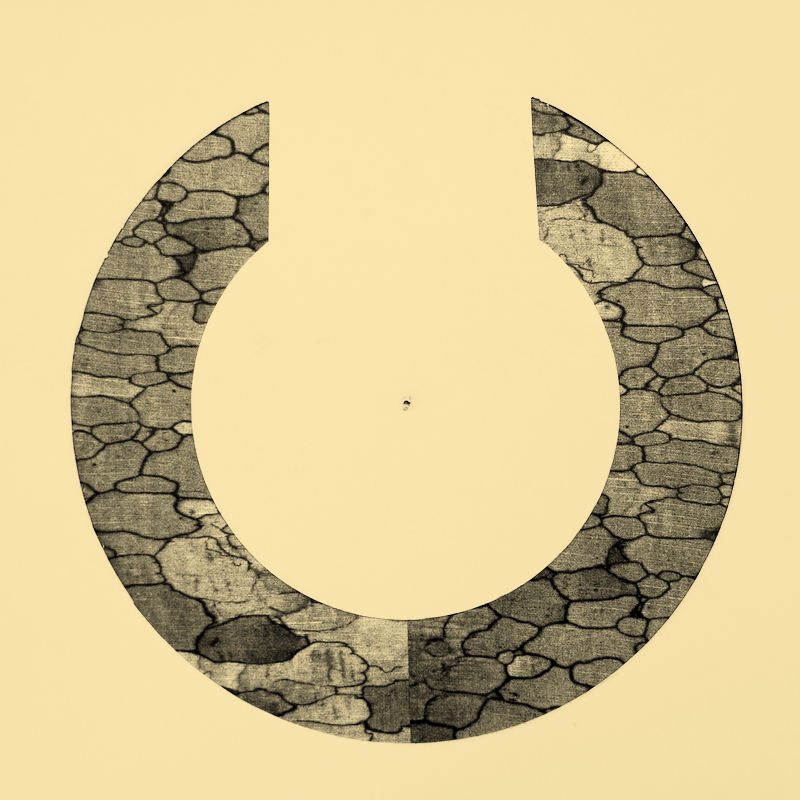
Using a Dremel mounted in a jig (details of jig available here) I cut out the rosette making the depth of cut just through the layer of thin plywood. It was then possible to remove the rosette using a thin blade – an ordinary knife from the dinner table works well – sliding it between the plywood and MDF layers in the plane of cleavage provided by the paper. Any paper or glue remaining on the underside of the rosette can easily be cleaned off with a hot damp cloth, which of course was the reason for using hide glue in the first place.

DSC_0007

I missed the opportunity to photograph either the detached rosette or the routed channel in the soundboard but below you can see the rosette being glued into position on the soundboard, weighted down so that it dries flat.

DSC_0010

Looking around for more on V-joints, I found Gary Demos’ site where he describes not only the construction of the joint but how he made a copy of a Panormo guitar. It’s a fine looking instrument and there are a few mp3 files that show that it sounds very good as well.

Cumpiano’s website has a brief discussion of the merits of the V-joint versus the scarf joint too. (You’ll need to scroll down a bit to find it.) I enjoyed his comment:

If you use a v-joint people will shower you with praises for your skill and those in the know will guess that you don’t have to make a living at making guitars.

There’s probably some truth in that. I’ve always admired Cumpiano’s down to earth approach to guitar making and his refusal to subscribe to anything that can’t be properly explained. See, for example, his courteous but uncompromising dismissal of the mystique of tap tone tuning.

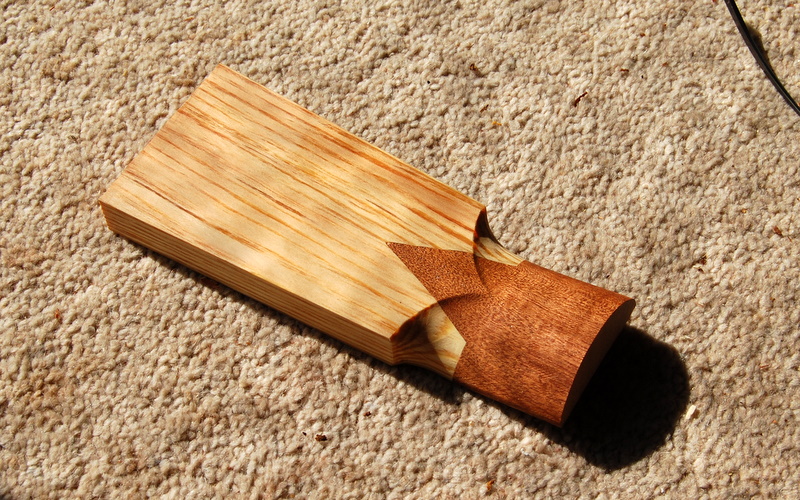
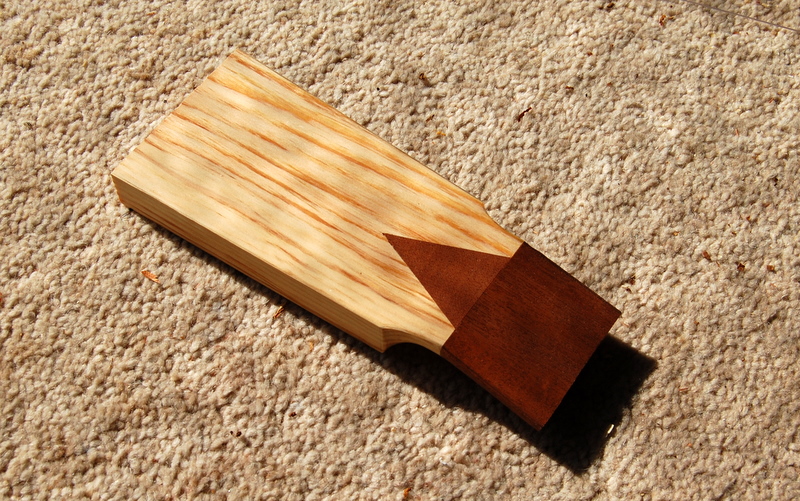
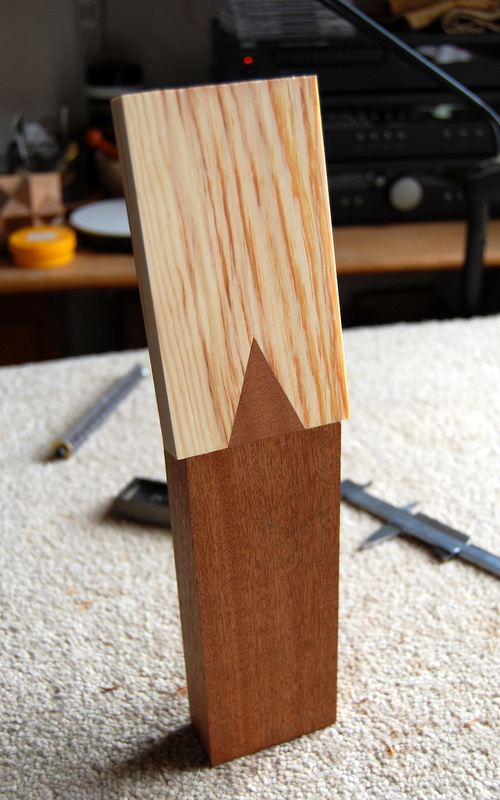
Still, in the interests of historical accuracy, I’m going to pursue the V-joint a bit further. It seemed worth shaping the neck and headstock of my trial joint to get an idea of what it would look like on a finished instrument. In reality, it doesn’t look quite as good as the photographs suggest. At this resolution, glue lines, which in places are wider than they should be, don’t show up. But I’ve discovered two useful things: first, that the joint isn’t impossibly difficult to make and second, that it’s certainly strong enough.

DSC_0003

DSC_0004

Following on from my recent experiment with a small guitar, I’ve been thinking about going a stage further and making a copy of a 19th century guitar of the sort for which Panormo is famous. There’s one in the Edinburgh University collection of historic musical instruments and, rather helpfully, there’s a measured drawing available. The collection’s website has fierce warnings about all the content being copyright so I haven’t posted a photograph, but you can see the instrument by clicking here.

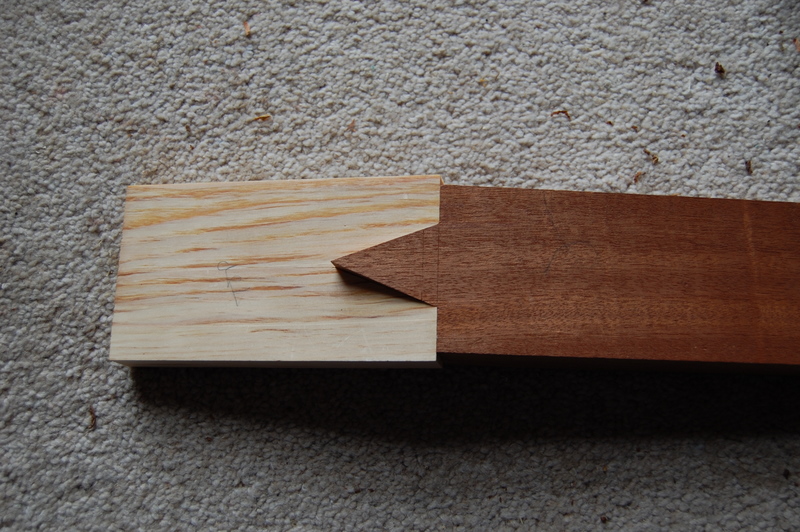
The neck of this guitar joins the head in a traditional V-joint. This isn’t a technique that I’ve ever used before so I’ve been trying it out, partly to get my hand in for making it and partly to reassure myself that the joint is stronger than it looks. There’s a good illustrated article on making V-joints on the Official Luthiers Forum, although you may have to register with the forum to get access. The geometry of the joint isn’t really very complicated but, on the other hand, it isn’t entirely straightforward either. The article explains it well.

The photograph below shows my rough first attempt being glued up. Hot hide glue is the correct stuff to use but, for this trial run, I substituted Titebond.

DSC_0001

Here it is with the clamps off.

DSC_0006

And after cleaning it up.

DSC_0008

And trying to break it.

DSC_0015

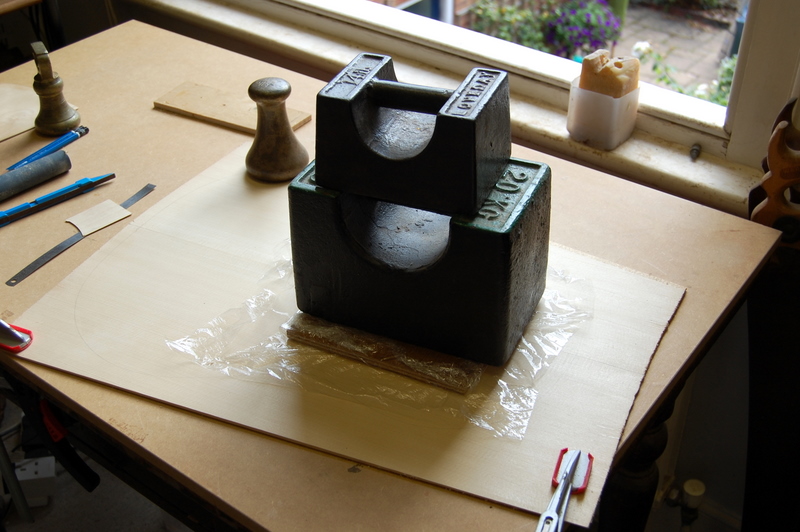
I wondered, in view of the endgrain gluing surfaces of the joint, whether the joint would be strong enough. So I played around, first by loading it with a 20kg weight and then by putting it in the vice and pulling on it as hard as I could. I couldn’t shift it and now feel entirely confident that it’s up to the job.

Classic Hand Tools held a show at West Dean last weekend. It wasn’t a big event but I’m glad that I went for all sorts of reasons. One was the opportunity to meet Karl Holtey and to see and handle some of the planes that he makes. Another was to talk to Mark Bennett who, as always, had brought some amazing wood with him. With some difficulty, I succeeded in persuading him to part with this remarkable specimen of spalted beech.

DSC_0001

It’s not a big block (only about 5 inches by 5 inches by 6 inches) but the figure is exactly the right scale for instrument making. My first thought was  that it would make striking rosettes for guitars and I’ve been playing around with designs (using photocopies so as not to waste any of the material). Here’s one idea:

DSC_0007

This has nothing to do with instrument making, I know, but it has been such a wonderful year for bluebells in Hampshire that I couldn’t resist posting this photograph.

l10015291

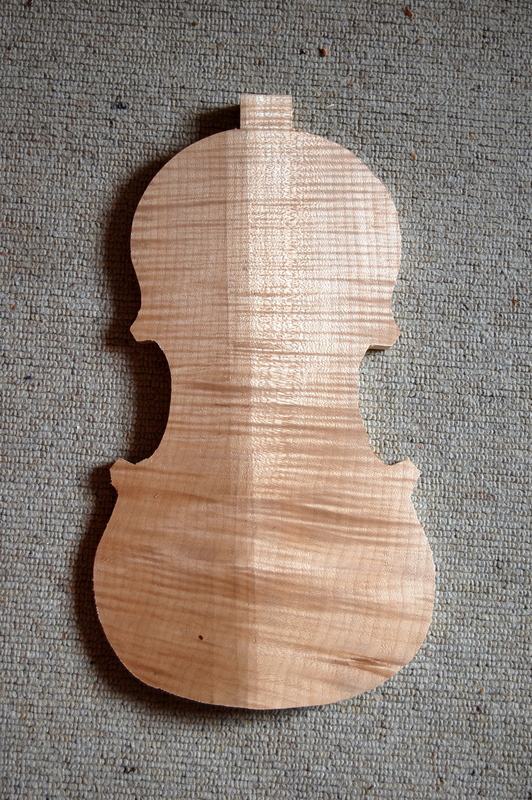
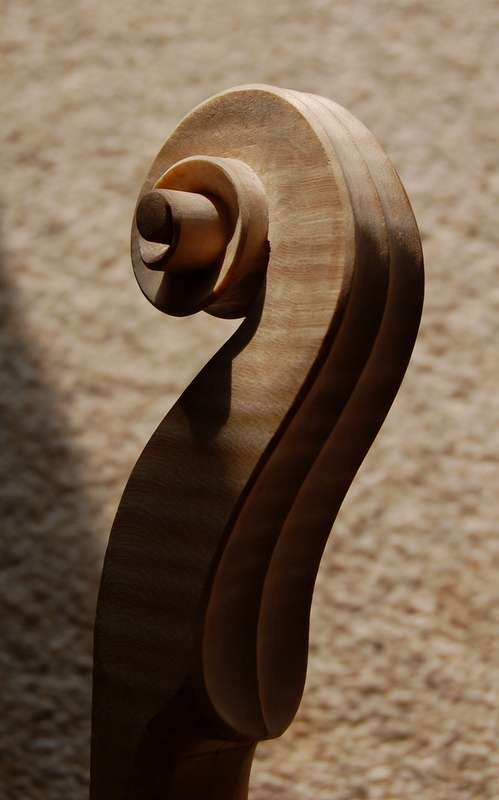
I’ve also been enjoying making a violin. I say making, but completing would be more accurate. The instrument was started many years ago by Pamela Rosenfeld while attending the Cambridge courses on violin making that were run by Juliet Barker. Unfortunately, it was never finished because Pamela became ill. Having seen Patrick’s cello, she contacted me, wondering whether I might carry on where she had left off. She presented me with a complete rib structure around an inside mould, and a neck and scroll that had already been roughed out and various bits and pieces, including a bridge blank and boxwood pegs. We chose a nicely figured one piece back, decided on the wood for the front, fixed some details and work began at the beginning of March. Here are some photographs of the instument as it progressed:.

dsc_0004

dsc_0007

dsc_0011

dsc_0004-1

dsc_0003

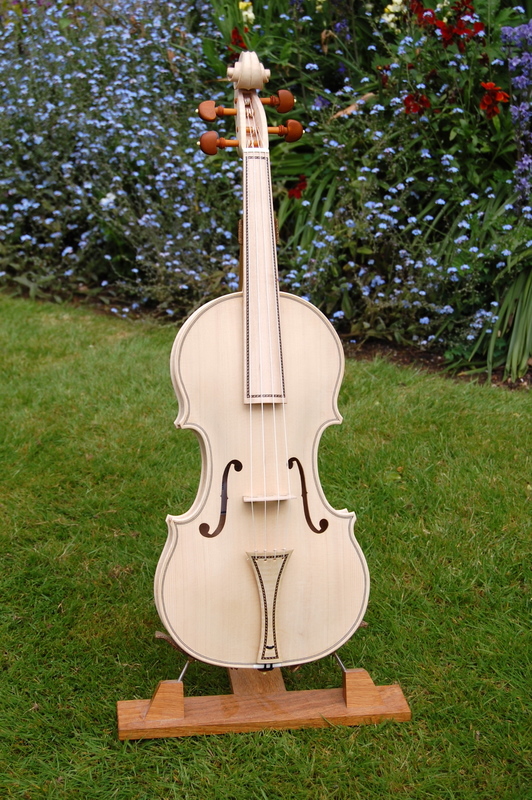
And here’s the instrument more or less completed but still to have proper strings fitted and, of course, still to be varnished. It’s loosely based on the Charles IX violin by Andrea Amati, made in 1564 and now in the Ashmolean museum, Oxford. It’s set up in the baroque manner with a light bassbar, low bridge, short fingerboard and simple tailpiece, but the neck is morticed into the top block in the modern way – a compromise that should make it easier for Pamela to play. It’s very light – under 350 grammes – and I’m hopeful that, with gut strings and played with a baroque bow, it will prove to be responsive and lively.

dsc_0008-1

A couple of posts ago, I wrote about making a pair of tailpieces for two violinists who wanted to change the way their instruments were set up. The violinists, Pamela Rosenfeld and Liz Gregg, are members of the recently formed Tartini Trio who specialise in music of the baroque period. Naturally, they’re keen to produce an authentic baroque sound and, having already switched to gut strings and baroque bows, wanted to take things a stage further by fitting baroque bridges and tailpieces. Over the Easter holiday, Pamela and Liz visited me and let me hear the sound they were making. Very generously, and without rehearsal, they let me record them as a duet playing the Bourée from Handel’s Water Music. The primitive recording (made in my workshop with nothing more than an Edirol digital recorder propped up on the work bench) doesn’t do them justice – but even so, it sounds pretty good.

handel-bouree

A few weeks ago, I mentioned that I had started making a classical guitar with slightly smaller dimensions than usual. I hadn’t got anything radical or particularly innovative in mind but I hoped that, by reducing the diameter of the lower bout, decreasing the depth of the ribs and using a scale length of 640mm, the instrument would be easier and more comfortable for a smaller person to play. The fingerboard and string spacing were also to be narrower by a few millimeters to suit someone with small hands, and the guitar was to be as light as reasonably possible.

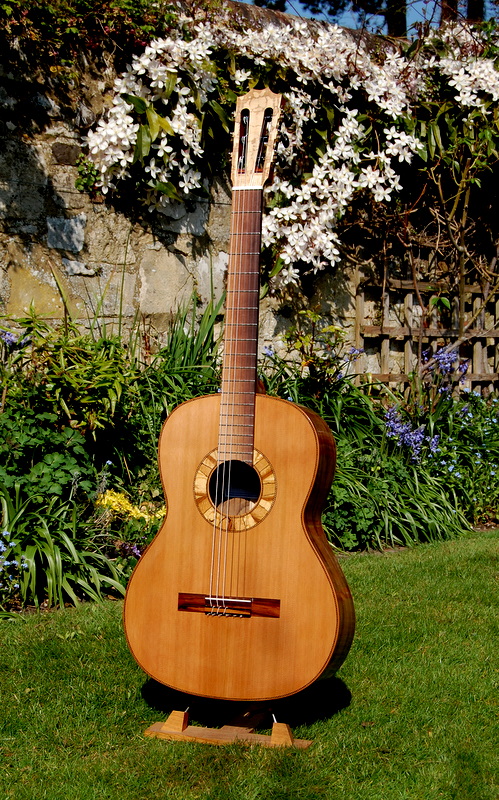
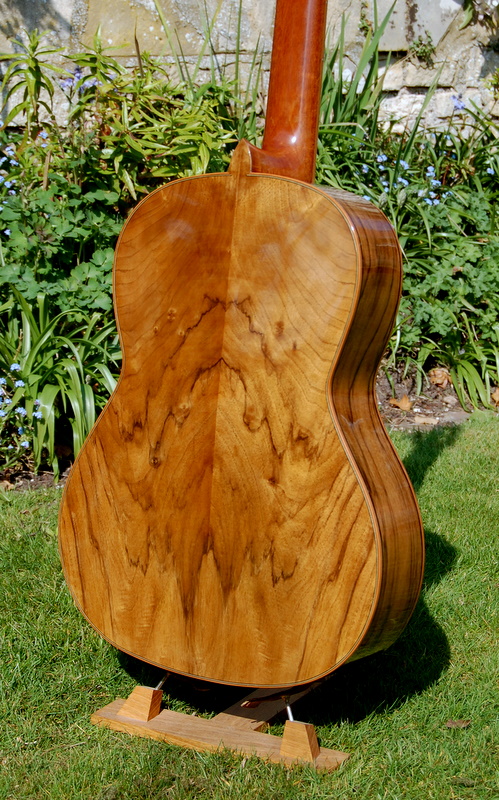
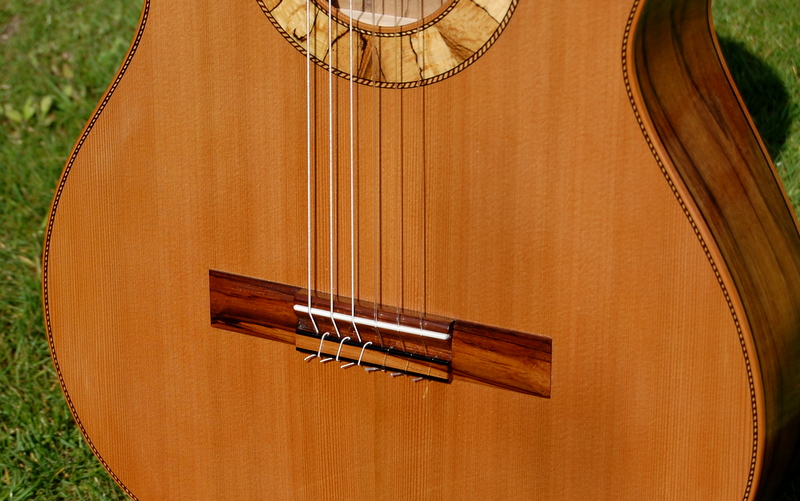
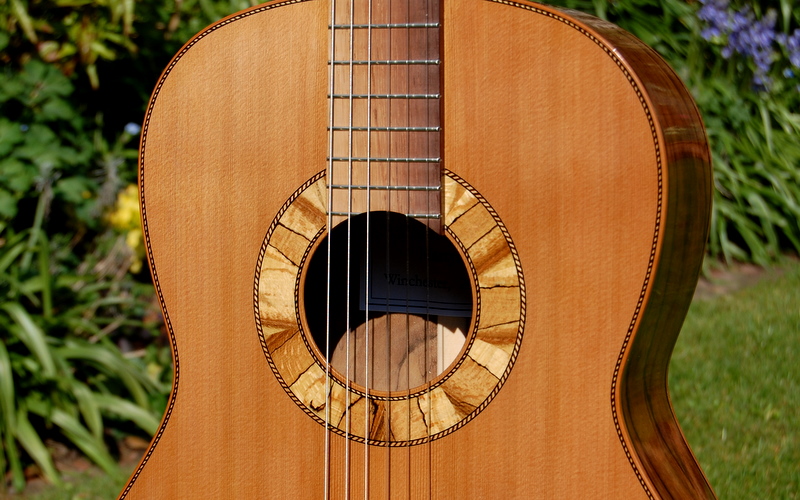
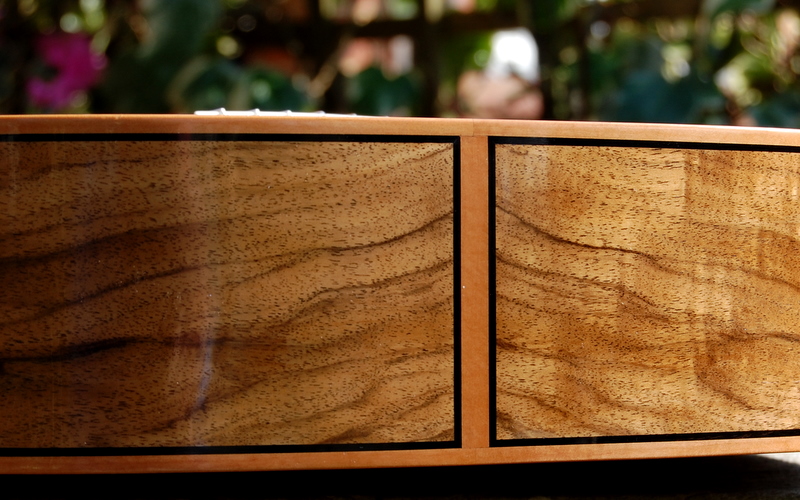
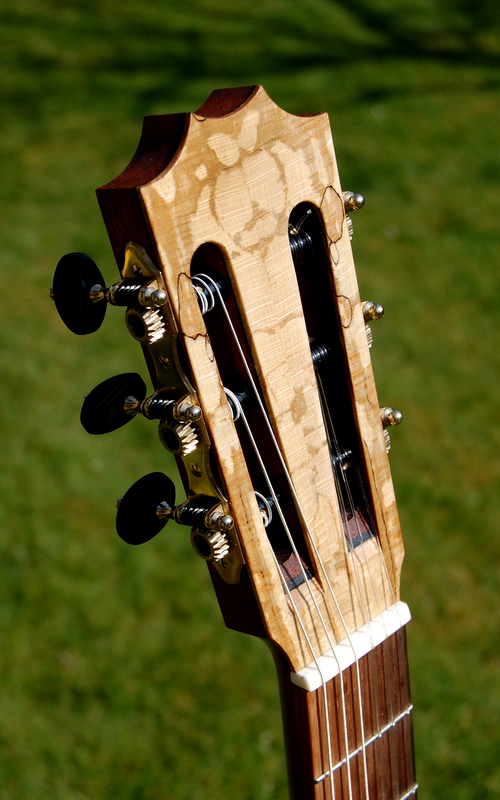
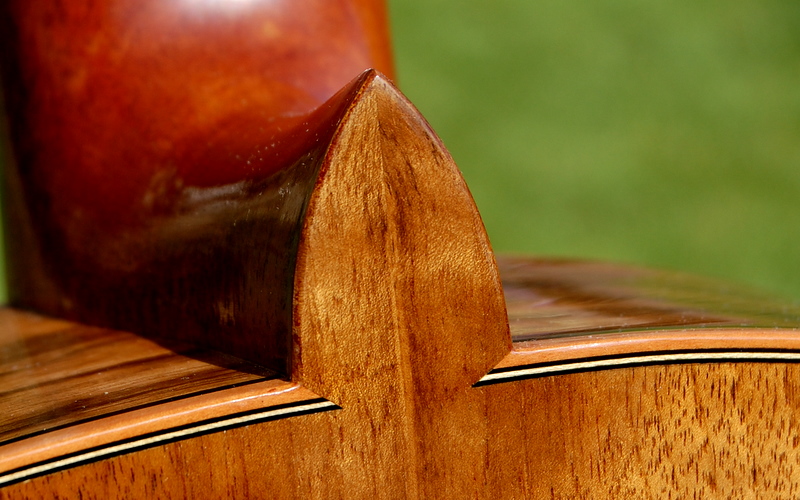
The instrument is now finished. The top is cedar with lattice bracing. The ribs and back are of English walnut with an unusual ‘watermark’ figure and the rosette and headstock were made using spalted beech that Mark Bennett, who runs a funiture making business called the Woodlark, sold me a while ago. The fingerboard and bridge are of Rio rosewood and the tuning machines were made by Keith Robson. The final weight, with strings and tuning machines in place, was just over 1400 grammes, which is significantly lighter than the weight of most of my instruments.

It has only been strung up for a day or two and it has yet to be played by a proper guitarist but my first impressions of the sound are good and the volume doesn’t seem to be perceptibly less than that of larger instruments. I’ll try to add a recording sometime but, in the meantime, here are a few photographs of the completed guitar.

dsc_0018

dsc_0016

dsc_0020 dsc_0019 dsc_00231 dsc_0005 dsc_0011

Making Patrick’s cello led to a request to make tail pieces for two violins belonging to musicians who play in the same ensemble. They wanted to modify the set up of their instruments to produce a more ‘baroque’ sound and, as a first step they changed to gut strings. The obvious thing to do next, is to fit a lighter tail piece and I was delighted to make two out of a scrap of bird’s eye maple that I had left over from the fingerboard of the cello. I roughed out the shape on the bandsaw and then planed, carved and scraped them to their final shape before staining them. The weight ended up about 7 grammes, which is probably about half the weight of the ebony tailpieces they will replace. It’ll be interesting to see how much difference they make to the sound.

The varnish on the baroque cello eventually got hard enough to let me string up the instrument again and send it off to its new owner, Patrick Gale, who lives in Cornwall. Patrick is best known as a novelist but he’s a keen and talented musician too and I hope he will be pleased with cello and the sound it makes. He tells me that he taking part in a series of programmes on amateur music-making that will be broadcast on BBC Radio 3 later this year. Unfortunately, although he mentions this cello on the programme, he doesn’t get to play it.

Before parting with the cello, I took a few photographs. There are 3 below and more in Gallery.

dsc_0004

dsc_0011

dsc_0008-1

A report from the UK last year complained that gender stereotyping influenced children’s choices about which musical instruments they took up. Girls get to play harps and flutes, while boys prefer trumpets and drums. I don’t know whether this is really right or that, even if it were, it would be a very terrible thing, but it certainly is true that more boys than girls play guitars. And while this might be gender politics, I can’t help wondering if the dimensions of the guitar have something to do with it too. The body of a concert guitar can be too big for many women to hold comfortably and I suspect that the usual measurements for the string spacing and fingerboard size are optimised for a male rather than a female hand.

I thought that it might be interesting to make a guitar with a slightly smaller body size than usual and combine it with a shorter scale length and narrower fingerboard. The idea is to make an instrument that a woman will find easy and responsive to play without compromising either the quality or the volume of the sound it produces.

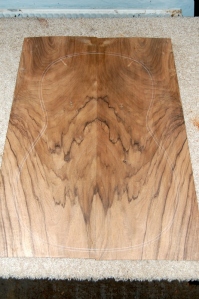
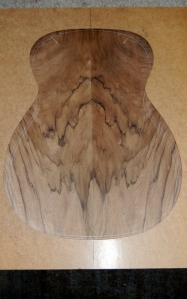
The water-mark figure in this walnut is attractive but delicate and I think that it might work well for the back of a smaller guitar:

dsc_0003 dsc_0004

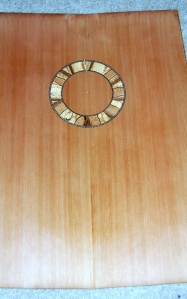
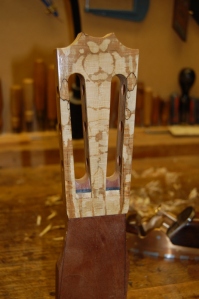
The front will be cedar and I’ve inlaid a rosette of spalted beech. I’ve carried the same theme through to the headstock veneer.

dsc_0001dsc_00081

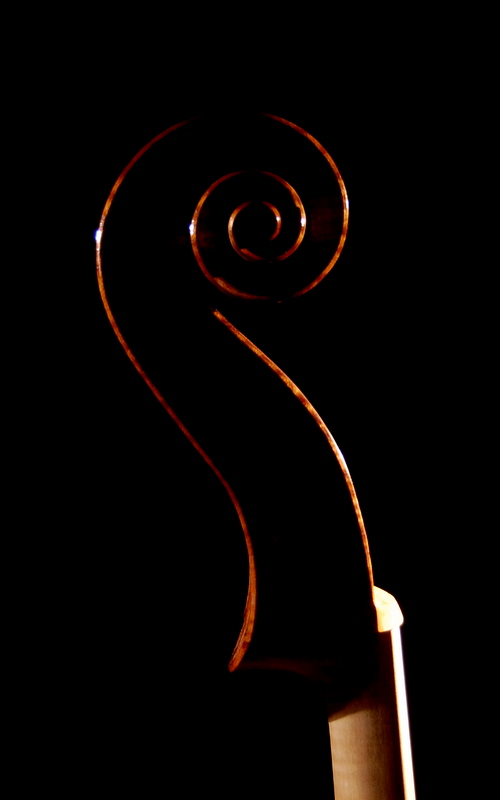
Watching varnish dry is a famously dreary activity. I’ve been passing the time thinking about ways of photographing the cello. Here’s one attempt.

dsc_0002