Skip navigation

Category Archives: musical instruments

The cello is now finished, although not yet varnished. I made a short fingerboard and a tailpiece out of bird’s eye maple, turned an endpin out of boxwood to match the nut and saddle, fitted a baroque bridge and strung it up. It’s always an exciting moment when one first tries it out. Will it sound as good as one hopes or will it be a disappointment?

Fortunately, it has turned out well, producing a warm resonant tone with an even response across the strings. I’m no cellist, but the person I made it for has tried it and we’re both pleased with the sound that it makes. Almost inevitably, there’s a ‘wolf’ – on this cello it’s somewhere between f and f sharp on the 3rd string – but I don’t think it will prove to be a serious problem.

Of course, it was necessary to unstring the instrument to varnish it but, before I did so, I took a couple of photographs.

dsc_0002-41

dsc_0008-21

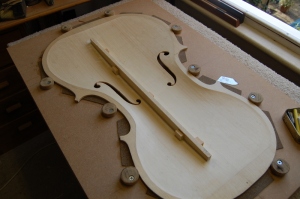
The front, like the back, is made from two book-matched pieces – but this time of spruce rather than maple. Here they are, joined and cut out and being roughly shaped.

dsc_0020-1

The arching has been completed and the position of the f holes sketched in place.

dsc_0005-2

The hollowing of the inside is now finished.

dsc_0007

Blocks have been glued into place so that the bass bar can be fitted. They’re a temporary scaffolding and will be removed later.

dsc_0009

The next stage of fitting the bass bar.

dsc_0010

Below is a photograph of the front being glued onto the instrument.

dsc_0023

The starting point for the back was two pieces of nicely figured book-matched maple.

dsc_0005

I glued them together and cut out the outline roughly on the band saw. Then followed quite a lot of hard work, finalising the outline and establishing the arching – at first roughly with a gouge, but later smoothly and precisely with thumb planes and scrapers.

dsc_0130

Here a channel has been cut for the purfling.

dsc_0131

After hollowing the back to a thickness of around 6mm in the centre and 3.5mm at the edges, the weight of the plate had been reduced to 630 grams and the tap tone had fallen to somewhere between C and C sharp and I was ready to glue it to the rib and neck assembly completed earlier.

dsc_0015-1

After the clamps have come off, it begins to look something like a cello.

dsc_0022

Unlike modern cellos, which have their necks morticed into the top block, baroque cello necks are simply glued and nailed. I say ‘simply’ but it’s a slightly nerve racking business partly because there’s little opportunity for later adjustment if the neck position isn’t absolutely right but also because, if the neck splits as the nails are driven in, a good deal of work is wasted. You drill pilot holes first, of course, but even so…

The first step is to prepare the neck and carve the scroll and pegbox.

dsc_0001-1dsc_0004-4

Then the partially completed neck is glued and nailed onto the top of the rib assembly. As the photograph shows, this is done upside down.

dsc_0011-3

It has been a shamefully long time since I wrote my last post and I apologise to anyone who has been waiting for  news of the cello. Although it has been progressing well, I became so absorbed in making it that I didn’t have enough energy left over to write about it. However, I did keep a camera nearby and I’ll sketch out the various stages of the instrument’s construction in photographs. Here’s the rib structure complete, with the corners trimmed.

dsc_0004-1

The top layer of the mould has been lifted off, exposing the inner sides of the ribs so that the linings can be glued into place.

dsc_0003-1

The lining of the C bout is morticed into the corner block

dsc_0004-2

And here is the rib structure complete and removed from the mould. I’m in the process of trimming the blocks down to their final size.

dsc_0013

The ribs were thicknessed to 1.8 mm first and then coaxed into their curves using a bending iron. Because this is a baroque cello, when the neck is fitted, it won’t be mortised into the top block but simply glued and nailed into position. So, to add strength and minimise the risk of the top block splitting when the nails are driven in, I used a continuous piece for the ribs of both upper bouts to avoid having a join at the top.

Here are a couple of photographs of the ribs being glued into position around the mould.

Some of my earliest posts when I started this blog at the beginning of the year were about making a clavichord. I recently went to see David Condy, who had commissioned the instrument, and had the great pleasure of hearing him play it. Although an accomplished pianist and organist, he told me that it had taken him a little while to get used to the different action of a clavichord keyboard. As you can hear if you click on the pieces below, he has succeeded magnificently. Clavichords make a beautiful but rather small sound, so don’t turn the volume up too high.

He’s playing a piece from Sweelinck’s Liedvariationem für Klavier, called Unter der Linden grüne. The first is just a snippet for anyone who wants to hear what a clavichord sounds like. The second, which lasts a little longer, comprises the theme and the first two variations. Click on the blue titles below to hear them (or use the audio player in the bar).

Clavichord piece

Unter der Linden grüne

A friend of mine, a writer by trade, but also a talented amateur musician, has asked me to make him a cello. He plays in a baroque ensemble and his current instrument, which has a modern set up and metal wound strings, doesn’t  make the right sort of sound for music of that period.

Although I was delighted to be asked, I’d never made a baroque cello before and I needed to do some research before starting. It turns out that accurate information is hard to come by. Any number of books and websites will explain some of the differences between a baroque and a modern instruments: the lack of an end pin, the shallower neck angle, the broader and shorter fingerboard and the lower bridge. While this is all correct, it’s not detailed enough to be of much use to a would be maker. However, I’ve found out most of what I need to know through the generosity of an experienced professional cello maker who has made lots of instruments in the baroque style and who patiently explained what’s required.  Thanks to his advice, I  feel confident enough to make a start.

I’m going to re-use the three layer mould based on the Stradivari Forma B that I made for my last cello. Here are the corner blocks (willow) being glued into position.

And here they’ve been shaped, ready for the ribs to be glued in place.

The responses that I’ve had to the last two posts on how to construct small planes for violin-making stimulated me to look around more widely for people who make their own planes.  The basic idea of constructing them as a ‘sandwich’ came from chapter 2 of James Krenov’s book, The Fine Art of Cabinetmaking. But there’s a much more detailed account of how to make these sorts of planes in Making and Mastering Wood Planes by David Finck (ISBN 0-8069-6163-5). As you’d guess from the title, this book also has stuff on sharpening plane irons  and using planes.

Derek Cohen, from Perth, Australia, has a website full of interesting stuff about tools and woodworking, mainly angled towards furniture makers.  Among other things, he describes how to make a large jointer and a plane to cut sliding dovetails.

Philip Edwards makes traditional wooden planes professionally in Dorset, England and very nice tools they are too. Better still, they’re very reasonably priced. I met him recently and he told me that he too, used the sandwich method of construction. You can just make this out if you look carefully the pictures at Philly Planes.

I’ve mentioned Konrad Sauer  before in this blog. He’s a Canadian planemaker who makes infill planes that are not only beautiful  but highly functional. He has re-invented the Norris adjuster and it works perfectly – which is more than can be said for the orginal version. However, it’s a website to visit for inspiration rather than instruction unless you are a highly skilled metalworker.

Bill Carter’s website falls into a similar category but it’s well worth a visit both to see his copies of rare mitre planes and the ingenious use he makes of discarded materials, especially the brass backs of worn out tenon saws.

Of course, if you want to buy a plane, there are many places to go – just search the web. But I hope these resources might be of use to people who want to make their own.


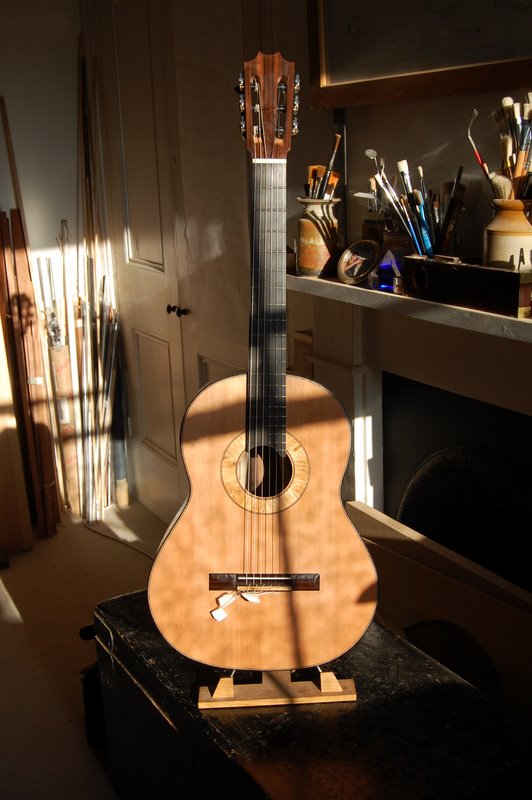
So far in this blog, I’ve been writing about how instruments are made and showing photographs of what they look like. But what matters most, certainly to players and listeners but to makers too, is what they sound like. The trouble is that it’s not easy to make recordings that do justice either to player or instrument. Having made that excuse, I’m going to try. So here, as a first step, are three short pieces played by Fiona Harrison on this cedar top guitar that I’ve written about before. Click on the labels to hear them.

Piece 1

Piece 2

Piece 3

Making guitars means that there are often offcuts of attractively figured wood left over. One thing to do with them is to turn them into musical boxes. As well as making amusing presents, they demonstrate how even a tiny box and soundboard act to produce a surprisingly loud sound from a mechanism that, on its own, is whisper quiet.

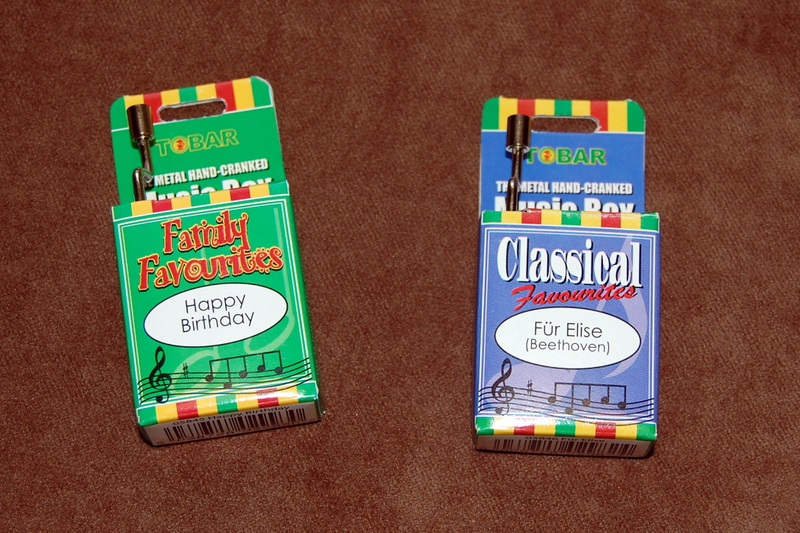
The musical mechanism can be bought from novelty shops quite cheaply. A range of tunes is available of which two are shown below.

The mechanism is a steel comb whose teeth are tuned to a scale. Rotating the hand cranked drum causes the raised pimples on it to ‘ping’ notes as they first bend a tooth and then release it.

Held in the hand, turning the handle produces a tune so quiet as to be almost inaudible. But pressed against something that can itself vibrate – even a table top or a wooden box – the volume of sound is substantially increased.

If you go to the trouble of mounting the mechanism on a thin plate of spruce (I simply glue it with a little epoxy), the sound is really quite loud. Here’s one in a walnut box. The mechanism is mounted upside down beneath the top and hidden inside the box so that only the handle protrudes.

And two views of another, this time with four mechanisms each playing a different tune.

This guitar is now completed and is due to go off to its new owner next week. Since I’ve written so much about making it, it seemed worth posting some pictures of it in its finished state. There are a few more in Gallery too.

The Maidstone violin that I wrote about in my last post has found a new home. A young violinist friend, who has grown out of the half-size instrument that I made for him a few years ago, came around to see it at the weekend and liked it enough to take away to try it out properly. If the speed with which he adapted to the new string length, and the good sound that he got out of it, are anything to go by, it will suit him well until he needs a full-size instrument. It’s rather pleasing to think that this abandoned fiddle may have a second lease of life making music again. Here’s the violinist, trying it out in my workshop.

A couple of years ago, I was given a three-quarter size violin in an old wooden case. It was in a shabby state and evidently hadn’t been played for many years. Nor had it ever been a valuable instrument: the scroll and pegbox were crudely carved, the fingerboard and nut were made out of dyed wood rather than ebony and although it had laid in purfling, the job had clearly been done by someone with more concern for speed than accuracy.

There was no label inside but a small brass plate on the wooden case gave a strong clue about its provenance. This was a Maidstone violin, probably made in Bohemia at the end of the 19th century and imported by John G Murdoch and Co in large numbers to provide cheap instruments for schools and for a contemporary movement that sought to bring music to the people by providing group instruction for adults. (See here for more information about this enterprise.)

Although restoring this violin made little sense financially, I thought it would be worthwhile – partly for the opportunity to practice repairing skills on an instrument of little value and partly for the pleasure of returning something that had fallen into a decrepit state back to its former glory. So I took off the fingerboard and substituted a decent piece of ebony, cut out and replaced some wormy wood at the bottom of the pegbox, rebushed the pegholes and fitted new pegs, renewed the edges where they had been damaged and gave it a new bridge, a new soundpost and a new tailpiece. It was an interesting exercise and a rewarding one too, because, when set up with Dominant strings it made a very nice sound indeed.

Unfortunately, the shellac experiments failed to reproduce the problem that I had with the polish that failed to harden. I put blobs of shellac from each of the containers of the stuff that I had in the workshop onto a sheet of glass and left them overnight: all hardened satisfactorily. So I can rule out the possibility that the shellac I was using was too old.

I also French polished a piece of scrap mahogany, using a lot of mineral oil on the rubber and building up a thickish layer as quickly as I could. That worked fine. So Bob Flexner was quite right when he said that it wasn’t the oil causing the problem.

I’m left without an explanation but I have learnt something. First, it’s always worthwhile to check that the shellac hardens using the ‘blob on glass’ technique before starting to polish an instrument. Second, mineral oil is an effective lubricant for the rubber and doesn’t compromise the quality of the finish. And third that, if the polish doesn’t harden fairly quickly, the best thing to do is wipe it off and start again rather than waiting around in the hope that it will harden eventually.