Although I haven’t written about it, I’ve been making steady progress with the guitar. I decided on a rosette of spalted apple wood and a cedar top with a lattice strutting system as you can see in these pictures:


Although I haven’t written about it, I’ve been making steady progress with the guitar. I decided on a rosette of spalted apple wood and a cedar top with a lattice strutting system as you can see in these pictures:
I’ve been thinking about the rosette for this guitar. The traditional rosette on a classical guitar is a repeating mosaic pattern made up of thin strips of differently coloured woods often less than a millimetre square in size. It’s an elaborate and painstaking business to make and, though it’s heresy to say so, I’ve never thought that the results were very exciting. The pattern is just too fine to be appreciated, or even noticed, more than a couple of feet away. Besides, it’s too contrived, too finicky, too far removed from any function.
Trying to find a simpler and visually bolder solution I’ve been experimenting with inlays of saw cut veneer and you can see the results below. The rosette on the left is made out of laburnum by slicing a sector-shaped log containing both sapwood and heartwood across the grain, and arranging the slices in order around the sound hole. The one in the middle is made in the same way but using yew rather than laburnum – another wood with a striking contrast between sapwood and heartwood. On the right, the rosette is made of spalted crab-apple but orientated to display long grain, not end grain.
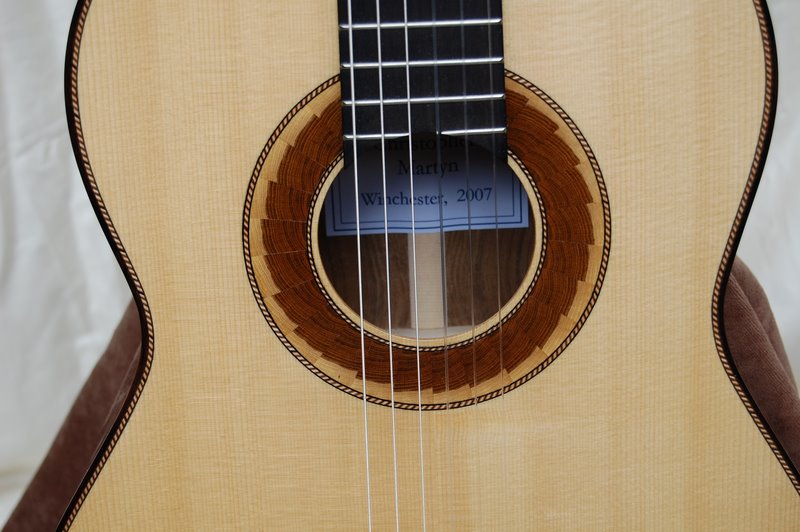
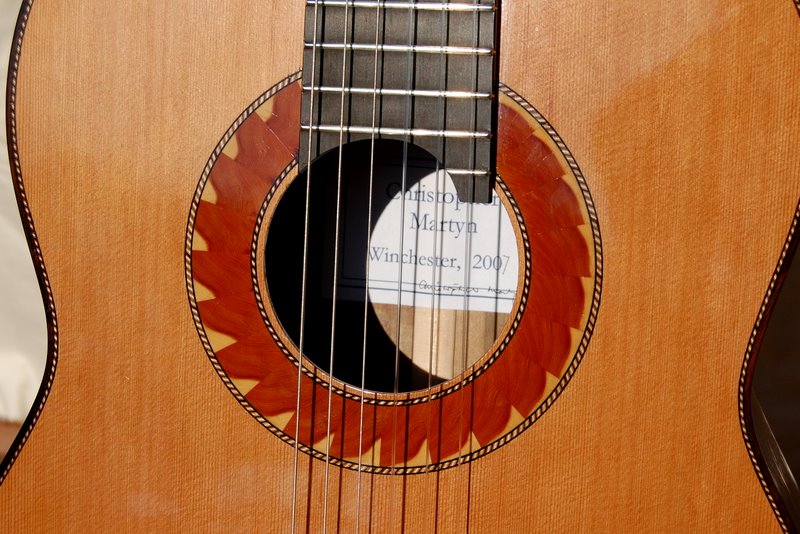

Click on thumbnails for an enlarged view.
I’m inclining towards using spalted crab-apple for the rosette of this guitar too. The creamy colour should make a striking contrast with the sandy colour of the cedar top that I intend to use. In a previous guitar, I carried the theme a bit further by using spalted crab-apple veneer for the headstock – an idea which might work with this guitar too.

My first instrument of 2008 is going to be a classical guitar. I jointed the back out of three pieces of nicely figured macassar ebony but already there’s a decision to be made. Macassar ebony rarely comes in pieces wide enough to make a back out of the usual 2 bookmatched pieces and this set was no exception. To achieve the necessary width across the lower bout, I put in an extra tapered piece in the centre. The result looks quite good, I think, but the question is whether the mismatch in figure at the joins is inconspicuous enough not to be a problem. Maybe it would be better to make a virtue of it by inlaying 2 backstripes? I’m going to put it aside while I decide. The pictures below give an idea. Any comments would be welcome.
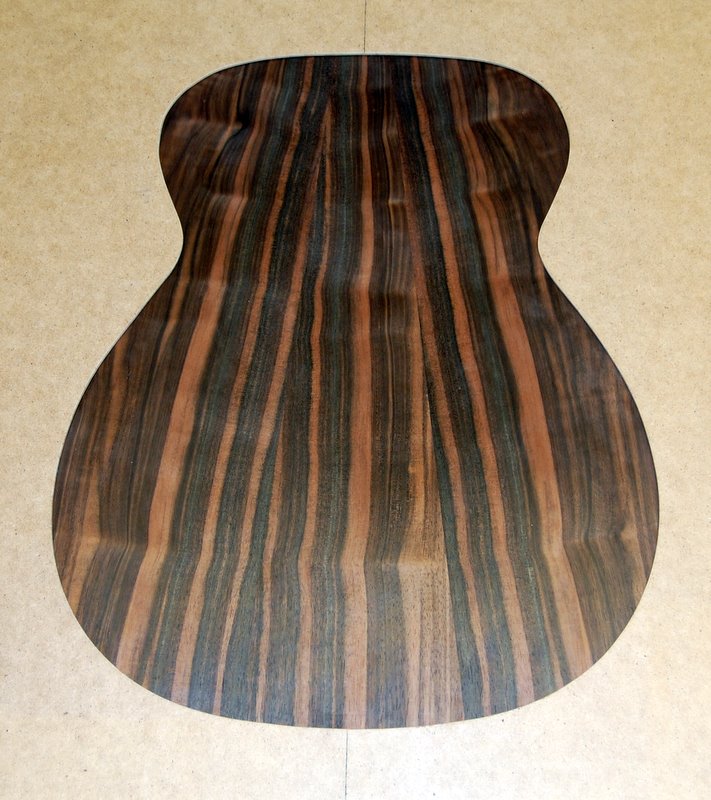
The picture above shows the back as it is at the moment.
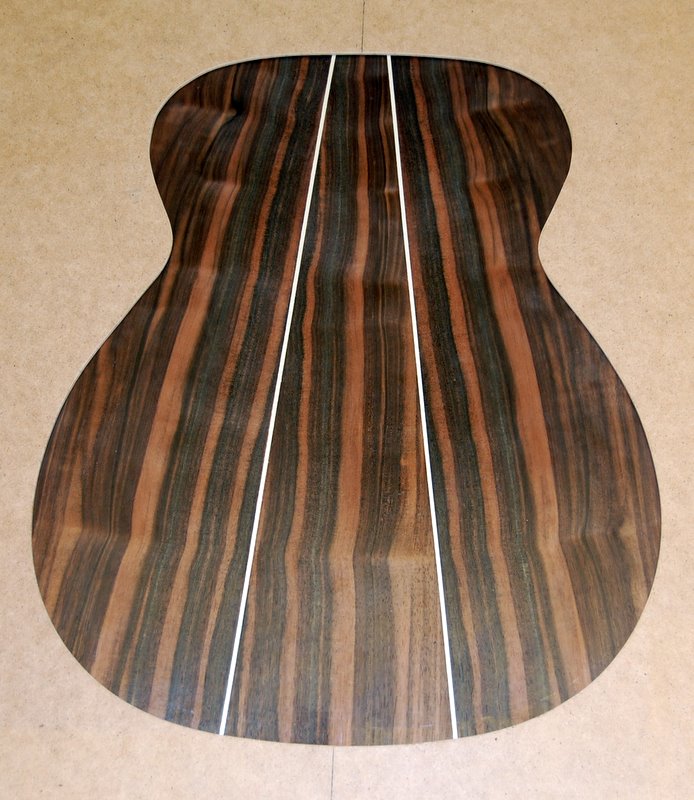
Here it is with two bands of light coloured wood placed on top to give an idea of what it would look like with inlay. Bear in mind that the bands would be narrower and that, on the finished instrument, they will link up with a similar coloured border – the purfling – around the edges.
 Finely Strung